The 8 Styles of Preaching (and Why the Greats Blend Two)
Like music, preaching runs in genres. We studied the sermons of 87 great preachers, from the early church to the pastors filling arenas today, and the same eight shapes kept showing up. Every preacher has a different voice. But underneath, each one builds sermons in one of these eight ways, week after week.
Each style has its own beat: where the text arrives, what the sermon spends the most time on, and the moment it builds toward. Below is each one, with a typical 40-minute sermon drawn as a bar so you can see its rhythm. The solid block is the style’s signature, the part it builds toward and spends the most on.
- 1. Expository
- 2. Doctrinal points
- 3. Apologetic
- 4. Narrative & celebration
- 5. Revival & invitation
- 6. Practical & topical
- 7. Spirit & encounter
- 8. Contemplative
1. Expository: walk the text
The passage sets the sermon. You take the next few verses of a book, explain what the author meant in context, and press that meaning on the room. The outline comes out of the text, not the other way around.
Read the text → Set the context → Walk it phrase by phrase → Christ in the passage → Apply and press → Pray
Hear it in: John Calvin, Martyn Lloyd-Jones, John Stott, John MacArthur, Tim Keller, Joby Martin and Matt Chandler.
 Free Expository Preaching Cheat SheetTen steps to build your next sermon this way →
2. Doctrinal points: prove the heads
One verse, one truth stated in a sentence, then that truth proved under clear heads. The sermon ends by applying the doctrine to each kind of hearer in the room, and then makes an appeal.
Text → One-sentence doctrine → Head 1, proved → Head 2 → Head 3 → Uses for each hearer → Appeal
Hear it in: Thomas Aquinas, Jonathan Edwards, John Wesley, Charles Spurgeon, Adrian Rogers and J.I. Packer.
 Free Doctrinal Preaching Cheat SheetTen steps to build your next sermon this way →
3. Apologetic: answer the skeptic
It starts with the listener’s question, not the outline. You name an honest objection out loud, take it seriously, answer it from the text and from reason, and show Christ as the better answer.
Name the objection → Text → Take it seriously → Answer from text and reason → Christ the better answer → Reconsider → Pray
Hear it in: Tertullian, C.S. Lewis, Jon Tyson and Mark Clark.
 Free Apologetic Preaching Cheat SheetTen steps to build your next sermon this way →
4. Narrative & celebration: tell it, then climb
You retell a Bible story so the room is standing in it, find the turn in the story, give people a refrain to say back, and climb into a celebration that restates the truth.
Warm the room → Text and title → Retell the story → The turn → Refrain builds → Celebration
Hear it in: C.L. Franklin, Gardner C. Taylor, E.V. Hill, T.D. Jakes and Steven Furtick.
 Free Narrative Preaching Cheat SheetTen steps to build your next sermon this way →
5. Revival & invitation: call for a verdict
The whole sermon is built toward one decision. You read a short text, strip away false hopes, lift up the cross, count the cost, and ask people to respond now.
Text and stakes → Sin and false hopes → Urgency → The cross → Count the cost → Invitation, now
Hear it in: George Whitefield, D.L. Moody, Billy Graham, Greg Laurie and Josh Howerton.
 Free Revival Preaching Cheat SheetTen steps to build your next sermon this way →
6. Practical & topical: need, then steps
You start where people live: a real need, named as “me” and then “we.” Then you open one text and give a few clear steps people can take on Monday, with a line they can remember.
Hook → Felt need: me and we → Text → Step 1 → Step 2 → Step 3 → Recap line → “Will you?” → Next step
Hear it in: Charles Stanley, Rick Warren, Andy Stanley, Craig Groeschel and Chris Hodges.
 Free Topical Preaching Cheat SheetTen steps to build your next sermon this way →
7. Spirit & encounter: make room for god
Worship flows into the Word. You teach the text clearly, let testimony and faith rise, and leave real time at the end for people to respond to God, not just to the sermon.
Worship flows in → Text → Teach → Testimony → Faith rises → Ministry time
Hear it in: Oral Roberts, Jack Hayford, John Wimber, John Bevere and Michael Koulianos.
 Free Spirit & Encounter Preaching Cheat SheetTen steps to build your next sermon this way →
8. Contemplative: form the soul
Short text, deep well. You quiet the room, name the ache people carry, and stay with one word slowly, alongside the voices of the saints, until Jesus is at the center. People leave with a practice for the week.
Quiet and read → Name the ache → One word, slowly → Voices of the saints → Jesus at the center → A practice for the week → Blessing
Hear it in: Bernard of Clairvaux, Oswald Chambers, A.W. Tozer, Eugene Peterson, Francis Chan and John Mark Comer.
 Free Contemplative Preaching Cheat SheetTen steps to build your next sermon this way →
Most great preachers are a remix of two
Here’s the part that surprised us. Very few of the great preachers live in only one style. Most have a main style, and then a second one they blend in, the way a musician raised on one genre borrows from another. When we drew the family tree of preaching, the remix lines were everywhere, especially among preachers of the last 50 years.
- John WesleyDoctrinal with a revival remix
- Martyn Lloyd-JonesExpository with a doctrinal remix
- Chuck SwindollNarrative with an expository remix
- Tim KellerExpository with an apologetic remix
- Joby MartinExpository with a narrative remix
- Craig GroeschelTopical with a revival remix
- Steven FurtickNarrative with a topical remix
- Jon TysonApologetic with a topical remix
- Francis ChanContemplative with a Spirit & encounter remix
That’s good news for you. You don’t have to become someone else. Find your main style, the one that already sounds like you. Then pick a second style to borrow from on purpose. An expository preacher who borrows the apologist’s habit of naming the skeptic’s question will reach people a straight exposition misses. A topical preacher who borrows the revivalist’s invitation will see more people respond.
Read until one style makes you say, “That’s how I’m wired.” Then find the one you want to grow into.
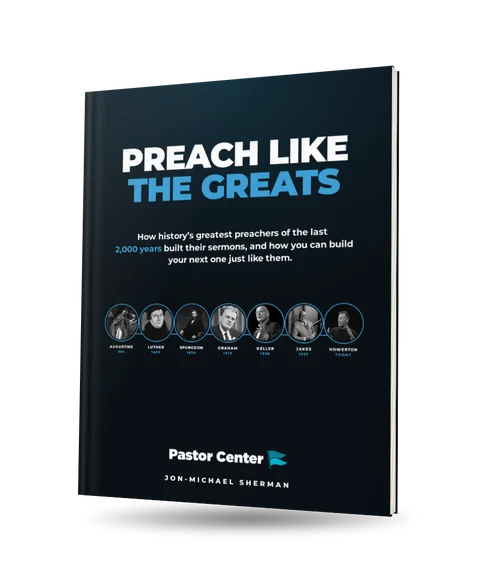
Free book · 203 pages
Preach Like the Greats.
All eight styles, the full family tree of preaching, and how each of 87 great preachers built a sermon, with ten steps and a fill-in outline for every one.
Common questions
What are the different types of preaching?
Eight styles show up again and again across 2,000 years of preaching: expository, doctrinal, apologetic, narrative and celebration, revival and invitation, practical and topical, Spirit and encounter, and contemplative. Each has its own shape and its own “signature” moment it builds toward.
What is the difference between expository and topical preaching?
Expository preaching lets one passage set the outline and walks it phrase by phrase. Topical preaching starts from a real need, opens one text that speaks to it, and gives clear steps. Many preachers blend the two.
What are the different styles of preaching?
The same eight: expository, doctrinal, apologetic, narrative, revival, topical, Spirit and encounter, and contemplative. “Styles” and “types” of preaching mean the same thing here: the repeatable shape a preacher builds sermons in.
Can a preacher use more than one style?
Yes, and most great preachers do. Tim Keller was expository with an apologetic edge. Craig Groeschel is topical with a revival-style call to respond. Find your main style, then the second one you naturally blend in.
How do I find my preaching style?
Look at the beat of your last few sermons: what you spend the most time on, and what you build toward. Then compare it with the eight beats in this post. The one that sounds like you is your main style.