How Chuck Swindoll Preaches: Write the Application First
Chuck Swindoll is a former Marine who has pastored through the rise of evangelical radio and the megachurch. We studied eight of his sermons, most from Stonebriar Community Church in 2023 and 2024 and two from Dallas Theological Seminary chapel. Under every one sits the same shape: a relational opening, a run of personal stories through the middle, and an ending built to answer “now what?”
Who Chuck Swindoll is
Swindoll was born in Texas and pastored First Evangelical Free Church of Fullerton from 1971 to 1994. Insight for Living began in 1979, and he has led Stonebriar Community Church since 1998. He served as president of Dallas Theological Seminary from 1994 to 2001 and is now chancellor emeritus.
Insight for Living has aired on more than 2,100 outlets, and he has written more than 70 books, including Saying It Well, his book on preaching. In a 2010 LifeWay survey of Protestant pastors, he ranked second only to Billy Graham as the most influential living preacher.
The shape of a Swindoll sermon
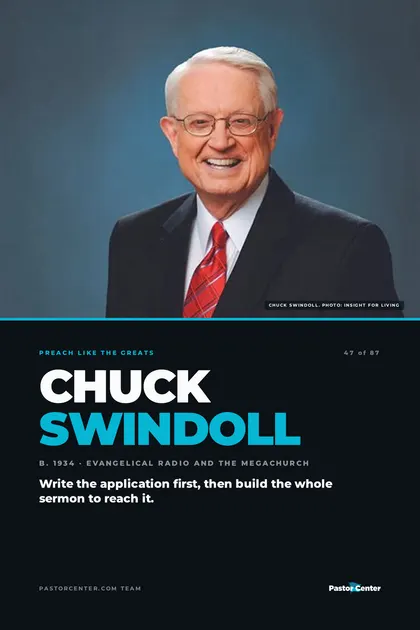
Swindoll builds the sermon backward. He writes the applications first, then shapes the title, introduction and body to reach them. That’s why everything he says seems to be heading somewhere.
He also keeps a rule of thumb he calls 25-50-25: a quarter of the time for rapport, half for the body, and a quarter for application and close. Every sermon we studied opens relationally, with a story, a memory or a question, before the text.
Most of the time he reads the text in one block and then sets the context and backstory. In the middle, personal and biographical stories carry the meaning, so the exposition sounds like conversation. He rarely numbers his points out loud.
The application gathers in the final third. Then he closes in prayer, and often with a gospel invitation. In “Greatness Personified,” a proverb from his mother opens a sermon on Stephen that ends with a call to “stand tall.”
What made his preaching different
Application first
He writes the applications before anything else, then builds the rest of the sermon to reach them.
Stories carry it
Personal and biographical stories carry the meaning, so his exposition feels like a conversation.
“Now what?”
Every sermon lands on what to do next, with the application gathered in the last third.
What others said
“Known by millions around the world for his practical application of the Bible to everyday living.”
— Dallas Theological Seminary
“One of my personal heroes and role models for effective, relevant teaching.”
— A pastor writing in Leadership, Christianity Today, 2005
What to take into your own pulpit
Start where you want to finish
Swindoll writes the application first. If you know what people should do, every other part of the sermon can serve that.
Earn the room before the text
He spends real time on rapport. People listen more closely to someone they feel they know.
Let stories do the explaining
A personal or biographical story can turn exposition into conversation, and conversation is easier to follow.
Those are the ideas. The guide turns them into ten steps you can follow this week, plus the sermons we studied and a fill-in outline in his shape.
Free PDF · Preach Like the Greats
Learn to preach like Chuck Swindoll.
This post is the overview. The guide has the research and the method.
- The 8 sermons we studied, start to finish
- Ten steps to preach the way he does
- His sermon outline, movement by movement
- A fill-in template for your own text, 9 pages
Common questions
What is Chuck Swindoll’s preaching style?
Warm, conversational and practical. He opens relationally, reads and sets the text in context, lets personal and biographical stories carry the meaning, and always lands on what to do next.
How does Chuck Swindoll structure a sermon?
He builds backward from the application and follows a 25-50-25 rule: a quarter for rapport, half for the body, and a quarter for application and close, usually ending in prayer and often an invitation.
What is Chuck Swindoll’s book on preaching?
Saying It Well. It’s one of more than 70 books he has written.