How R.T. Kendall Preaches: Doctrine With a Revivalist’s Urgency
R.T. Kendall held Martyn Lloyd-Jones’s pulpit at Westminster Chapel in London for 25 years. We studied seven of his sermons, preached at churches including Times Square Church, Saddleback and Kensington Temple. Under all of them sits the same fusion: Lloyd-Jones’s doctrinal exposition, a revivalist’s urgency, his own stories, and a turn toward eternity that ends with a call to stand.
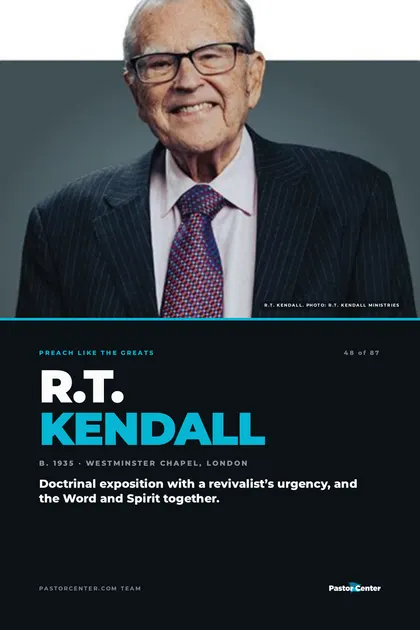
Who R.T. Kendall is
Kendall is Kentucky-born and Oxford-trained. He earned a DPhil at Oxford on saving faith in the English Puritans, then followed G. Campbell Morgan and Lloyd-Jones as minister of Westminster Chapel, serving from 1977 to 2002.
He has written more than 50 books. Total Forgiveness (2002) is the best known and is preached and taught worldwide. His call to bring “the Word and the Spirit” back together has shaped a generation of preachers on both sides of the Atlantic.
The shape of a Kendall sermon
Every sermon we studied opens briefly, with a personal word or a thesis, and then he reads the whole passage in one block. Most of the time he prays right after the reading.
From there he usually names clear points, often alliterative, and cross-references heavily. He likes sharp doctrinal distinctions: gifts and fruit, saving faith and persistent faith, Word and Spirit.
His own stories run through all of it, from personal moments to Westminster anecdotes, and especially his own hurts. In “Total Forgiveness,” he starts with Joseph’s backstory before he reaches the text.
Then nearly every sermon turns toward death, judgment or eternity. He leads a prayer of commitment phrase by phrase and calls for a public response: stand, come forward, pray.
What made his preaching different
Sharp distinctions
He draws sharp lines between things people blur together: gifts and fruit, Word and Spirit, saving faith and persistent faith. The distinction is often the whole point.
His own hurts
Personal stories run through the doctrine, especially his own hurts. The teaching never floats free of his life.
Toward eternity
He turns toward eternity, then leads a prayer of commitment and a call to stand. The sermon ends with a decision, not a summary.
What others said
“At times, Kendall seems to be the legitimate successor of Martin Lloyd Jones.”
— Trevin Wax
“A man of deep commitment to the Bible and wants others to know it, love it and understand it as he does.”
— Billy Graham, book endorsement
What to take into your own pulpit
Draw the line clearly
Kendall’s sermons often turn on one distinction. Naming the difference between two things people confuse can unlock a whole passage.
Let your hurts serve the text
His own wounds show up in his preaching. Honest stories of pain make doctrine like forgiveness feel possible, not abstract.
Ask for a response
He doesn’t assume the sermon did its work. He turns toward eternity and gives people a clear way to respond.
Those are the ideas. The guide turns them into ten steps you can follow this week, plus the sermons we studied and a fill-in outline in his shape.
Free PDF · Preach Like the Greats
Learn to preach like R.T. Kendall.
This post is the overview. The guide has the research and the method.
- The 7 sermons we studied, start to finish
- Ten steps to preach the way he does
- His sermon outline, movement by movement
- A fill-in template for your own text, 9 pages
Common questions
What is R.T. Kendall’s preaching style?
Doctrinal exposition with a revivalist’s urgency. He reads the whole passage, names clear points, draws sharp distinctions, weaves in his own stories, and turns toward eternity with a call to respond.
How does R.T. Kendall structure a sermon?
A brief personal or thesis opening, the whole passage read in one block, prayer, announced points with heavy cross-referencing, a sharp doctrinal distinction, a turn toward eternity, and a prayer of commitment with a call for a public response.
What is R.T. Kendall best known for?
His 25 years in Martyn Lloyd-Jones’s pulpit at Westminster Chapel, his book Total Forgiveness, and his call to bring “the Word and the Spirit” back together.