How John Wimber Preached: Kitchen-Table Teaching, Then “Doin’ the Stuff”
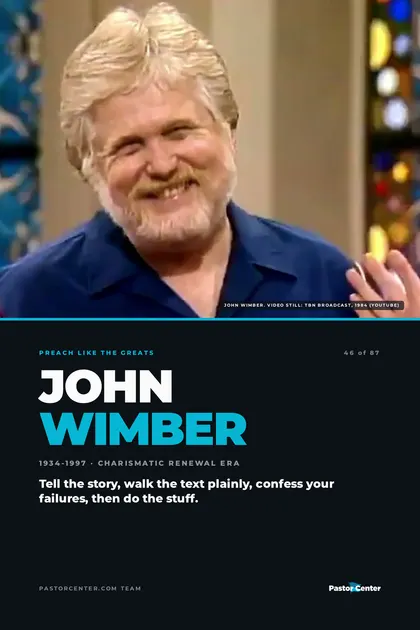
John Wimber taught like a man explaining something at the kitchen table, then did it in front of you. We studied six recordings of his teaching and ministry, from the 1980s to the last years of his life. The shape is simple: tell the story, walk the text plainly, confess your failures, then stop talking and invite the Holy Spirit to come.
Who John Wimber was
Wimber was born in Kirksville, Missouri, in 1934 and played in the group that became the Righteous Brothers before his conversion in 1963, at 29. He became founding director of church growth at the Fuller Evangelistic Association in 1974, and from 1982 to 1986 he taught the course “Signs, Wonders and Church Growth” (MC510) at Fuller Theological Seminary.
In 1977 he began leading a home prayer meeting that became the Vineyard Christian Fellowship of Anaheim. From there he led the Vineyard movement and trained pastors on several continents in what he called “doin’ the stuff.” When he died in 1997, the Vineyard had nearly 500 churches in the U.S. and about 250 more abroad, and his Anaheim church, which seats 3,200, overflowed for his memorial. He co-wrote Power Evangelism and Power Healing, and the Vineyard now counts more than 2,400 churches worldwide.
The shape of a Wimber sermon
His teaching sessions don’t open on the text. They open with a story or a review of last time, and the topic arrives a good way in. In one he starts with the 1977 house meeting and his own verdict that “it’s not going to go anywhere.”
Then he names a theme and a plain framework, often in numbered stages, and walks them in order. He reads long stretches of the Bible aloud, from Mark, Acts or 1 Samuel, with running commentary in everyday words.
Along the way he reaches for homely analogies (ironing a shirt, the King “on the phone,” a jump-start), jokes at his own expense, and tells stories of ordinary believers doing the ministry: an office worker, a baker, a bedridden mother. He also admits failure out loud, from a failed fast to a friend who died unhealed.
The end is not a summary. He stops teaching and moves into ministry time: prayer for the room, words of knowledge, people praying for each other. His calm, unhurried delivery made the supernatural feel normal rather than staged.
What made his preaching different
Kitchen-table teaching
Long Bible readings explained in everyday words and jokes. He sounds like someone talking across a kitchen table, not lecturing from a stage.
Honest about failure
He tells the fasts he failed and the friends who died unhealed. His honesty about what didn’t work made the room trust what did.
Ministry time
He stops talking, says “Come Holy Spirit,” and the room prays. The people practice what they just heard before they leave.
What others said
“He raised the level of expectation of divine action in the life of the church.”
— J.I. Packer, Christianity Today, 1998
“We didn’t like shouting. And John did not shout. He spoke peacefully.”
— Sandy Millar, vicar of Holy Trinity Brompton, 1998
What to take into your own pulpit
Let the Bible be read at length
Wimber read long passages aloud and talked through them plainly. Sometimes the text explains itself if you give it room.
Tell the truth about what didn’t work
Admitting failure doesn’t weaken a sermon. It makes the room trust you with the rest.
Leave time to practice
If you teach on prayer or ministry, give people a chance to do it before they go home.
Those are the ideas. The guide turns them into ten steps you can follow this week, plus the sermons we studied and a fill-in outline in his shape.
Free PDF · Preach Like the Greats
Learn to preach like John Wimber.
This post is the overview. The guide has the research and the method.
- The 6 recordings of his teaching we studied
- Ten steps to preach the way he did
- His sermon outline, movement by movement
- A fill-in template for your own text, 9 pages
Common questions
What was John Wimber’s preaching style?
Calm, plain and practical. He opened with a story, named a simple framework, read long Bible passages with everyday commentary and self-deprecating humor, admitted his failures, and moved into ministry time.
How did John Wimber structure a sermon?
His teaching sessions usually opened with a story or review, then named a theme and numbered stages, walked long Bible readings in order, and ended with prayer for the room rather than a recap.
What did Wimber mean by “doin’ the stuff”?
It was his phrase for ordinary believers doing the ministry they read about in the Bible, such as praying for the sick. His teaching usually ended with the room practicing it.