How Jack Hayford Preached: Explain It Until It Feels Reasonable
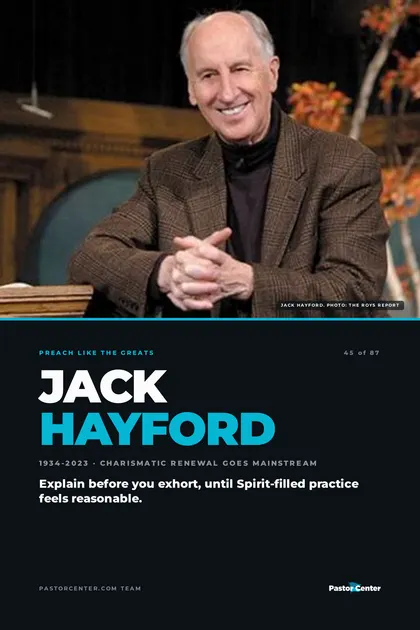
Jack Hayford took a tiny Foursquare congregation in Van Nuys, California, and pastored it for 30 years as it became The Church On The Way. We studied eight of his sermons from 1974 to 1977. Under all of them sits the same habit: explain why something is biblical before asking anyone to do it, ask what the text has to do with me, and end with something people do in the room.
Who Jack Hayford was
When Hayford arrived in 1969, the First Foursquare Church of Van Nuys had about 25 regular attenders. By the end of the 1980s it drew about 10,000 a week. He wrote “Majesty” among roughly 600 hymns and choruses, and he became a trusted voice for Pentecostal and non-Pentecostal pastors alike.
He founded The King’s College and Seminary in 1997 (now The King’s University), served as president of the International Church of the Foursquare Gospel from 2004 to 2009, and wrote more than 50 books. In 2010 Preaching magazine named him one of the 25 most influential preachers of the previous 25 years.
The shape of a Hayford sermon
Hayford usually preached from one main passage with cross-references alongside it. Often he read an Old Testament story as a picture of Christ or the believer. In “Arising to Possess the Land,” Joshua 1 points to Jesus as the true Joshua.
He explained before he exhorted. He took practices that made people nervous, like raising hands, praying for the sick and forceful intercession, and walked the room through why each one was biblical until it felt reasonable.
His sermons carry a personal edge. He read Scripture on his knees asking, “What does this have to do with me?” He told his own story, set up clear contrasts like dead religion and living bread, and pointed to Christ’s work rather than the hearer’s effort.
Then he called people to rise from passivity and act, and the sermon often ended in ministry right there: communion, prayer, laying on hands or a spoken blessing.
What made his preaching different
Explain, then exhort
He showed why something was biblical before asking anyone to do it. The explanation carried the exhortation.
Personal edge
He asked of every text, “What does this have to do with me?” and his sermons kept that question in front of the hearer.
Respond in the room
His sermons end in something people do now, in the room, not just a thought to take home.
What others said
“I think pastors sense in him what they are longing to be.”
— Lloyd Ogilvie
“His motivation is to get theology into people, to get it lived out.”
— Jim Tolle, pastor of The Church On The Way, 2005 (Christianity Today)
What to take into your own pulpit
Explain before you ask
If a step of obedience makes people nervous, show them why it’s biblical first. Understanding makes room for faith.
Make it personal
Read the text with the question “What does this have to do with me?” and let the sermon carry that edge.
Give the response a place
Hayford’s sermons ended in something people could do right then. A response in the room turns hearing into practice.
Those are the ideas. The guide turns them into ten steps you can follow this week, plus the sermons we studied and a fill-in outline in his shape.
Free PDF · Preach Like the Greats
Learn to preach like Jack Hayford.
This post is the overview. The guide has the research and the method.
- The 8 sermons we studied, start to finish
- Ten steps to preach the way he did
- His sermon outline, movement by movement
- A fill-in template for your own text, 9 pages
Common questions
What was Jack Hayford’s preaching style?
Gracious, explanatory and personal. He explained why Spirit-filled practices were biblical until they felt reasonable, asked what each text had to do with the hearer, and usually ended with a response in the room.
How did Jack Hayford structure a sermon?
He usually worked one main passage with cross-references, often read an Old Testament story as a picture of Christ, drew a clear contrast, pointed to Christ’s work, called people to act, and closed in ministry such as prayer or communion.
What hymn did Jack Hayford write?
He wrote “Majesty,” one of roughly 600 hymns and choruses he composed.