How Jonathan Edwards Preached: One Sentence, Proved, Then Applied Longest
Jonathan Edwards preached in New England during the Great Awakening, and about 1,200 of his sermons survive in small handmade manuscript booklets. We studied ten of them, from Boston in 1731 to Enfield in 1741. Every one follows the same shape: a short text, the whole sermon reduced to one sentence, numbered reasons that close every escape, and an application that runs longest of all.
Who Jonathan Edwards was
Edwards was pastor at Northampton from 1727 to 1750. During the revival of 1734-35, nearly 300 young people joined the church in six months. His Faithful Narrative (1737) carried news of it to England and Scotland, where Wesley read it.
On July 8, 1741, he preached “Sinners in the Hands of an Angry God” at Enfield, the most famous sermon in American history. More than 1,000 of his sermon manuscripts survive at Yale.
The shape of a Edwards sermon
Edwards started small. He took a short text, often a single verse, and drew out of it one sentence he called the Doctrine. In “Sinners in the Hands of an Angry God,” the Doctrine is that only God’s pleasure keeps the wicked out of hell.
Then he proved it. The middle of the sermon is a chain of numbered reasons from Scripture and reason, with objections raised and answered, so that by the end there was no way out of the conclusion.
The longest part came last. He called it the application, or the uses, and he broke it into numbered uses and directions aimed at specific groups in the room: the young, the old, the unconverted. In “Christian Knowledge” the reasons give way to seven directions: read, compare, discuss, practice, pray.
He didn’t do it with theatrics. His student Samuel Hopkins said he barely moved his head or hands. The force came from the argument and from a man who plainly felt it.
What made his preaching different
One sentence
He reduced the whole sermon to one sentence, the Doctrine. Everything else in the sermon served that sentence.
Close every escape
He proved the Doctrine with numbered reasons that left no way out, answering objections before the listener could raise them.
Apply it longest
The application was the longest section, and it spoke to specific groups by name rather than to the room in general.
What others said
“He made but little motion of his head or hands in the desk, but spake as to discover the motion of his own heart.”
— Samuel Hopkins, his student and first biographer
“Before the sermon was done there was a great moaning and crying out throughout the whole house.”
— Diary of Rev. Stephen Williams, Enfield, July 8, 1741
What to take into your own pulpit
Say it in one sentence
If you can’t reduce the sermon to one sentence, the room won’t either. Edwards wrote his down and built everything on it.
Answer the objection before it’s asked
His proofs closed the escape routes people use to dodge a hard truth. Name the “yes, but” and deal with it.
Give application the most time
Edwards spent longest on what the truth means for specific people. Speak to the young, the old and the unconverted by name.
Those are the ideas. The guide turns them into ten steps you can follow this week, plus the sermons we studied and a fill-in outline in his shape.
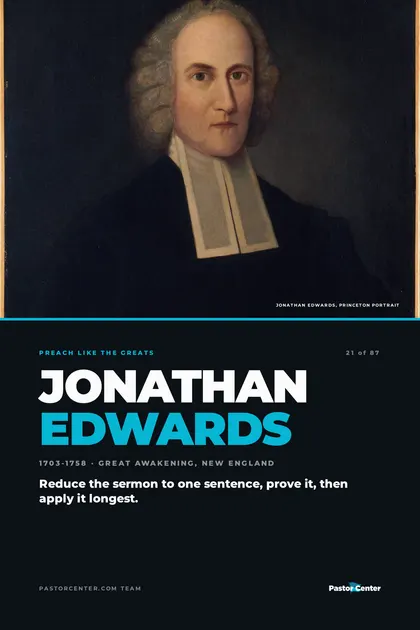
Free PDF · Preach Like the Greats
Learn to preach like Jonathan Edwards.
This post is the overview. The guide has the research and the method.
- The 10 sermons we studied, start to finish
- Ten steps to preach the way he did
- His sermon outline, movement by movement
- A fill-in template for your own text, 8 pages
Common questions
What was Jonathan Edwards’s preaching style?
Calm, logical and searching. He reduced the sermon to one sentence, proved it with numbered reasons, and applied it at length to specific groups. He wanted truth felt, not just agreed with.
How did Jonathan Edwards structure a sermon?
Text, Doctrine, proof and application. A short text yielded one-sentence Doctrine, numbered reasons proved it, and a long application spoke to specific groups with numbered uses and directions.
Did Jonathan Edwards preach with emotion?
Not outwardly. Samuel Hopkins said his delivery was “easy, natural and very solemn,” with great inward fervor but little noise or motion.