How George Whitefield Preached: Wound, Then Woo
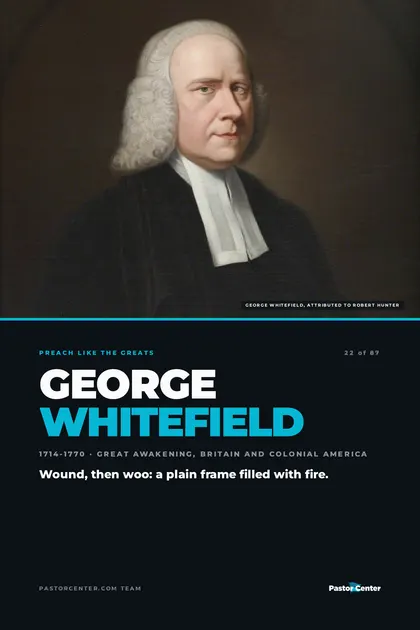
George Whitefield preached more than 18,000 times on both sides of the Atlantic, often outdoors and without notes. We studied eleven of his sermons, from “The Seed of the Woman” to “The Almost Christian.” Under the fire sits a plain Puritan frame: correct an error, announce the heads, strip away false hopes, speak to each group in the crowd, and close with “Come, come…”
Who George Whitefield was
Whitefield began open-air preaching in England in 1739 and drew Wesley into it. He preached at least 18,000 times in Britain and colonial America, to perhaps 10 million people. Benjamin Franklin calculated that he “might well be heard by more than thirty thousand” at once.
His farewell sermon on Boston Common drew about 23,000, likely the largest gathering in America to that time. For all that preaching, fewer than about 90 of his sermons survive.
The shape of a Whitefield sermon
Whitefield often opens by correcting an error or answering a critic. Then he usually announces his division, most often three heads, and fills each one with numbered sub-points: what a duty implies, the means, the motives.
Inside every head he strips false hopes and examines the conscience. He answers objections as he goes and asks the hearers questions about themselves. Nobody gets to listen as a spectator.
The formal application comes late. He turns to the crowd group by group: sinners, believers, the curious, ministers, even “you who have stopped in your coaches.” Sometimes he paints a scene with “Behold” or “Methinks I see.”
In his evangelistic sermons the close is a long, doubled, tearful “Come, come…” In “The Almost Christian” it becomes “Come then, ye harlots, come ye publicans.” Many end with a Trinitarian doxology.
What made his preaching different
Three heads, packed
Three heads, each packed with numbered sub-points. The frame is plain and Puritan; the fire is in how he fills it.
Strip false hopes
He strips false hopes at every head, asking the conscience questions until the hearer can’t hide behind religion.
“Come, come…”
Late in the sermon he turns to each group in the crowd by name, and then he pleads: “Come, come…”
What others said
“My hearing him preach gave me a heart wound.”
— Nathan Cole, Connecticut farmer, 1740
“I emptied my pocket wholly into the collector’s dish, gold and all.”
— Benjamin Franklin, who had resolved to give nothing
What to take into your own pulpit
Wound before you woo
Whitefield took away false comfort before he offered real comfort. The invitation meant more because the need was clear.
Talk to the people actually in the room
He named the groups in front of him and spoke to each. Specific address makes a crowd feel like individuals.
Plead, don’t just conclude
His endings weren’t summaries. They were invitations, repeated and personal.
Those are the ideas. The guide turns them into ten steps you can follow this week, plus the sermons we studied and a fill-in outline in his shape.
Free PDF · Preach Like the Greats
Learn to preach like George Whitefield.
This post is the overview. The guide has the research and the method.
- The 11 sermons we studied, start to finish
- Ten steps to preach the way he did
- His sermon outline, movement by movement
- A fill-in template for your own text, 8 pages
Common questions
What was George Whitefield’s preaching style?
A plain Puritan frame filled with fire. He announced heads packed with sub-points, stripped false hopes and examined the conscience throughout, addressed each group in the crowd, and closed with a pleading “Come, come…”
How did George Whitefield structure a sermon?
An introduction that often corrects an error, an announced division of usually three heads with numbered sub-points, examination woven through each head, a late application to groups by name, and a closing appeal and doxology.
How many times did George Whitefield preach?
At least 18,000 times, on both sides of the Atlantic, to perhaps 10 million people. Fewer than about 90 of his sermons survive.