How Charles Finney Preached: A Lawyer’s Case for a Verdict Tonight
Charles Finney was a trained lawyer who carried courtroom habits into the pulpit. We studied six of his sermons, from his Sermons on Important Subjects (1836) to sermons preached at Oberlin and published in 1876. Under every one sits the same shape: define the key word, clear away what it doesn’t mean, build the argument, answer the objections, and ask for a decision on the spot.
Who Charles Finney was
Finney was born in Warren, Connecticut, in 1792 and studied law in Adams, New York. He turned to preaching after his conversion in 1821. In Rochester, from September 1830 to March 1831, he preached 98 sermons in six months, and more than 1,200 converts joined the city’s churches.
His Lectures on Revivals of Religion (1835), first printed as 22 lectures in the New York Evangelist, became a handbook for revival preaching. He pastored in New York City, became professor of theology at Oberlin in 1835, served about 15 years as its president, and died in Oberlin on August 16, 1875.
The shape of a Finney sermon
Finney opened by defining the text’s key word or stating a bold proposition. “Death” is defined before anything else is said about it. Then he often announced numbered heads or questions so the hearer could follow the case.
Next he cleared the ground. Before saying what a text means, he usually said what it doesn’t mean. Then he built a chain of argument with illustrations from courts, governments and daily work: a judge, a governor, a citizen, a jury.
He didn’t wait for the listener to object. He named the excuses himself and answered them one by one. In “The Sinner’s Excuses Answered,” the whole sermon becomes a conversation with a Deist who is finally won over.
The whole way through, he spoke to the hearer as “you” or “Sinner.” After the argument he often drew numbered remarks or inferences, and then he asked for a decision now: “give a verdict upon the spot.”
What made his preaching different
A case to win
He treated the sermon as a case to win: define the word, clear the ground, build the chain.
Objections first
He named the listener’s excuses before the listener could, and answered each one.
A verdict tonight
He asked for a decision on the spot, and the anxious seat gave that decision a place to happen.
What others said
“It did not sound like preaching, but like a lawyer arguing a case before a court and jury.”
— Henry B. Stanton, 1830
“No more impressive revival has occurred in American history.”
— Whitney R. Cross, historian, on Rochester, 1950
What to take into your own pulpit
Define before you defend
Finney started by saying exactly what a word means and what it doesn’t. Clear terms make a clear argument possible.
Answer the objection out loud
If you know what keeps people from responding, say it for them and answer it honestly.
Ask for a response
His sermons didn’t end in a summary. They ended in a question that needed an answer that night.
Those are the ideas. The guide turns them into ten steps you can follow this week, plus the sermons we studied and a fill-in outline in his shape.
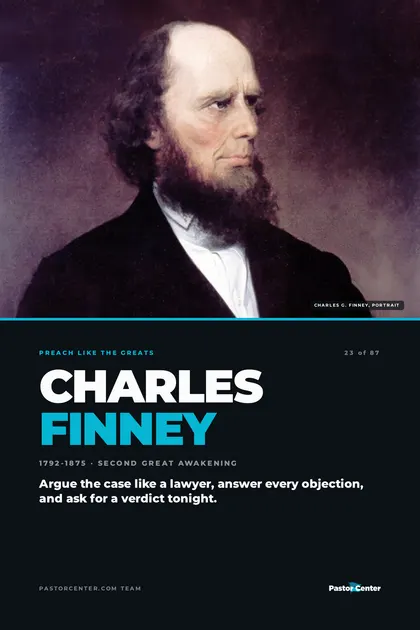
Free PDF · Preach Like the Greats
Learn to preach like Charles Finney.
This post is the overview. The guide has the research and the method.
- The 6 sermons we studied, start to finish
- Ten steps to preach the way he did
- His sermon outline, movement by movement
- A fill-in template for your own text, 9 pages
Common questions
What was Charles Finney’s preaching style?
Argumentative, direct and urgent, like a lawyer before a jury. He preached without a manuscript, addressed hearers as “you,” answered their objections, and pressed for a decision on the spot.
How did Charles Finney structure a sermon?
He defined the text’s key term or stated a proposition, often announced numbered heads, cleared away what the text doesn’t mean, built a chain of argument, answered objections, and closed with an appeal for a decision now.
What was the anxious seat?
It was the place Finney gave hearers to act on the decision his sermons called for, so the verdict he asked for had somewhere to happen.