How Charles Spurgeon Preached: The Sermon Shape Behind 3,500 Sermons
Charles Spurgeon preached to thousands every week and published more than 3,500 numbered sermons. We studied ten of them, from his first published sermon in 1855 to one printed long after his death. Under every one sits the same shape: a short text, three announced headings, illustrations used as windows, a road to Christ, and an appeal.
Who Charles Spurgeon was
Spurgeon was 19 when New Park Street Chapel in London called him as pastor, and by 22 he was the most popular preacher of the day. On October 7, 1857, he preached at the Crystal Palace to a crowd of 23,654. From 1861 he preached at the Metropolitan Tabernacle, which seated 5,000 with standing room for 1,000 more.
His sermons didn’t stay in the room. They were printed every week and sold for a penny around the world, which is why more than 3,500 of them are numbered today. Along the way he founded the Pastors’ College in 1856 and the Stockwell Orphanage in 1867.
The shape of a Spurgeon sermon
Across the ten sermons we studied, the skeleton barely moves: a text, its divisions, illustrations, a road to Christ, and an appeal. He took a short text, often a single verse, and broke it into headings people could carry home.
The headings came out of the text itself. In “All of Grace” (Ephesians 2:8), he walked the verse phrase by phrase, so the outline was simply the verse, opened up.
And every road ended in the same place. The appeal to the unconverted wasn’t tacked on at the end. In “Compel Them to Come In,” the whole sermon is one appeal.
What made his preaching different
Three headings
He told the room where he was going, then went there. Announced headings are why people could repeat his sermons on Monday.
Windows of light
He treated illustrations as windows: their job was to let light into the point, not to decorate it. In “Christ Precious to Believers,” a story about the road to London drives home the call to examine yourself.
Road to Christ
Whatever the text, the sermon found its way to Christ before it ended, and then it turned to the person who hadn’t yet come.
What others said
“Sell all that you have… and buy Spurgeon.”
— Helmut Thielicke, Encounter with Spurgeon
“The preacher held us fast bound for about two hours.”
— Letter to The Times on his Surrey Gardens services
What to take into your own pulpit
Let the text hand you the outline
His headings came out of the words of the verse. Before you build points, look for the divisions the passage already has.
Announce the road
People remember what they can see coming. Spurgeon told them the headings up front, and the sermon felt simple even when the theology wasn’t.
End with a person, not a recap
His sermons didn’t close with a summary. They closed by talking straight to the one person in the room who still needed Christ.
Those are the ideas. The guide turns them into ten steps you can follow this week, plus the sermons we studied and a fill-in outline in his shape.
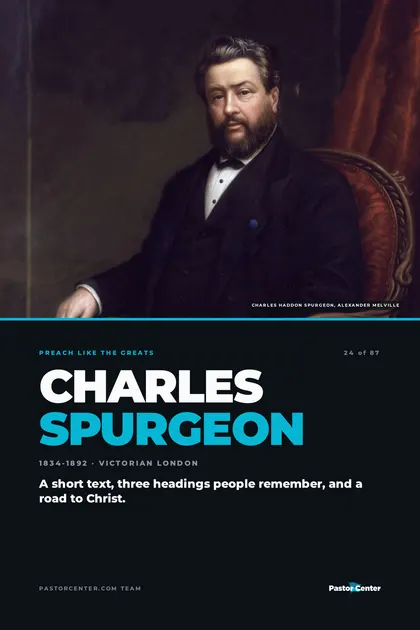
Free PDF · Preach Like the Greats
Learn to preach like Charles Spurgeon.
This post is the overview. The guide has the research and the method.
- The 10 sermons we studied, start to finish
- Ten steps to preach the way he did
- His sermon outline, movement by movement
- A fill-in template for your own text, 8 pages
Common questions
What was Charles Spurgeon’s preaching style?
Plain, vivid and evangelistic. He took a short text, announced three memorable headings, used illustrations as “windows” to let in light, found a road from the text to Christ, and closed with a direct appeal to the unconverted.
What sermon structure did Spurgeon use?
Text, divisions, illustrations, a road to Christ, and an appeal. That shape held across all ten sermons we studied, from No. 1 in 1855 to No. 3479, published in 1915.
How many sermons did Spurgeon preach?
More than 3,500 of his sermons are numbered, because they were printed and sold every week, and the numbered series ran on for years after his death.