How A.W. Tozer Preached: The Being of God, Not Tips for Living
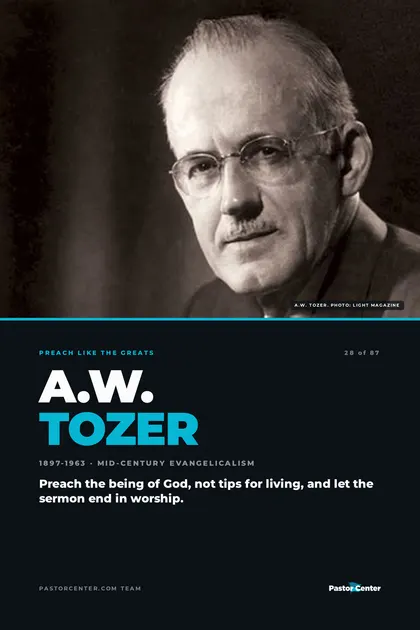
A.W. Tozer preached in an age of booming crusades and busy church calendars, and spent his ministry asking whether the church still knew the God it was so busy for. We studied seven of his sermons and sermon series, from his years in Chicago to his last years in Toronto (1959-63). Under each one sits the same shape: start from a text or a large question, clear away what something is not, define what it is, and press the hearer to stand before God.
Who A.W. Tozer was
Tozer had no college, seminary or Bible school training. Even so, he pastored Southside Alliance Church in Chicago for 31 years (1928-1959), where the congregation grew from about 80 to 800, and then Avenue Road Church in Toronto until his death in May 1963.
He edited the Alliance Weekly from 1950 to 1963, preached a weekly program on Moody’s radio station WMBI, and received honorary doctorates from Wheaton and Houghton. More than 40 books have been compiled since his death from his editorials and transcribed sermons.
The shape of a Tozer sermon
Every sermon we studied starts from a text or a big question about God or man. In Worship: The Missing Jewel, he opens with “What is the chief end of man?” The subject is always God’s character or presence, never a technique.
Often he clears away false ideas before he builds: “God is ___, but God is not ___.” Then he defines the subject, often as a short list of elements. In his series on the Spirit, he first establishes that the Holy Spirit is a Person, with will, mind and love, before he names what the Spirit does.
From doctrine he moves into ordinary life: Monday, the dishes, daily habits. “If you worship on Sunday, what happens on Monday?” Some sermons turn toward Christ as the one who restores or reveals, and he calls on saints and hymn writers as witnesses, like Brother Lawrence at the dishes.
James L. Snyder said his preaching was an extension of his prayer life, and it sounds like it. The sermons drift toward adoration, and some end in prayer or a call to reverence rather than a list of tasks.
What made his preaching different
The being of God
Not tips for living: who God is. Tozer kept God’s character and presence at the center and let everything else flow from it.
What it is not
Clear away, define, then press the hearer. Removing the wrong picture of God made room for the right one.
Ends in adoration
Many sermons end in prayer. The goal wasn’t a to-do list but a room standing in reverence before God.
What others said
“A. W. Tozer released a laser beam from the pulpit, a beam that penetrated your heart, seared your conscience, exposed sin.”
— Warren W. Wiersbe
“He had the ability to make his listeners face themselves in the light of what God was saying to them.”
— James L. Snyder, Tozer biographer
What to take into your own pulpit
Preach the person before the practice
Tozer believed people needed to know who God is before they were told what to do. Let the vision of God carry the weight.
Say what it isn’t
Name the false ideas people already hold about God, then build the true picture on cleared ground.
End in worship, not homework
A sermon can close by bringing people before God rather than handing them a checklist.
Those are the ideas. The guide turns them into ten steps you can follow this week, plus the sermons we studied and a fill-in outline in his shape.
Free PDF · Preach Like the Greats
Learn to preach like A.W. Tozer.
This post is the overview. The guide has the research and the method.
- The 7 sermons we studied, start to finish
- Ten steps to preach the way he did
- His sermon outline, movement by movement
- A fill-in template for your own text, 9 pages
Common questions
What was A.W. Tozer’s preaching style?
Searching, quotable and God-centered. He preached the being of God rather than tips for living, cleared away false ideas before defining the truth, pressed the hearer to respond, and let many sermons end in prayer.
How did A.W. Tozer structure a sermon?
He started from a text or a large question, cleared away what the subject is not, defined what it is, often as a short list, then moved into ordinary life and pressed the hearer to stand before God.
Did A.W. Tozer have formal theological training?
No. He had no college, seminary or Bible school training, yet he pastored in Chicago for 31 years, and more than 40 books have been compiled from his sermons and editorials.