How C.S. Lewis Preached: Voice the Doubt, Answer It With a Homely Picture
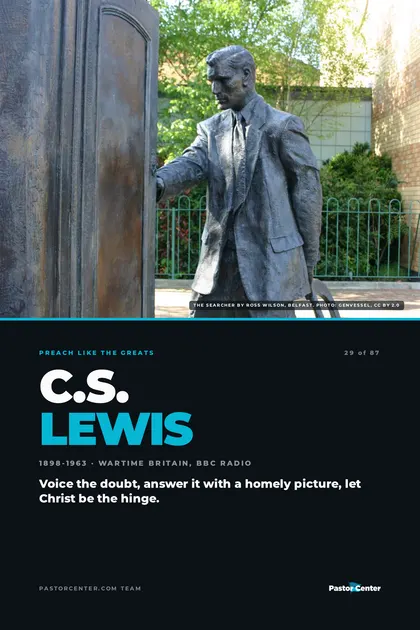
C.S. Lewis was never ordained, and he preached only when churches invited him. He gave a small number of sermons and 25 wartime BBC radio talks. We studied nine of them, from Oxford in 1939 to Northampton in 1946. The shape is consistent: voice the doubt in the listener’s own words, answer it with a homely picture, and let Christ arrive as the hinge the whole argument was building toward.
Who C.S. Lewis was
Lewis was a layman: an English tutor at Magdalen College, Oxford, from 1925 to 1954, then a professor at Cambridge. He came to faith in 1931 after years as an atheist. In February 1941 the BBC’s director of religious broadcasting, James Welch, invited him to the microphone after reading The Problem of Pain.
His 25 talks ran in four series between 1941 and 1944 and were collected as Mere Christianity (1952). It has been translated into more than 30 languages and had spent 513 straight weeks on the BookScan religion bestseller list by 2010. His June 1941 sermon “The Weight of Glory” drew one of the largest congregations St Mary the Virgin, Oxford, had seen in modern times, and from 1941 he also spoke at RAF stations.
The shape of a Lewis sermon
Lewis almost never opened with a Bible reading. He started with a question, a hypothetical or an everyday scene: people quarrelling, a student wondering why anyone should study during a war.
Then he said the skeptic’s case out loud, fairly, in the skeptic’s own voice, and answered it. Each step of the answer rode on a homely picture: trains about to collide, a bridge, a map of the Atlantic, a car built to run on petrol, statues that come alive. Early on he often turned a common assumption upside down. In “The Weight of Glory,” our problem isn’t that our desires are too strong, but too weak.
He rarely expounded a passage verse by verse. Scripture appears sparingly, as a hinge rather than as exposition. He took one hard idea, cleared away the wrong version of it, and made it plain enough for a soldier on a ten-minute break. Somewhere in the second half, Christ or the Incarnation becomes the turn the whole argument swings on.
And he ended quietly. No invitation, no appeal. Just a short line or a single picture, and then he stopped.
What made his preaching different
The objection voiced
He stated the skeptic’s case in the skeptic’s own words, and fairly, before he answered it. Listeners heard their own doubts taken seriously.
One picture per step
Trains, bridges, maps and statues carried every move of the argument. Each step got its own picture.
Quiet last line
He ended on one small image and stopped, with no appeal. In “The Weight of Glory,” the last word is that your neighbour hides Christ.
What others said
“It is a natural voice that commands your attention, but Lewis does not talk down to you”
— Justin Phillips, BBC journalist, 2002
“There is an elegant turn of phrase, a clarity of thought and logical structure that is always evident.”
— Justin Phillips, C.S. Lewis in a Time of War, 2002
What to take into your own pulpit
Say their objection better than they can
Lewis earned a hearing by stating the doubt fairly in the doubter’s words. People listen to the answer once they feel understood.
Give every step a picture
An argument without images is hard to follow. Lewis paired each move with something ordinary people had seen or done.
End small
You don’t need a big finish. One quiet image the listener carries out the door can do more than a closing appeal.
Those are the ideas. The guide turns them into ten steps you can follow this week, plus the sermons we studied and a fill-in outline in his shape.
Free PDF · Preach Like the Greats
Learn to preach like C.S. Lewis.
This post is the overview. The guide has the research and the method.
- The 9 sermons we studied, start to finish
- Ten steps to preach the way he did
- His sermon outline, movement by movement
- A fill-in template for your own text, 9 pages
Common questions
What was C.S. Lewis’s preaching style?
Conversational, logical and full of everyday pictures. He voiced the skeptic’s objection in the skeptic’s words, answered it with homely analogies, let Christ become the hinge of the argument, and ended on a quiet line.
How did C.S. Lewis structure a sermon?
He opened with a question or an everyday scene rather than a Bible reading, stated and answered objections one step at a time with a picture for each, turned on Christ or the Incarnation in the second half, and closed with a short image and no appeal.
Was C.S. Lewis a preacher?
Not by office. He was a layman, never ordained, who preached a small number of sermons when churches invited him and gave 25 BBC radio talks between 1941 and 1944.