How Martyn Lloyd-Jones Preached: Logic on Fire, Hung on One Word
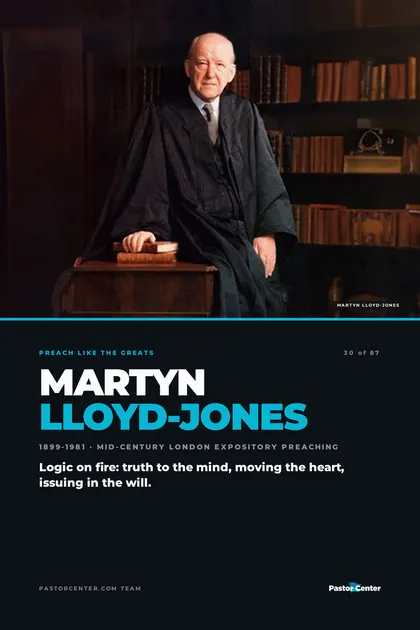
Martyn Lloyd-Jones, “the Doctor,” pastored Westminster Chapel in London from 1939 to 1968. We studied nine of his sermons, from Sunday mornings, Sunday evenings and a Friday night on Romans, between 1954 and 1966. The shape: start from the text, never the subject, clear away the wrong views and wrong cures, hang the argument on one word, and let truth go to the mind before it moves the heart and the will.
Who Martyn Lloyd-Jones was
Lloyd-Jones was a physician who had worked as chief clinical assistant to the royal physician. He gave up medicine in 1926 to preach in a mission church in Wales. At Westminster Chapel about 1,500 came on Sunday mornings and 2,000 in the evenings by 1947.
He preached three times a week: Friday nights for teaching, Sunday mornings for building up believers, Sunday evenings for evangelism. His verse-by-verse series ran for years. Romans ran to 366 sermons and Ephesians to 233. About 1,600 of his recorded sermons survive, most of them free from the MLJ Trust, and Preaching and Preachers (1971) defined preaching for a generation as “logic on fire.”
The shape of a Lloyd-Jones sermon
Lloyd-Jones always announced the text first, before any problem. Then he drew the people’s condition out of it. He didn’t start with a topic and go looking for a verse.
Next he cleared the ground. Before giving the right answer he ruled out the wrong views and the wrong cures: the world’s remedies, the idea that a decision brings constant happiness. Only then did he build.
The exposition usually turns on one word or phrase. In “But God” it’s two words: “man’s extremity is God’s opportunity.” In “The Wrath of God” it’s “by nature.” He raised his points one at a time as the argument needed them, answered objections as they came up, and sometimes stopped mid-sermon to say “let me sum up.”
He applied all the way through, then gave a dedicated block of application near the end, and he matched the close to the service. Friday teaching ended in prayer and benediction with no appeal. Sunday evening ended with a question like “Have you repented?”
What made his preaching different
Text first
Never the subject, always the text. He announced the passage first and drew the hearers’ condition out of it.
Wrong cures first
He cleared away the wrong views and wrong cures before giving the right one, so the true answer had room to land.
One word
Everything hangs on one word: “But,” “wrath,” “by nature.” Find the hinge and the whole passage opens.
What others said
“I had never heard such preaching.”
— J. I. Packer, who heard him as a student
“I have not heard such preaching for years… This is preaching.”
— Wilbur Smith, American seminary professor, at Westminster Chapel, 1955
What to take into your own pulpit
Start where the text starts
Let the passage name the problem. The condition you preach to should come out of the verse, not out of your topic list.
Rule out the wrong cures
People already have answers they trust. Name them and set them aside before you offer the right one.
Go to the mind first
His rule was that truth goes to the mind, moves the heart and issues in the will. “The heart is never to be approached directly.”
Those are the ideas. The guide turns them into ten steps you can follow this week, plus the sermons we studied and a fill-in outline in his shape.
Free PDF · Preach Like the Greats
Learn to preach like Martyn Lloyd-Jones.
This post is the overview. The guide has the research and the method.
- The 9 sermons we studied, start to finish
- Ten steps to preach the way he did
- His sermon outline, movement by movement
- A fill-in template for your own text, 9 pages
Common questions
What was Martyn Lloyd-Jones’s preaching style?
“Logic on fire.” He started from the text, cleared away wrong views and cures, built his argument point by point around one key word, answered objections as they came, and applied the truth throughout.
How did Martyn Lloyd-Jones structure a sermon?
Text announced first, often a recap of the series, wrong answers ruled out, exposition turning on one word, points raised one at a time, and a dedicated application near the end, with a close matched to the service.
What does “logic on fire” mean?
It’s how Lloyd-Jones defined preaching in Preaching and Preachers (1971): truth reasoned out for the mind that then moves the heart and issues in the will.