How Billy Graham Preached: One Sermon Shape for 60 Years
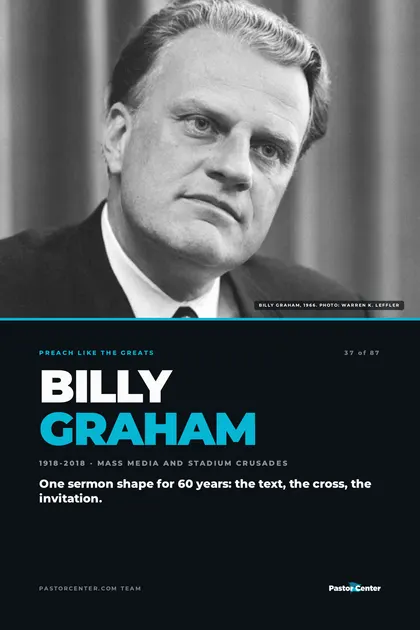
Billy Graham preached to millions in person and many more on television, and his sermons survive on audio and video. We studied eleven of them, from the 1957 New York crusade onward. The shape barely changed in 60 years: read the text, make the stakes personal, anchor the cross early, strip away false hopes, build to the cross and resurrection, then give the invitation and wait.
Who Billy Graham was
Over more than 65 years Graham preached in person to nearly 215 million people in 185 countries and territories. His 1954 London crusade ran 12 weeks and drew more than 2 million. His 1957 Madison Square Garden crusade was extended from 6 weeks to 16.
Gallup listed him among the ten most admired men a record 60 times. In a 2010 survey of 1,002 Protestant pastors, he was named the most influential living preacher.
The shape of a Graham sermon
Graham read the text early and leaned on it the whole way through. “The Bible says” was his catchphrase. Then he made the stakes personal, usually with the word “tonight.” In “Excuse Me, Please” he opens with family-dog humor and turns it into “God is scanning you tonight.”
Next comes the diagnosis. He names sin plainly and strips away false hopes and excuses. Sometimes he numbers the points. In “Dead Men Tell No Tales” he lists symptoms of the spiritually dead: “Dead men don’t love.”
The cross is anchored early and built to fully, usually with the resurrection beside it. He names the cost of following Christ, lays out the steps of response, and closes off neutrality with a block of urgency: there is danger in delay.
Then the invitation. He asks people to get up out of their seats and come, often names the counselors who will meet them, and waits. The sermon was the short part. The invitation took the time.
What made his preaching different
“The Bible says”
He read the text first and leaned on it. “The Bible says” put the authority on Scripture, not on the preacher.
The cross, early and full
The cross was anchored early and built to fully, with the resurrection, so the whole sermon pointed somewhere.
Invite, then wait
The invitation took the time. He asked people to come forward and then gave them room to do it.
What others said
“The plainness of his preaching… his utter, breathtaking conviction.”
— TIME, 1996
“He “can safely be regarded as the best who ever lived at what he did.””
— William Martin, Graham biographer (quoted in the AP obituary, 2018)
What to take into your own pulpit
Make it about tonight
Graham kept saying “tonight.” Stakes feel real when the decision belongs to this moment, not someday.
Take away the excuses first
He stripped false hopes before he offered Christ, so the offer met a real need.
Give the response room
If you ask people to respond, plan for it and wait. The invitation is part of the sermon, not an add-on.
Those are the ideas. The guide turns them into ten steps you can follow this week, plus the sermons we studied and a fill-in outline in his shape.
Free PDF · Preach Like the Greats
Learn to preach like Billy Graham.
This post is the overview. The guide has the research and the method.
- The 11 sermons we studied, start to finish
- Ten steps to preach the way he did
- His sermon outline, movement by movement
- A fill-in template for your own text, 10 pages
Common questions
What was Billy Graham’s preaching style?
Plain, urgent and Bible-centered. He leaned on “The Bible says,” made the stakes personal, named sin and false hopes, built to the cross and resurrection, and gave an unhurried invitation.
How did Billy Graham structure a sermon?
Text read early, “tonight” stakes, sin diagnosed and false hopes stripped, the cross anchored and built to, the cost and the steps of response named, a block of urgency, and then the invitation.
How many people did Billy Graham preach to?
Over more than 65 years he preached in person to nearly 215 million people in 185 countries and territories, and to many more on television.