How John Stott Preached: Double Listening and a Bridge Between Worlds
John Stott served All Souls Church, Langham Place, in central London for his whole parish ministry, and from that pulpit he became a Bible teacher on every continent. We studied seven of his sermons and series, from Keswick Bible readings in 1965 to his last public address at Keswick in 2007. The shape is steady: a question from the world, numbered points taken from the passage, Scripture explaining Scripture, and a call to respond.
Who John Stott was
Stott was born in London on April 27, 1921, and ordained in 1945. He served as curate of All Souls until 1950, became rector that year at age 29, served until 1975, and then became Rector Emeritus. Nearly 650 of his recorded sermons are preserved.
He was the chief architect of the Lausanne Covenant (1974) and founded what became Langham Partnership to train preachers and supply books in the Majority World. He wrote more than 50 books translated into some 65 languages, including I Believe in Preaching (US title Between Two Worlds, 1982) and The Cross of Christ (1986).
The shape of a Stott sermon
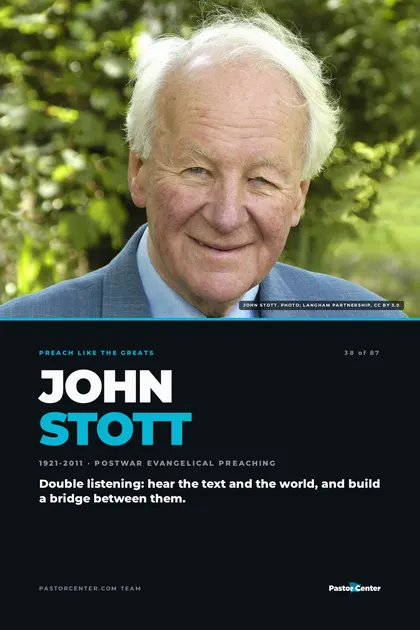
Stott practiced what he called “double listening,” hearing the ancient text and the modern world at the same time. His sermons often open on a question or a cultural objection. One begins with a question that puzzled him as a young Christian, another with the claim that the culture is hostile to sermons.
Then he states the shape of the sermon up front and lets the passage set the outline. His main points are numbered and parallel so a listener can follow them without notes. In “Guard the Gospel,” a series through 2 Timothy, each chapter gives one charge.
He explained Scripture by other Scripture, quoted voices from church history like Calvin, Baxter and Simeon, and held pairs of truths in balance rather than pushing one to an extreme: biblical and contemporary, authoritative and tentative.
His delivery was calm and deliberate, giving people room to think. He moved from light to heat, and often ended with concrete consequences and then prayer, silence or a recited text.
What made his preaching different
Double listening
He heard the ancient text and the modern world at once, and built a bridge between the two in every sermon.
The passage sets the outline
The passage sets the outline, with numbered points people can follow without taking notes.
Light, then heat
Clear explanation came first, then a direct call to respond. The heat never arrived before the light.
What others said
“John Stott turned the words of Bible sentences into windows onto glorious reality.”
— John Piper
“a whole cross-section of people who came off the streets of London to sit under his ministry.”
— Joseph Stowell, president of Cornerstone University, 2011 (Christianity Today)
What to take into your own pulpit
Listen twice
Study the text, and study the people who will hear it. The sermon is the bridge between what you hear in each.
Let the passage number your points
Stott’s outlines came from the structure already in the text. Clear, numbered points help people follow without notes.
Hold the pairs together
Many truths come in pairs. Keeping both in view guards a sermon from swinging to an extreme.
Those are the ideas. The guide turns them into ten steps you can follow this week, plus the sermons we studied and a fill-in outline in his shape.
Free PDF · Preach Like the Greats
Learn to preach like John Stott.
This post is the overview. The guide has the research and the method.
- The 7 sermons we studied, start to finish
- Ten steps to preach the way he did
- His sermon outline, movement by movement
- A fill-in template for your own text, 9 pages
Common questions
What was John Stott’s preaching style?
Calm, clear and expository. He practiced “double listening” to the text and the world, let the passage set numbered points, held truths in balance, and moved from explanation to a call to respond.
How did John Stott structure a sermon?
He often opened with a question or a cultural objection, stated the sermon’s shape up front, drew numbered, parallel points from the passage itself, and closed with concrete consequences, then prayer, silence or a recited text.
What did John Stott mean by “double listening”?
Hearing the ancient text and the modern world at the same time, so the sermon can build a bridge between them.