How J.I. Packer Preached: Clear the Bad Picture, State the Truth, Summon to Action
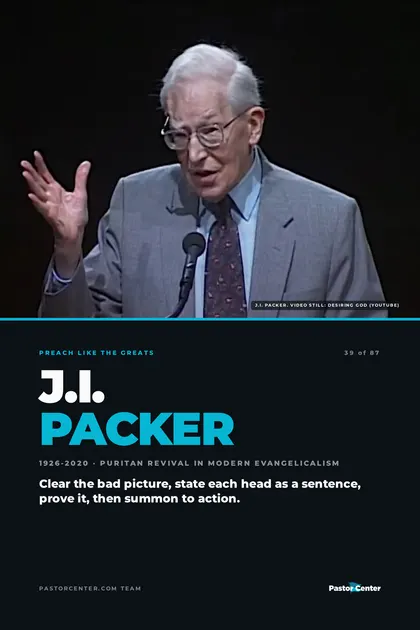
J.I. Packer called himself an “adult catechist,” and his pulpit and lectern sound alike: a teacher explaining doctrine so that it lands on the heart. We studied five of his sermons and talks, from 1981 to 2014. The structure is consistent: clear away the bad picture, state each head as a sentence you could write down, prove it, then summon the room to act.
Who J.I. Packer was
Packer was born near Gloucester on July 22, 1926, converted as an Oxford student, and ordained in the Church of England in 1952. He taught in English colleges and moved to Regent College in Vancouver in 1979, where he stayed for the rest of his life. For 37 years he was an honorary assistant at St. John’s Shaughnessy in Vancouver, where he preached, led the liturgy and taught adult classes. He died on July 17, 2020, at 93.
Knowing God (1973) has sold about a million and a half copies, and Christianity Today readers ranked it fifth among the books that shaped evangelicals. He served as general editor of the English Standard Version, and Time named him one of the 25 most influential evangelicals in 2005.
The shape of a Packer sermon
He starts with a prayer or a personal word before he gets to the subject, and the Scripture is read early. Then he clears the ground. He names a truth people find dull or misuse and sweeps away the bad picture, the bad teaching or the confusion around it.
Only then does he announce his numbered heads, somewhere between a fifth and two-fifths of the way in. Each head is usually a full sentence, a proposition you could write down: “It is God alone who quickens.”
Every head gets proved by a chain of passages and a voice from church history, such as McCheyne, Edwards, Finney or Toplady. One extended everyday picture carries the central truth: a floodlight, a spring, a stagnant pond, a river with buoys. More than once he admits aloud that the clock is beating him and compresses the rest.
He always ends with a direct summons. “I beg,” “I call you,” “the summons with which I leave you.” Doctrine, for Packer, is meant to be done.
What made his preaching different
Heads as sentences
Each point is a proposition you could write down. The heads aren’t topics. They are claims, stated in full.
The floodlight
One plain picture, like a floodlight or a stagnant pond, carries the central truth. A single extended image does more work than a scatter of illustrations.
Doctrine into duty
He ends every message with a direct summons. The doctrine has to become duty before he sits down.
What others said
“His content was always thoughtful, logically packaged, clear, and substantial.”
— Leland Ryken, Christianity Today (2020)
“His mastery of ideas and the most fitting words in which to express them is peerless.”
— Timothy George, founding dean, Beeson Divinity School (quoted by Justin Taylor, The Gospel Coalition, 2020)
What to take into your own pulpit
Clear the ground first
If people carry a bad picture of a doctrine, they won’t hear the true one. Name the misunderstanding before you build.
Write your points as sentences
A heading like “Holiness” is a topic. A sentence is a claim people can remember and test.
Close with a summons
Packer didn’t end on a summary. He told the room plainly what the truth asked of them.
Those are the ideas. The guide turns them into ten steps you can follow this week, plus the sermons we studied and a fill-in outline in his shape.
Free PDF · Preach Like the Greats
Learn to preach like J.I. Packer.
This post is the overview. The guide has the research and the method.
- The 5 sermons we studied, start to finish
- Ten steps to preach the way he did
- His sermon outline, movement by movement
- A fill-in template for your own text, 9 pages
Common questions
What was J.I. Packer’s preaching style?
Clear, logical and warm. He taught doctrine as a working truth: clear away the bad picture, state each head as a full sentence, prove it from Scripture and church history, light it with one plain picture, and end with a direct summons.
How did J.I. Packer structure a sermon?
He opened with a prayer or personal word and the text, cleared the ground, announced numbered heads stated as propositions, proved each one with a chain of passages and a voice from the past, and closed by urging the room to act.
Why did Packer call himself an “adult catechist”?
Because he saw his work as teaching doctrine to adults so that it lands on the heart. His sermons and lectures sound alike for that reason.