How Rick Warren Preaches: The Application Is the Outline
Rick Warren planted Saddleback Church in 1980 and preached there until he retired in 2022, while training pastors around the world. We studied eight of his messages, including his 2022 farewell sermon, where he preached his 1980 first sermon again. His method is simple to name: he makes the application the outline. Every point is an action, every point carries a verse, and every message comes down to “Will you?”
Who Rick Warren is
Warren preached at Saddleback through the seeker-church, megachurch and small-group decades. Alongside the pulpit he trained pastors through Purpose Driven conferences and his “Preaching for Life Change” seminar.
By 2002 he had trained about 180,000 pastors through Purpose Driven Church seminars, and by 2006 more than 400,000 church leaders in 22 languages. The Purpose Driven Life had sold more than 30 million copies by 2006.
The shape of a Warren sermon
Warren almost always starts with a felt need before he gets to the text: life is hard, stress you can’t control, a world that feels shaken. Then he reads the text early, often after telling people to get their notes out.
He previews the count up front, “three things,” and then delivers the points. Most are written as first-person, present-tense action statements with a verb in them, like “I must anchor my identity to what God says about me.” Each one carries a verse and goes in the notes.
He coaches the room as he goes: write this down, circle that. Lists often alliterate or rhyme, so the points are easy to remember.
Every message pushes toward a decision. In the complete transcripts we studied, he recaps the points and closes with a prayer of commitment. In “The Beginning of a Miracle,” his farewell, a card leads into that prayer.
What made his preaching different
Points are actions
His points are actions, not topics: first-person, present-tense statements with a verb, so the outline is already the application.
A verse each
Every point carries a verse and is printed in the notes, so people can follow along and take it home.
“Will you?”
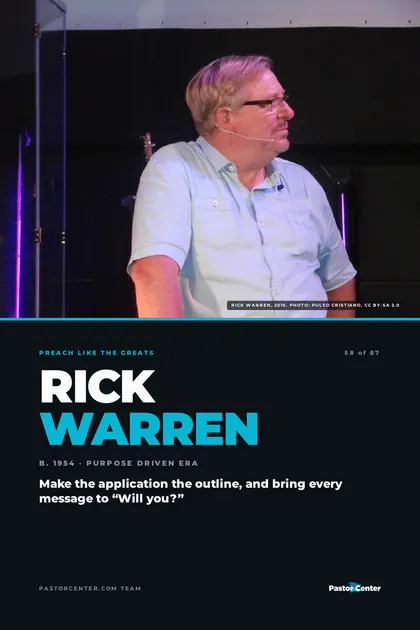
Every message pushes toward a decision. In his own summary, it all comes down to “Will you?”
What others said
“He reinterprets the tradition and he does so brilliantly.”
— Eddie Gibbs, Fuller Seminary
“Pastor Rick takes these huge concepts and squishes them down.”
— Donna Petit, Saddleback member
What to take into your own pulpit
Write points people can do
A topic is something to think about. An action statement with a verb is something to do. Warren’s outline is the to-do list.
Anchor every point in Scripture
A practical point without a verse is just advice. Give each one a text, and put it where people can see it.
Ask for a decision
Information isn’t the goal. Warren brings every message to one question: “Will you?”
Those are the ideas. The guide turns them into ten steps you can follow this week, plus the sermons we studied and a fill-in outline in his shape.
Free PDF · Preach Like the Greats
Learn to preach like Rick Warren.
This post is the overview. The guide has the research and the method.
- The 8 sermons we studied, start to finish
- Ten steps to preach the way he does
- His sermon outline, movement by movement
- A fill-in template for your own text, 9 pages
Common questions
What is Rick Warren’s preaching style?
Practical, clear and aimed at life change. He opens on a felt need, makes every main point a first-person action statement with a verb and a verse, and pushes every message toward a decision.
How does Rick Warren structure a sermon?
A felt-need hook, the text read early, a preview of how many points are coming, points written as personal action statements in the notes, and in full messages a recap and a commitment prayer.
What does Rick Warren mean by “Will you?”
It’s his own summary of where every message lands. The sermon isn’t finished until the listener is asked to act on it.