How John Mark Comer Preaches: Teach Like a Rabbi, Then Hand Out a Practice
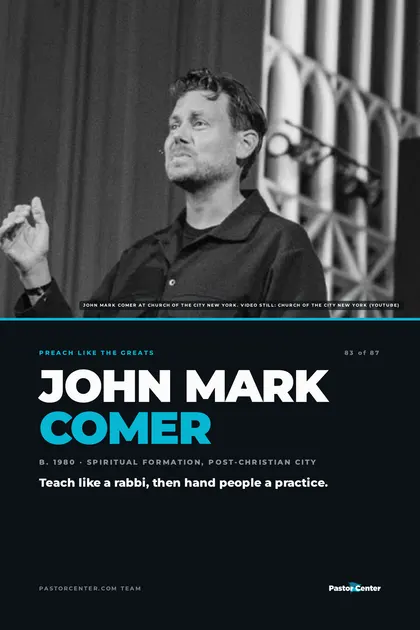
John Mark Comer teaches like a rabbi running a seminar. We studied nine of his sermons, from Bridgetown Church in 2016 to guest talks around 2025. The shape is steady: name the anxiety in the air, open one Greek or Hebrew word, hand the room a counted map, and send people out with a practice.
Who John Mark Comer is
Comer grew up in the Bay Area, where his father was a pastor. At 23 he planted a church in the Portland area with his father, and by his own account it grew by about 1,000 people a year for roughly seven years. He spent “just shy of about 20 years church planting and pastoring up in Portland” at Bridgetown Church. In 2021 he stepped down to build Practicing the Way, and he now teaches from Los Angeles as teacher in residence at Vintage Church LA.
The Ruthless Elimination of Hurry (2019) has sold more than a million copies in more than twenty languages. Practicing the Way (2024) has sold more than 500,000 copies, spent 25 weeks on the New York Times list, and was named ECPA Christian Book of the Year in 2025.
The shape of a Comer sermon
He usually opens on the cultural moment: the news, burnout, a popular belief. In “Becoming a Non-Anxious Presence,” it is “so much anxiety in the air.” The problem is named before the text arrives.
Then he counts and announces his points: three levels of faith, five practices, three shifts. He often unpacks one Greek or Hebrew word, like talmidim or praus, and fills each point with a shelf of named voices, ancient and modern.
Everything bends toward one picture: Jesus as the gentle teacher and the listener as an apprentice who trains rather than tries. Self-deprecating humor and a coined contrast line keep it light, and the cross or resurrection often arrives in the last quarter.
His approach has shifted over time. His 2016 sermons read the text late. His recent ones stand the room up for the reading in the first minutes and end with a practice or take-home question. He closes with “Let’s stand and pray” or “Let’s stand together,” with no altar call.
What made his preaching different
A counted map
Three levels, five practices. He counts the points out loud so the room can follow the map.
A shelf of voices
Ten to fourteen named sources a talk, ancient and modern. He teaches like he is pulling books off a shelf for you.
Train, don’t try
He ends with a practice for the week. The goal is training, not just trying harder.
What others said
“A master at distilling theological concepts for a general audience.”
— Brad East, Christianity Today
“John Mark Comer is a hugely talented leader, speaker, and writer.”
— Nicky Gumbel, vicar of Holy Trinity Brompton, 2019
What to take into your own pulpit
Name what’s in the air
Start with the anxiety or belief your people brought with them. It earns the right to open the text.
Give them a map
Counted points help people follow and remember. Tell them how many stops are on the road.
Train, don’t just try
End with a practice, not just a call to do better. Apprentices grow by doing something every week.
Those are the ideas. The guide turns them into ten steps you can follow this week, plus the sermons we studied and a fill-in outline in his shape.
Free PDF · Preach Like the Greats
Learn to preach like John Mark Comer.
This post is the overview. The guide has the research and the method.
- The 9 sermons we studied, start to finish
- Ten steps to preach the way he does
- His sermon outline, movement by movement
- A fill-in template for your own text, 9 pages
Common questions
What is John Mark Comer’s preaching style?
Teacherly, conversational and formation-focused. He names the cultural anxiety, opens a Greek or Hebrew word, gives a counted map of points filled with named sources, and ends with a practice for the week.
How does John Mark Comer structure a sermon?
He opens on the cultural moment or a popular belief, announces counted points, unpacks a key word, quotes many named thinkers, often names the cross or resurrection late, and closes with a practice and “Let’s stand and pray.”
What does Comer mean by apprenticeship to Jesus?
It is his picture of discipleship: Jesus as the gentle teacher and the listener as an apprentice who trains rather than tries. Many of his sermons end with a practice to make that concrete.