How Chris Hodges Preaches: The Church Family First, Then the Text
Chris Hodges founded Church of the Highlands in Birmingham, Alabama, and co-founded ARC. We studied eight of his sermons, on texts from Genesis to John, including two he preached as a guest. The shape: preach the church family first, name a felt need, retell one Bible story with plenty of humor, give practical points with a verse and a laugh each, and end at an altar.
Who Chris Hodges is
Hodges and 34 charter members founded Church of the Highlands on February 4, 2001. It grew to about 60,000 weekly attenders across more than two dozen campuses and was the largest church in America on the 2018 Outreach 100. Its services are broadcast into all 28 Alabama state prisons.
He co-founded the Association of Related Churches (ARC) in 2000, and Highlands’ four-step Growth Track has been copied by churches across the country. In 2025 he became founding pastor, with Mark Pettus now leading.
The shape of a Hodges sermon
On a Highlands Sunday, Hodges opens with a huddle: wins, stats, humor and the week’s next steps. He doesn’t treat it as announcements. In his words: “Don’t make announcements. Preach them.”
Then he frames the series, often recapping the theme verse, and names a felt need up front. Usually he gives a one-line definition that the rest of the sermon proves: “A setback is a school, not a jail.”
Most sermons anchor on one Bible story, retold with plenty of humor. The points come out of it, three or four of them, and nearly every point gets its own verse and a laugh. In “Only Believe,” an Easter sermon from John 11, the three points are three characters: Martha, Thomas and Mary.
The landing is practical and spiritual at once. He names a next step, usually prays out loud for the felt need, and closes with a salvation prayer or a response card.
What made his preaching different
Family first
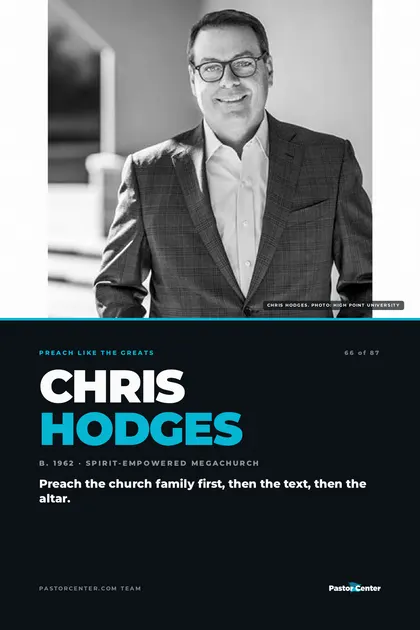
He preaches the church family first: wins and next steps come before the text, so the room feels like a family before it hears the sermon.
One Bible story
One Bible story anchors the message, retold with plenty of humor.
Practical points
Practical points follow, each with a verse and a laugh, and then the altar.
What others said
“Don’t make announcements. Preach them.”
— Chris Hodges
“Sermons usually consist of accessible messages that apply biblical concepts to practical life.”
— Ansley L. Quiros, historian, Encyclopedia of Alabama
What to take into your own pulpit
Treat the open as part of the sermon
The wins and next steps aren’t filler for Hodges. They tell people they belong before the text tells them anything else.
Name the need before the story
When people know what problem the sermon answers, they listen to the Bible story differently.
Pair every point with Scripture
His points are practical, but nearly each one stands on a verse. Practical and biblical don’t have to compete.
Those are the ideas. The guide turns them into ten steps you can follow this week, plus the sermons we studied and a fill-in outline in his shape.
Free PDF · Preach Like the Greats
Learn to preach like Chris Hodges.
This post is the overview. The guide has the research and the method.
- The 8 sermons we studied, start to finish
- Ten steps to preach the way he does
- His sermon outline, movement by movement
- A fill-in template for your own text, 9 pages
Common questions
What is Chris Hodges’s preaching style?
Warm, practical and funny. He opens with church-family wins and next steps, names a felt need, retells one Bible story with humor, gives practical points with a verse and a laugh each, and ends at an altar.
How does Chris Hodges structure a sermon?
A huddle of wins and announcements, a series frame, a felt need and a one-line definition, one narrative anchor passage, three or four practical points, a named next step, and a closing prayer or response card.
What does “Don’t make announcements. Preach them” mean?
It’s Hodges’s way of saying the church’s wins and next steps belong in the message. He treats them as part of shepherding the room, not as housekeeping before the sermon.