How Ed Young Jr. Preaches: Big Ideas Made Short Enough to Say Back
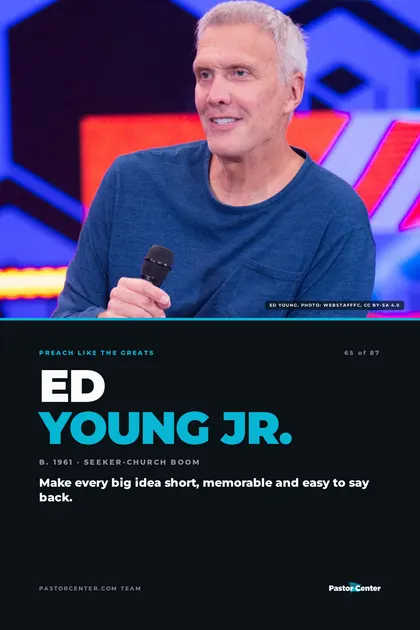
Ed Young Jr. came of age in the 1990s seeker-church boom and built Fellowship Church into one of the largest churches in America. We studied eight of his messages, from Christmas and Father’s Day sermons to a C3 conference talk. Every one is built to be said back: short triads, rhyming points and mirrored two-line sayings, all hung on a single prop or metaphor that runs the whole message.
Who Ed Young Jr. is
He and his wife, Lisa, started Fellowship Church in the Dallas-Fort Worth suburbs in 1990 with a small core group. By 2018 it ranked among the largest churches in the U.S., at about 24,000 weekly attenders. He preached in series with stage sets and made TV and online content before most pastors did.
He founded the Creative Church Conference (C3) and has written more than a dozen books, including The Creative Leader. He has said he spends “twenty-five to thirty hours at least a week” on a weekend message with a creative team.
The shape of a Young Jr sermon
Young opens on something personal or from pop culture: a haircut, a movie poll, a texting story. Then a one-line twist sets the theme for everything that follows.
Usually one metaphor or prop carries the whole message. In “Just This Once,” part of a series called “Hair,” he got a live haircut on stage and the hair became the frame for Samson’s story. In “Forgiving Others and Yourself,” a Doberman illustration opens the message and comes back at the end.
The points are built to be repeated. Most share a letter, a prefix or a rhyme, and he lands them with mirrored sayings like “Name your shame / Own your shame.” Many messages include a personal story of grief or failure, and many end with homework or a challenge.
Most close with a gospel invitation. Behind all of it is a word-for-word manuscript and rehearsed transitions, which is how so much fits into about 30 minutes. He also changes the format often enough that no one can predict it.
What made his preaching different
Easy to say back
He makes big ideas easy to say back with triads that share a letter, rhyming point names and two-line sayings that mirror each other.
One prop
A single metaphor or prop runs the whole message, from the opening to the callback at the end.
Word for word
He writes the manuscript word for word and rehearses the transitions exactly. In his words, “the higher the predictability the lower the connectivity.”
What others said
“Fellowship’s flavor is pure, unmitigated Bible 101 packaged in a 21st-century way.”
— Mark Davis, Dallas Morning News
“I think his methods are unconventional… but his message is conventional.”
— T.D. Jakes, Dallas Morning News, c. 2013
What to take into your own pulpit
Hang the message on one thing
One prop or metaphor, carried from start to finish, gives people a handle for everything else you say.
Write lines people can repeat
If the room can’t say it back, they won’t take it home. Triads, rhymes and mirrored sayings make truth portable.
Don’t let them predict you
Young changes the format so the room stays awake. Predictability costs connection.
Those are the ideas. The guide turns them into ten steps you can follow this week, plus the sermons we studied and a fill-in outline in his shape.
Free PDF · Preach Like the Greats
Learn to preach like Ed Young Jr..
This post is the overview. The guide has the research and the method.
- The 8 sermons we studied, start to finish
- Ten steps to preach the way he does
- His sermon outline, movement by movement
- A fill-in template for your own text, 9 pages
Common questions
What is Ed Young Jr.’s preaching style?
Creative, memorable and tightly prepared. He hangs each message on one prop or metaphor, names his points with shared letters or rhymes, and writes and rehearses the manuscript word for word.
How does Ed Young Jr. structure a sermon?
A personal or pop-culture hook, a one-line twist that sets the theme, a handful of alliterated or rhyming points carried by one metaphor, often homework or a challenge, and usually a gospel invitation.
How long does Ed Young Jr. spend preparing a sermon?
He has said he spends “twenty-five to thirty hours at least a week” on a weekend message, working with a creative team.