How Francis Chan Preaches: Pray Against Your Pride, Then Read It Plainly
Francis Chan planted a megachurch, then left it to start a network of house churches, and he preaches against the pull of the very platform he stands on. We studied six of his sermons, most given as a guest at churches, campuses and gatherings. Under every one sits the same shape: a prayer against his own pride, one passage read plainly in blunt everyday words, a warning aimed at the people in the seats, and a close in prayer instead of a summary.
Who Francis Chan is
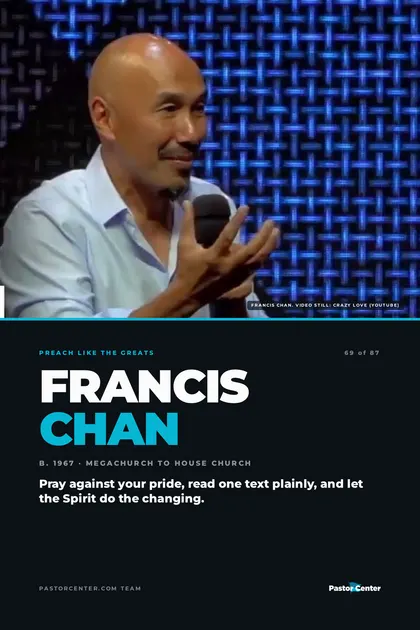
Chan was born in San Francisco in 1967. He, his wife Lisa and about 30 others founded Cornerstone Church in Simi Valley, California, in 1994. Within two months about 100 people were attending, and by 2008 it was one of the largest churches in Ventura County. The church famously gave away half its budget.
He founded Eternity Bible College in 2004 with 100 students. Crazy Love (2008) became a New York Times bestseller, followed by books including Forgotten God, Erasing Hell, Letters to the Church and Beloved (2025). He later moved to San Francisco to start We Are Church, a network of house churches, and now preaches mostly as a guest through Crazy Love Ministries.
The shape of a Chan sermon
Chan usually starts before the text with prayer or a confession. He prays against his own pride or admits he is afraid of the stage. In “The Power of a Quiet Life,” he opens by calling the stage “poison.”
Then he reads one anchor passage in full and paraphrases it in blunt modern voice: “What are you, brain dead?” He chains several other passages around it and sets up “What if…” scenarios that make the hearer choose.
The warning lands inside the room, not outside it. He aims the text at churchgoers, leaders and himself, and he confesses his own failure along the way. His own life is the proof: a teenage conversion, a father who did not want him, the sale of the family house.
He won’t end with a summary. He often says plainly that a sermon cannot change a heart and only the Spirit can. So he closes by praying over the room, often at length.
What made his preaching different
Pride prayed against
He opens by praying against his own pride or confessing his fear of the stage, before the text.
Warning turned inward
He aims the text’s warnings at churchgoers, leaders and himself, not at people outside the church.
Prayer, not summary
He ends by praying over the room instead of recapping his points.
What others said
“He was in demand as a speaker and received invitations to preach at the biggest churches and conferences.”
— Tim Challies, pastor and reviewer, 2018
“He gave a powerful message about the God in Heaven who’s looking down on Earth.”
— Lauren D’Avolio, Gospel Herald, 2013
What to take into your own pulpit
Deal with your own heart first
Chan prays about his pride before he preaches to anyone else’s. The room can tell when the preacher has already been under the text.
Aim the warning at the church
It’s easy to preach about people who aren’t there. He points the text at the people in the seats, starting with himself.
Close by asking God to act
If only the Spirit changes hearts, the end of the sermon is a good place to ask him to.
Those are the ideas. The guide turns them into ten steps you can follow this week, plus the sermons we studied and a fill-in outline in his shape.
Free PDF · Preach Like the Greats
Learn to preach like Francis Chan.
This post is the overview. The guide has the research and the method.
- The 6 sermons we studied, start to finish
- Ten steps to preach the way he does
- His sermon outline, movement by movement
- A fill-in template for your own text, 9 pages
Common questions
What is Francis Chan’s preaching style?
Blunt, personal and prayer-soaked. He prays against his own pride, paraphrases Scripture in everyday language, turns its warnings on churchgoers and himself, and tells stories from his own life as proof.
How does Francis Chan structure a sermon?
He opens with prayer or a confession, reads one anchor passage in full and chains others around it, presses the hearer with “What if…” choices and personal stories, and ends with extended prayer instead of a summary.
Why does Francis Chan end sermons with prayer?
He often says that a preacher cannot change a heart and only the Spirit can. So instead of recapping his points, he prays over the room.