How Tertullian Preached: Speak to Them by Name, Root It in Christ, Make It Concrete
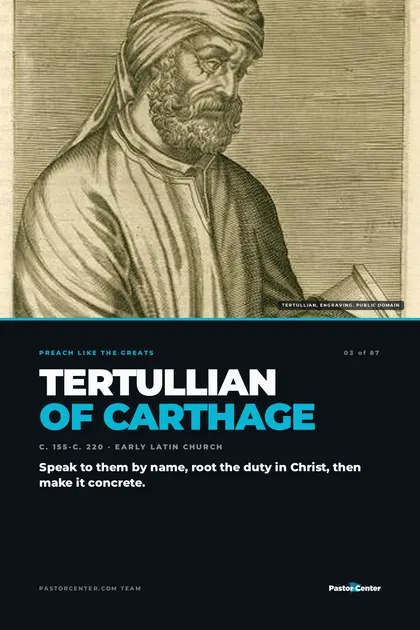
Tertullian taught the persecuted church of Roman North Africa about a century after the apostles. None of his sermons survive, but several of his treatises were written for the congregation or for people preparing for baptism, and they read like spoken exhortation. We studied six of them, on duties from prayer and patience to facing martyrdom. The shape holds across all of them: speak to the hearers by name, root the duty in God’s character or Christ’s example, then make it concrete.
Who Tertullian was
Tertullian was born in Carthage around 155, trained in rhetoric, and became a Christian as an adult. Thirty-one of his works survive, plus fragments of others. He is the first writer in Latin known to use the word “trinity,” and a line from his Apology, usually quoted as “the blood of the martyrs is seed,” is still repeated in churches today.
He is often called the father of Latin Christianity and the founder of Western theology. Cyprian, the great bishop of Carthage a generation later, read him every day. Because no sermons of his survive, the treatises he wrote as exhortation to the congregation and to catechumens stand in for his preaching.
The shape of a Tertullian sermon
He almost always opens by speaking to the people in front of him or about himself. It might be a greeting, a word of praise, or a confession. In On Patience he admits he is the least patient man to be writing on the subject.
He never lets the hearers stay spectators. He addresses them directly with “O” or a title: “O sinner,” “O blessed ones,” “You are too dainty, Christian.” He takes one duty at a time, such as prayer, patience or repentance, and usually grounds it in God’s own character or Christ’s example before he gives a single rule.
Then he proves the point with a catalog of examples and often carries it with one sustained image: little fishes born in the water of baptism, the athlete in training, the tranquil face of Patience herself. He names the strongest objection early and answers it.
The practical part is always concrete, down to posture, timing and what to do with your hands. And he likes to end beyond this life: the resurrection, the return of Christ, Adam “restored… to his own paradise.”
What made his preaching different
Names the hearer
He speaks to the hearer directly and by title: “O sinner,” “O blessed ones,” “O Christian.” Nobody in the room gets to listen from a distance.
God before rules
Before he asks for patience or repentance, he shows God’s patience and Christ’s. The duty grows out of who God is, not out of a list of rules.
Ends on glory
He closes on Christ’s return, the resurrection or paradise. The last word lifts the hearer’s eyes past the present trouble.
What others said
“Every word almost was a sentence; every sentence a victory.”
— Vincent of Lérins, Commonitory (434)
“Give me the master.”
— Cyprian of Carthage, as Jerome reports it, Lives of Illustrious Men 53 (392)
What to take into your own pulpit
Talk to the person, not the crowd
Address your hearers directly and name who they are. People listen differently when the sermon is speaking to them.
Show God before you give the rule
Ground every duty in God’s character or Christ’s example first. Practice feels like a response, not a burden.
Get specific, then lift their eyes
Make the practice concrete enough to do this week, then end on the hope that makes it worth doing.
Those are the ideas. The guide turns them into ten steps you can follow this week, plus the sermons we studied and a fill-in outline in his shape.
Free PDF · Preach Like the Greats
Learn to preach like Tertullian.
This post is the overview. The guide has the research and the method.
- The 6 treatises we studied, start to finish
- Ten steps to preach the way he did
- His sermon outline, movement by movement
- A fill-in template for your own text, 9 pages
Common questions
What was Tertullian’s preaching style?
Direct, compact and practical. He spoke to his hearers by name, rooted each duty in God’s character or Christ’s example, proved it with examples and a sustained image, got concrete about practice, and ended on glory.
How did Tertullian structure a sermon?
He usually opened by addressing the hearers or confessing something about himself, grounded the duty in God or Christ, answered the best objection early, gave concrete practice, and closed on the resurrection, Christ’s return or paradise.
Do any of Tertullian’s sermons survive?
No. What survives is a set of treatises, and several were written for the congregation or for people preparing for baptism. They read like spoken exhortation, so they are the closest record of his preaching.