How Origen Preached: Plain Story First, Then the Soul, Then Christ
Origen preached to the church in Caesarea week after week in the third century, and his homilies are some of the oldest Christian sermons we still have. We studied eight of them, on texts from Genesis to Isaiah. Under every one sits the same habit: preach the passage the reader just read, phrase by phrase, and don’t let a verse go until it has spoken about the plain story, the soul and Christ.
Who Origen was
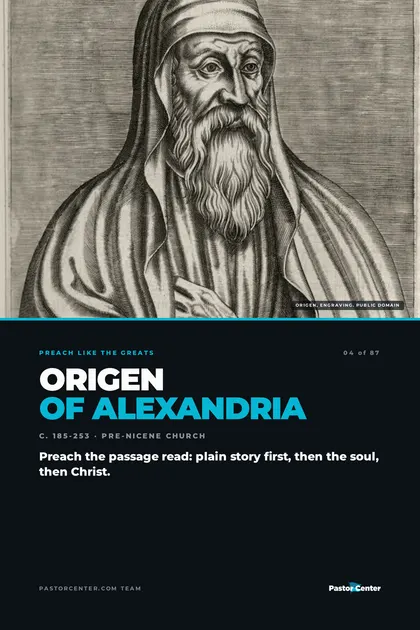
Origen was born in Alexandria around 185 and became a teacher of new believers there at eighteen. Around 215 the bishops of Jerusalem and Caesarea asked him to preach and explain the Scriptures in church while he was still a layman. He spent his last two decades in Caesarea on the coast of Palestine, preaching on Wednesdays and Fridays and later every day.
His sermons survive because they were taken down as he spoke. His patron Ambrose supplied seven stenographers, and the church historian Eusebius says Origen allowed his public sermons to be recorded only after he turned sixty. Hundreds of homilies survive, most in the Latin of later translators such as Jerome, including 16 on Genesis and 14 on Ezekiel.
The shape of a Origen sermon
Origen didn’t pick a theme and go looking for verses. He preached the passage that had just been read aloud in the service, in order, phrase by phrase. In one homily the lesson was so long that he let the bishop choose which part he should preach.
He worked each verse on three levels. First the plain story, which he told hearers to “believe that it happened truly.” Then what the passage says to the soul today. Then how it shows Christ. In his homily on Genesis 22, Isaac carrying the wood becomes “a figure of Christ,” and Christ is both the victim and the priest.
He also said the text’s hard questions out loud. Why is Samuel really there in 1 Samuel 28? Why does the text say “none beside Thee”? He named the puzzle and then answered it by chaining other Scriptures together.
And he kept turning to the room. He spoke to hearers as “you,” gathered them with “let us,” turned the text inward on their own souls, and more than once stopped in the middle of the sermon to ask God for light on a hard verse.
What made his preaching different
Three layers deep
He took a verse through three layers in order: the plain story first, then what it says to the soul, then how it shows Christ.
Asks the hard question
He voiced the text’s puzzle himself instead of skipping it, then answered it from other Scriptures.
Prays mid-sermon
When a verse was hard, he stopped mid-sermon to ask God for light, and invited the room to ask with him.
What others said
“Like some spark lighting upon our inmost soul, love was kindled and burst into flame within us.”
— Gregory Thaumaturgus, his student
“this man’s style and the simplicity of language, which alone is beneficial for the Churches.”
— Jerome, translator of the homilies, late 4th century
What to take into your own pulpit
Preach the passage that was read
Origen let the reading set the sermon. When the text people just heard is the text you preach, they can follow you with their own ears.
Ask the question the room is thinking
If a verse is puzzling, say so. Naming the difficulty out loud earns trust, and answering it from Scripture teaches people how to read.
Don’t stop at what happened
Start with the plain story, but keep going: what does it say to the soul, and where does it point to Christ?
Those are the ideas. The guide turns them into ten steps you can follow this week, plus the sermons we studied and a fill-in outline in his shape.
Free PDF · Preach Like the Greats
Learn to preach like Origen.
This post is the overview. The guide has the research and the method.
- The 8 sermons we studied, start to finish
- Ten steps to preach the way he did
- His sermon outline, movement by movement
- A fill-in template for your own text, 9 pages
Common questions
What was Origen’s preaching style?
Plain, verse-by-verse and searching. He preached the passage just read, asked its hard questions aloud, turned to the hearers with “you,” and sometimes stopped mid-sermon to pray for understanding.
How did Origen structure a sermon?
He followed the passage in order, phrase by phrase, and took each verse through three levels: the plain story first, then its meaning for the soul, then how it shows Christ.
How did Origen’s sermons survive?
They were taken down by stenographers as he spoke. His patron Ambrose supplied seven of them, and most of the homilies that survive come to us in the Latin of later translators such as Jerome.