How Gregory of Nazianzus Preached: Rhetoric Turned Into Worship
Gregory of Nazianzus preached in fourth-century Cappadocia and Constantinople, where the Nicene faith survived in one small chapel. We studied eight of his sermons, from his defence of fleeing ordination around 362 to his farewell to the Council in 381. Under festal sermons, funeral eulogies and doctrinal orations alike sits the same shape: name what the moment means, climb the story of God, and land on “now you take part.”
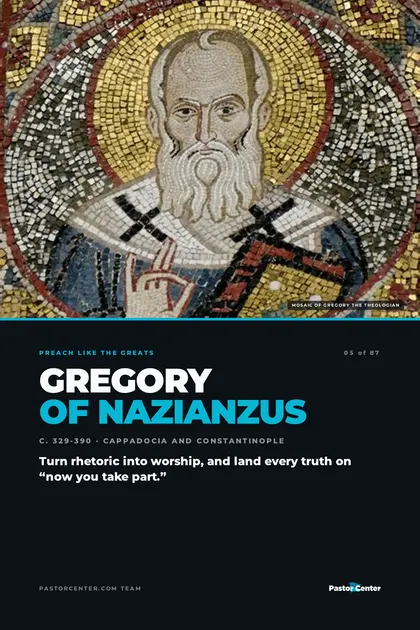
Who Gregory of Nazianzus was
Gregory trained in rhetoric at Athens alongside Basil. In his day the empire had turned Christian, but the churches of Constantinople were held by Arians. The Nicene faith held on in one small chapel he called the Anastasia, meaning “Resurrection.” He was briefly bishop of Constantinople, from 380 to 381.
In that chapel in 380 he preached five Theological Orations, which earned him the title “the Theologian.” The Orthodox Church still uses it. Jerome studied Scripture under him, and his Oration 2, on why he fled ordination, shaped Chrysostom’s and Gregory the Great’s own books on pastoral ministry. He is the church’s model for festal preaching, funeral eulogy and doctrinal preaching at once.
The shape of a Gregory sermon
Almost every sermon we studied opens with a proclamation or a confession. In his Christmas sermon, Oration 38, the first words are “Christ is born, glorify Him,” and then he names what the feast means.
From there he climbs. He starts with God, moves to creation, the Fall and the Incarnation, and only then turns to the hearer. Along the way he reaches for Scripture examples and typology, and he usually stops to answer objections before he moves on.
The landing is participation. He puts the hearer inside the story with lines that begin “with Christ…” and charges them to take part. In the Christmas sermon, that means “join the Magi.”
Then he closes in prayer and doxology. Even his funeral sermons and his farewell to the Council end by turning to God.
What made his preaching different
Name the occasion
He starts by telling the room what this feast or this moment means. The occasion frames everything that follows.
Climb the story
He climbs from God to creation, the Fall and the Incarnation, and only then turns to you. The hearer arrives at the end of a long story, not the start of a short one.
Short antitheses
He packs doctrine into short antitheses people can remember, like “the Uncreate is created.” A whole theology fits in one line.
What others said
“A most eloquent man, and my instructor in the Scriptures”
— Jerome, Lives of Illustrious Men 117
“He was famous for his eloquence”
— Benedict XVI, General Audience, 8 August 2007
What to take into your own pulpit
Say what the day means
Before the text does its work, tell people why this occasion matters. Gregory let the feast set the frame.
Tell the long story
He didn’t jump straight to application. He walked from God and creation to the Incarnation so the hearer could see where they fit.
Invite people in, not just on
His sermons end with “with Christ…” and a call to take part. Doctrine becomes something the hearer joins, then it turns to praise.
Those are the ideas. The guide turns them into ten steps you can follow this week, plus the sermons we studied and a fill-in outline in his shape.
Free PDF · Preach Like the Greats
Learn to preach like Gregory of Nazianzus.
This post is the overview. The guide has the research and the method.
- The 8 sermons we studied, start to finish
- Ten steps to preach the way he did
- His sermon outline, movement by movement
- A fill-in template for your own text, 9 pages
Common questions
What was Gregory of Nazianzus’s preaching style?
Rhetorical, doctrinal and worshipful. Trained in classical rhetoric, he turned it toward worship: he named what the occasion meant, climbed the story of God, packed doctrine into short antitheses and closed in doxology.
How did Gregory of Nazianzus structure a sermon?
He usually opened with a proclamation or confession, named the mystery or occasion, climbed from God to creation, the Fall and the Incarnation, answered objections, charged the hearer to take part “with Christ,” and ended in prayer and doxology.
Why is Gregory of Nazianzus called “the Theologian”?
His five Theological Orations, preached in 380 in a small chapel in Constantinople, earned him the title. The Orthodox Church still gives it to him.