How Ambrose of Milan Preached: The Day’s Readings, Then Christ
Ambrose of Milan preached in Milan’s basilicas for 23 years, and most of what survives from him began as sermons. We studied seven of them, from the funeral sermons for his brother around 378 to his sermon on the death of Theodosius in 395. Under every one sits the same shape: the day’s readings or the rite the hearers just lived through as the spine, an Old Testament picture set beside Christ, and a preacher talking straight to the room.
Who Ambrose of Milan was
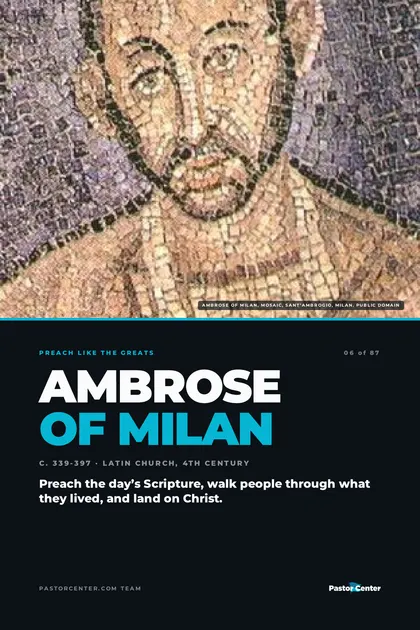
Ambrose was born at Trier around 339. He was a trained Roman lawyer and the governor of the province around Milan when the people acclaimed him bishop in 374, while he was still a catechumen. He was baptized, ordained and consecrated bishop within a week, on December 7, 374, and he served as Bishop of Milan until 397.
Augustine sat under his Sunday preaching for months, and Ambrose baptized him in Milan at Easter 387. Augustine came to hear a famous speaker and stayed for the Scripture. Ambrose’s nine Hexameron homilies on the six days of creation and his Easter-week sermons to the newly baptized became models of teaching new believers. He also wrote hymns still sung today, and in 1298 he was named one of the four great Latin Doctors of the Church.
The shape of a Ambrose sermon
Ambrose preached what the people had just read, sung or lived. Most of the sermons we studied open by naming the occasion or what the room is feeling, and then build on the day’s lessons or on the rite the hearers have just gone through.
In his Easter-week sermons On the Sacraments, he walked the newly baptized back through the rite they had just passed through: “What did we do on the Saturday?” The outline was their own week, explained.
At almost every step he set an Old Testament picture beside its fulfillment in Christ. He also argued from nature and reason alongside Scripture. Toward the end, the sermon usually belongs to Christ, the cross or the sacrament, and most endings land on baptism, new birth, heaven or a doxology.
He spoke to the room in the second person and opened points with short questions. In his funeral sermons he even turned and spoke to the dead, addressing his brother directly, and in one he let a single repeated line, “I have loved,” drive a whole section.
What made his preaching different
Preach the day’s readings
The lessons just read became the sermon’s spine. He preached the Scripture the people had just heard, or the rite they had just passed through, rather than a text chosen in isolation.
Picture, then Christ
Every Old Testament type was set beside its fulfillment. Ezekiel’s dry bones and Lazarus point to Christ the firstfruits, and no picture from the old covenant was left on its own.
Talk to the room
He named what hearers felt and asked them short questions. He once opened by telling a crowd, “I see that you are in an unusual state of excitement.”
What others said
“I was delighted with the pleasantness of his speech.”
— Augustine of Hippo, Confessions 5.13
“starts with the reading of the Sacred Books”
— Pope Benedict XVI, General Audience, 2007
What to take into your own pulpit
Preach what they just heard
Ambrose built on the readings and rites his people had just lived through. The sermon felt like an explanation of their own week.
Set the picture beside Christ
He didn’t leave an Old Testament image hanging. He put it next to its fulfillment so the room could see both at once.
Talk to people, not about them
Second person, short questions and naming what the room feels. Augustine came for the speaker and stayed for the Scripture.
Those are the ideas. The guide turns them into ten steps you can follow this week, plus the sermons we studied and a fill-in outline in his shape.
Free PDF · Preach Like the Greats
Learn to preach like Ambrose of Milan.
This post is the overview. The guide has the research and the method.
- The 7 sermons we studied, start to finish
- Ten steps to preach the way he did
- His sermon outline, movement by movement
- A fill-in template for your own text, 9 pages
Common questions
What was Ambrose of Milan’s preaching style?
Warm, direct and rooted in Scripture. He took the day’s readings as his spine, set Old Testament pictures beside their fulfillment in Christ, spoke to the room in the second person and opened points with short questions.
How did Ambrose structure a sermon?
He usually opened by naming the occasion or what the room was feeling, built the body on the day’s readings or the rite just completed, and let Christ, the cross or the sacrament carry the last part before ending on baptism, new birth, heaven or a doxology.
How did Ambrose influence Augustine?
Augustine sat under his Sunday preaching for months and was baptized by him in Milan at Easter 387. In the Confessions, Augustine says he noticed first how skilfully Ambrose spoke, and then how truly.