How John Chrysostom Preached: Deep on One Verse, Then Half the Sermon on One Sin
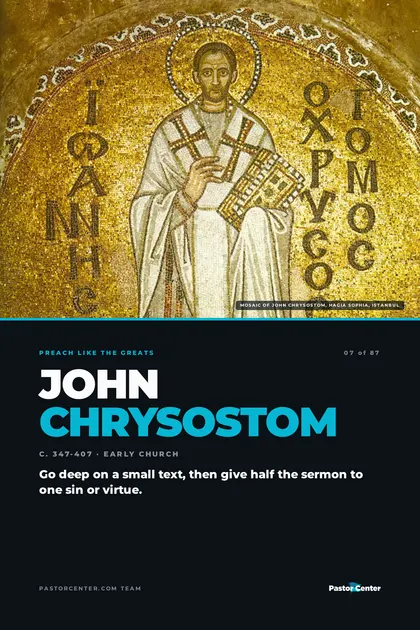
John Chrysostom preached verse by verse through whole books of the Bible, first in Antioch and then in Constantinople as archbishop. We studied ten of his sermons, from Antioch in 387 to Constantinople around 400. The shape holds across all of them: go deep on a small text, give nearly half the sermon to one concrete sin or virtue, and send people home with homework.
Who John Chrysostom was
Chrysostom was ordained in Antioch in 386 and made preaching his main work. He preached through whole books, verse by verse, and long series survive: 67 homilies on Genesis, 90 on Matthew and 88 on John. Later he preached in Constantinople as archbishop.
The name stuck to him after his death. “Chrysostom” means “golden-mouthed,” and it was first used of him in 553, about 150 years after he died. The Catholic Encyclopedia calls him “the greatest preacher ever heard in a Christian pulpit.” In Constantinople the crowds pressed in so close that he preached from the readers’ platform in the middle of them.
The shape of a Chrysostom sermon
The sermons we studied follow a steady road: a hook, the text, a puzzle in the text, exposition, an ethical turn, practice, and a doxology. Different books and different years, the same order.
He didn’t need a big text to get started. In Homily 1 on the Statues, preached in Antioch in 387, he takes a single verse, 1 Timothy 5:23, and argues that even a “trivial” verse is a gold mine.
The middle of the sermon is where he spends his time. After the exposition he turns to one concrete sin or virtue, like swearing oaths, theater-going, wealth or mercy to the poor, and stays there for close to half the message. In Homily 50 on Matthew, a cup of gold set against a cup of cold water becomes a long plea to honor Christ in the poor.
Then he lands it. Most sermons close with a specific practice for the week, sometimes with someone assigned to hold you to it, and then a doxology.
What made his preaching different
Deep on a small text
He would spend twenty minutes on a single verse, even one people skip. The smaller the text, the more he seemed to find in it.
Half the sermon on one turn
Once the text was open, he turned to one concrete sin or virtue and gave it nearly half the sermon. The application wasn’t a closing paragraph. It was the second half.
Ends with homework
He ended with a specific action for the coming week, and sometimes named who would hold you to it, like spouses correcting each other.
What others said
“The greatest preacher ever heard in a Christian pulpit.”
— Catholic Encyclopedia
“In public teaching he was powerful in reforming the morals of his auditors.”
— Socrates Scholasticus, Church History 6.3
What to take into your own pulpit
Don’t skip the small verses
Chrysostom found whole sermons in verses most readers pass over. A narrow text studied closely can carry more than a broad one skimmed.
Give application real time
He didn’t save the ethical turn for the last two minutes. One concrete sin or virtue got the room’s full attention.
Send people home with homework
A specific action for this week, with someone to hold you to it, turns a good sermon into a changed habit.
Those are the ideas. The guide turns them into ten steps you can follow this week, plus the sermons we studied and a fill-in outline in his shape.
Free PDF · Preach Like the Greats
Learn to preach like John Chrysostom.
This post is the overview. The guide has the research and the method.
- The 10 sermons we studied, start to finish
- Ten steps to preach the way he did
- His sermon outline, movement by movement
- A fill-in template for your own text, 8 pages
Common questions
What was John Chrysostom’s preaching style?
Expository and intensely practical. He preached verse by verse through whole books, went deep on a small text, then gave nearly half the sermon to one concrete sin or virtue and ended with homework for the week.
How did John Chrysostom structure a sermon?
A hook, the text, a puzzle in the text, exposition, an ethical turn, a specific practice, and a closing doxology. That order held across the ten sermons we studied.
Why is he called “Chrysostom”?
“Chrysostom” means “golden-mouthed.” The name was first used of him in 553, about 150 years after his death.