How Polycarp Preached: Hand On What You Received
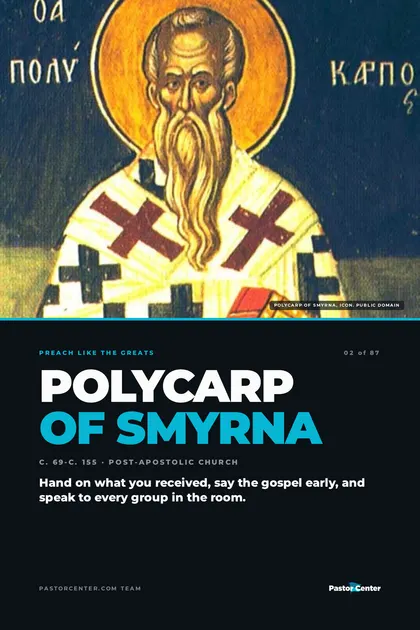
Polycarp was bishop of Smyrna in the generation after the apostles and a living link to the apostle John. No sermon of his survives, so we studied six texts that carry his voice: his letter to the church at Philippi, written to be read aloud, his answers at his trial, his prayer at the stake, and Irenaeus’s memory of his teaching. The shape is simple: warm praise, the gospel in the first lines, a word for every group in the church, and plain words under pressure.
Who Polycarp was
Irenaeus wrote that Polycarp was “instructed by apostles,” “conversed with many who had seen Christ,” and was appointed bishop of Smyrna by apostles in Asia. Ignatius of Antioch wrote him a personal letter on the way to his own death, and Polycarp collected Ignatius’s letters and sent them on to Philippi.
He visited Anicetus, bishop of Rome, and Irenaeus says he turned many back to the church there. He was martyred in Smyrna about 155 after telling the proconsul he had served Christ eighty-six years, and the crowd that demanded his death called him “the teacher of Asia, the father of the Christians.”
The shape of a Polycarp sermon
Polycarp didn’t try to be original. He wove the words of the apostles and of Jesus into almost every sentence and handed them on as received, not invented. Irenaeus remembered him seated, reporting what John and others “who had seen the Lord” had said.
His letter opens with warm praise for the hearers before any command, praising “the strong root of your faith.” Then, in the opening lines, he names the gospel: “by grace you are saved, not of works.”
From there he speaks to each group in the church in turn: wives, widows, deacons, young men, virgins and elders. He drives each duty home with the cross and the coming judgment, and he holds up named examples like Paul and Ignatius.
Under pressure he said very little. At his trial his answers were short and plain: a testimony of eighty-six years, a confession, “I am a Christian.” His last words, like his letter, end in prayer and blessing.
What made his preaching different
Scripture woven through
Nearly every line echoes the apostles or Jesus. He handed on what he had been given rather than building something new.
Every station addressed
Wives, widows, deacons, youth and elders each get a word, so no one in the church could hear the letter as meant for someone else.
Few plain words
Under threat he answered in short, steady sentences. The fewer words he used, the plainer each one became.
What others said
“[He] always taught the things which he had learned from the apostles”
— Irenaeus of Lyon, c. 180 (Against Heresies 3.3.4)
“an apostolic and prophetic teacher”
— The Church of Smyrna, c. 155 (Martyrdom of Polycarp 16)
What to take into your own pulpit
Don’t chase originality
Polycarp’s authority came from handing on what the apostles taught. Let Scripture carry more of your sentences than your own cleverness does.
Say the gospel early
He named grace in his first lines, before a single duty. Duties land differently when people have already heard what Christ has done.
Give every group a word
Look at who is actually in the room, and speak to each of them by name and station.
Those are the ideas. The guide turns them into ten steps you can follow this week, plus the sermons we studied and a fill-in outline in his shape.
Free PDF · Preach Like the Greats
Learn to preach like Polycarp.
This post is the overview. The guide has the research and the method.
- The 6 texts that carry his voice, studied start to finish
- Ten steps to preach the way he did
- His sermon outline, movement by movement
- A fill-in template for your own text, 9 pages
Common questions
What was Polycarp’s preaching style?
Plain, Scripture-soaked and pastoral. He wove the words of the apostles and Jesus into almost every sentence, named the gospel early, spoke to each group in the church in turn, and answered pressure in a few plain words.
How did Polycarp structure a sermon?
In his letter to the Philippians, warm praise for the hearers comes first, then the gospel of grace, then a word to each group in the church, driven home by the cross and the coming judgment, and it ends in prayer and blessing.
Do any of Polycarp’s sermons survive?
No. What survives is one letter written to be read aloud to the church at Philippi, the account of his death written by his own church, and Irenaeus’s memory of “the discourses which he made to people.”