How Clement of Rome Preached: Answering a Church Fight With Patience
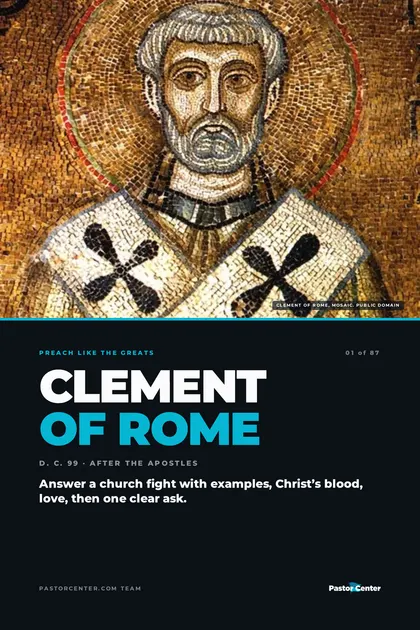
Clement of Rome led the church in Rome in the 90s, in the first generation after the apostles. He left no sermons, but his long letter to Corinth (c. 96) was written to be read aloud in worship and reads like a spoken exhortation from start to finish. We studied it in eight movements, with the anonymous homily called 2 Clement beside it for comparison. The shape: name the sickness, march through Scripture’s people, keep saying “let us,” look to Christ’s blood, and hold the one hard request until after a hymn to love.
Who Clement of Rome was
Irenaeus says Clement had known the apostles personally, and he lists him as the third bishop of Rome after Peter, following Linus and Anacletus. What survives from him is 1 Clement, a pastoral letter from the church in Rome to the church in Corinth. It runs 65 chapters, about twice the length of Hebrews, and closes with a long prayer that Benedict XVI called “the oldest prayer extant for political institutions.”
The letter didn’t stay in Corinth. Eusebius says it was “publicly used in a great many churches both in former times and in our own,” and the fifth-century Codex Alexandrinus bound it in with the New Testament. The so-called 2 Clement, often printed beside it, is the oldest surviving Christian sermon outside the New Testament, but it is an anonymous second-century homily, not his.
The shape of a Clement sermon
Clement answers a church fight with a slow, patient sermon instead of a quick ruling. He names the sickness early. In the opening movement, “Jealousy’s harvest,” the problem is jealousy, and he traces what it has wrecked from Cain onward.
Then he builds a roll call. He marches the hearers through Scripture’s people one by one, from Cain to Rahab to David, and sets recent and everyday examples beside them: Peter and Paul, soldiers in rank, the members of a body, even the phoenix. Creation shows up too, as a picture of God’s order. The heavens “obey Him in peace.”
He almost never lectures from above. Every few minutes he turns from “they” to “let us,” and he keeps pulling the room’s eyes back to Christ’s blood and sufferings. Sections often close with a doxology: “to whom be the glory.”
The concrete ask waits. He holds it for the last third of the letter, right after his hymn to love in “Love and the hard ask,” and then he closes with a great prayer built from the Psalms and the prophets.
What made his preaching different
Roll call proof
He lines up named Bible people, one after another, until the lesson can’t be missed. The examples do the arguing for him.
Let us, not you
He puts himself inside nearly every exhortation. “Let us forsake idle and vain thoughts” lands differently than “you must.”
Love before the ask
A hymn to love comes right before his hardest request, so the hearers meet his affection before they meet his correction.
What others said
“The Church in Rome dispatched a most powerful letter to the Corinthians”
— Irenaeus of Lyon, c. 180
“Of considerable length and of remarkable merit”
— Eusebius, Church History 3.16, c. 325
What to take into your own pulpit
Preach the conflict slowly
Clement didn’t open with a verdict. He named the sickness, then gave the room time to see it for themselves before he asked anything of them.
Stand with the people you’re correcting
“Let us” keeps the preacher under the same word as the hearers. Correction goes down easier from someone who includes himself.
Earn the hard ask
He spoke about love before he made his one difficult request. Put the hardest word where the room is most ready to hear it.
Those are the ideas. The guide turns them into ten steps you can follow this week, plus the sermons we studied and a fill-in outline in his shape.
Free PDF · Preach Like the Greats
Learn to preach like Clement of Rome.
This post is the overview. The guide has the research and the method.
- The texts we studied: his letter, read movement by movement
- Ten steps to preach the way he did
- His sermon outline, movement by movement
- A fill-in template for your own text, 9 pages
Common questions
What was Clement of Rome’s preaching style?
Pastoral and patient. He spoke straight to the room as “brethren” and “dearly beloved,” used “let us” instead of “you must,” lined up named Bible people as proof, and kept turning the hearers’ eyes to Christ’s blood.
How did Clement of Rome structure a sermon?
In his letter to Corinth he names the problem early, works through examples from Scripture and everyday life, seals sections with doxologies, and holds his one concrete request until the last third, right after a hymn to love.
Did Clement of Rome write 2 Clement?
No. 2 Clement is often printed beside his letter and is the oldest surviving Christian sermon outside the New Testament, but it is an anonymous homily from the second century.