How C.L. Franklin Preached: Head First, Heart Second
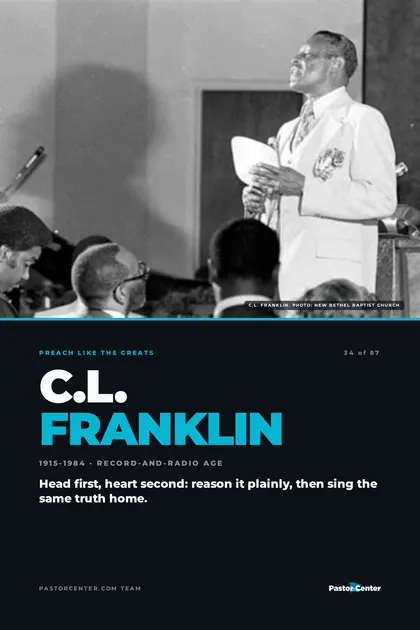
C.L. Franklin’s sermons were sold in record stores across the country, and his Sunday radio broadcasts made him the best-known Black preacher of his generation. We studied seven of his recorded sermons, including his 1953 live recording of “The Eagle Stirreth Her Nest.” Each one preaches the head first and the heart second: plain, reasoned teaching, then a whoop that sings the same truth home and narrows it to one phrase.
Who C.L. Franklin was
Franklin came out of the Mississippi Delta, pastored in Memphis and Buffalo, and became pastor of New Bethel Baptist Church in Detroit in 1946. He recorded more than 70 albums of sermons, first for Joe Von Battle’s JVB label in Detroit and later on Chess. At his 1950s peak he commanded up to $4,000 per appearance.
In 1953 he became the first preacher to join the gospel touring circuit. His radio sermon was so widely heard that, by CNN’s account, pastors moved their Sunday evening services to avoid competing with it. His 1953 recording of “The Eagle Stirreth Her Nest” was added to the Library of Congress National Recording Registry in its 2010 registry, announced in 2011.
The shape of a Franklin sermon
Franklin’s sermons open in conversational prose, not chant. He states the text’s big claim or image early, then teaches the background before he applies anything: the history behind the passage, or in “The Prodigal Son,” the three lost things.
Then he retells the Bible story in order, stopping to teach as he goes. Along the way he calls for the congregation’s response mid-sermon (“I wish somebody would pray with me”), and he often applies the text to his people’s history and present struggle.
At the story’s emotional turn, he moves into the whoop, a chanted, musical delivery. But he doesn’t leave the lesson behind. He restates it inside the climax. In “The Eagle Stirreth Her Nest,” the full whoop restates that God stirs history as the organ fades.
As the chant rises, the sermon narrows. In “Pressing On,” the body builds a cluster of images, then the celebration drops all of them but one and hammers “running the race” home.
What made his preaching different
Reason first
Plain, reasoned speech opens every sermon. He teaches the text before he tries to move anyone.
The whoop
At the emotional turn, a chanted delivery restates the lesson. The whoop serves the teaching instead of replacing it.
One phrase home
The chant narrows to one line people carry. By the end, the whole sermon fits in a single phrase.
What others said
“When it comes to the world of black preaching, all roads go back to C.L. Franklin.”
— Jonathan L. Walton, Harvard
“C.L. Franklin, the most imitated soul preacher in history, was a combination of soul and science and substance and sweetness.”
— Jesse Jackson, foreword to Give Me This Mountain, 1989
What to take into your own pulpit
Earn the celebration
Franklin taught plainly before he ever moved into the whoop. The emotion landed because the reasoning had already done its work.
Keep the lesson in the climax
His high point restated the truth instead of drifting away from it. Whatever your delivery, the peak should say the point again.
Narrow to one phrase
He built a cluster of images, then dropped all but one. Decide which line you want people to carry out, and land there.
Those are the ideas. The guide turns them into ten steps you can follow this week, plus the sermons we studied and a fill-in outline in his shape.
Free PDF · Preach Like the Greats
Learn to preach like C.L. Franklin.
This post is the overview. The guide has the research and the method.
- The 7 sermons we studied, start to finish
- Ten steps to preach the way he did
- His sermon outline, movement by movement
- A fill-in template for your own text, 9 pages
Common questions
What was C.L. Franklin’s preaching style?
Reasoned and musical at once. He opened in plain, conversational teaching, retold the Bible story in order, then moved into the whoop, a chanted delivery that restated the lesson and narrowed it to one phrase.
How did C.L. Franklin structure a sermon?
He stated the text’s big claim early, taught the background, retold the story while stopping to teach, applied it to his people’s history and struggle, then shifted into the whoop at the story’s emotional turn and restated the lesson inside the climax.
What is C.L. Franklin’s most famous sermon?
“The Eagle Stirreth Her Nest,” on Deuteronomy 32:11-12. His 1953 live recording at New Bethel was added to the Library of Congress National Recording Registry.