How Derek Prince Preached: Count the Points, Chain the Scriptures
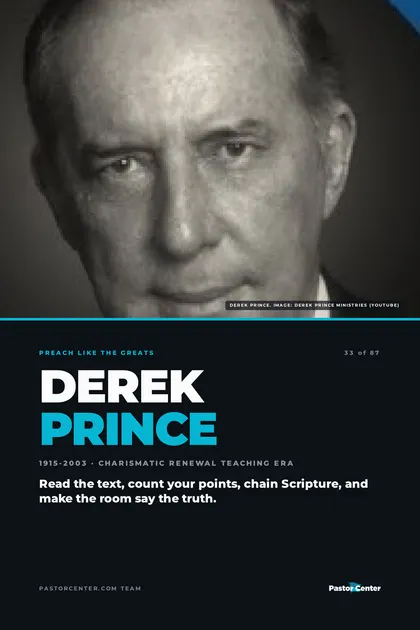
Derek Prince was a Cambridge-trained philosopher who met Christ in an army barracks and spent six decades teaching the Bible on several continents. We studied seven of his messages, all from his teaching series. Under every one sits the same shape: a frame announced early, points counted out loud, passage after passage read aloud, and then a personal turn, often with a line the whole room says back to him.
Who Derek Prince was
Prince was born in Bangalore to British parents and studied Greek and Latin at Eton and King’s College, Cambridge, where he held a fellowship in ancient and modern philosophy. He was converted in 1941 while serving in the British Army. He later served as a missionary educator in Kenya from 1957 and moved to the United States in 1963.
Derek Prince Publications opened in Fort Lauderdale in May 1971 and later became Derek Prince Ministries. His daily radio program, Today with Derek Prince, carried his teaching worldwide, and many of his roughly 600 audio and 100 video teachings have been translated into more than 100 languages. He died at his home in Jerusalem in 2003.
The shape of a Prince sermon
Prince usually taught in series, so a message often opens with a recap of the last session. Then he announced the text or theme early and laid out his frame. One message promises to show “who He is, where He is, and how He got there” in its first sentences.
From there he counted out loud: “Number one… number two.” Every message we studied has numbered points, steps or lists, and each point rests on a fresh passage read aloud. He chained Scripture to Scripture, often eight to fifteen passages in one message, and stopped to define key words like “sanctify.”
Then he made it personal. Stories from Kenya, Cambridge, the army and his ministry trips served as proof that the teaching worked. And in some messages he had the room say a line aloud, or pray after him, until they owned it.
He liked to compress a whole doctrine into one portable sentence, such as “The cross was the place of exchange.” The cross comes up in every message we studied, and he usually ended on one summary sentence instead of a recap.
What made his preaching different
Count out loud
He numbered his points, steps and portraits as he went, so the room always knew where it was.
Scripture chains
Each point rested on a fresh passage, read aloud, often with its key words defined.
Say it after me
He had the room repeat the key line, first as “we,” then as “I,” until it became their own confession.
What others said
“Courage to speak on Bible topics that most preachers were afraid to think about, let alone teach.”
— John Hagee, at Prince’s memorial (CBN, 2003)
“The same Derek Prince that I lived with at home in Jerusalem was the same man you saw in the pulpit.”
— Barry Segal, at Prince’s memorial (CBN, 2003)
What to take into your own pulpit
Tell them the frame
Prince said up front how many things he would cover. A visible structure lets people follow even dense teaching.
Let Scripture prove Scripture
He built each point on a passage read aloud. When the Bible carries the argument, the authority isn’t yours.
Give them a sentence to keep
Compress the doctrine into one line, then let the room say it. People remember what they have spoken.
Those are the ideas. The guide turns them into ten steps you can follow this week, plus the sermons we studied and a fill-in outline in his shape.
Free PDF · Preach Like the Greats
Learn to preach like Derek Prince.
This post is the overview. The guide has the research and the method.
- The 7 sermons we studied, start to finish
- Ten steps to preach the way he did
- His sermon outline, movement by movement
- A fill-in template for your own text, 9 pages
Common questions
What was Derek Prince’s preaching style?
Ordered, Scripture-heavy and personal. He taught like a classics scholar, counting his points out loud and chaining many passages together, then pleaded like an evangelist with personal stories and lines the room said back.
How did Derek Prince structure a message?
Often a recap of the last session, then a text or theme and a frame announced early, numbered points each resting on a passage read aloud, personal stories as proof, and a close on one summary sentence.
What did Derek Prince mean by “the place of exchange”?
It was his one-line summary of the cross: “The cross was the place of exchange.” He used sentences like this to compress a whole doctrine into something his hearers could carry and repeat.