How Leonard Ravenhill Preached: Hold the Church to the New Testament, Then Call It to Die
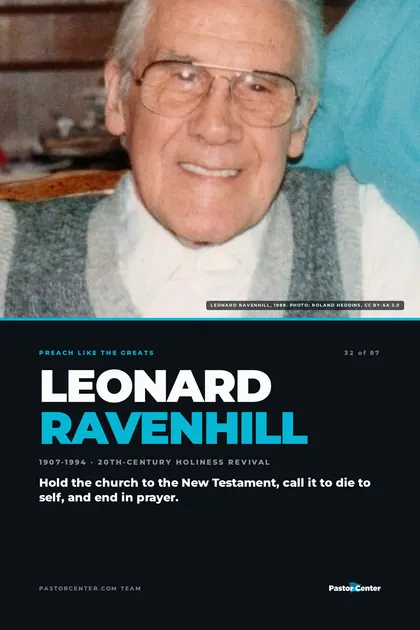
Leonard Ravenhill preached to large wartime crowds in Britain and spent his later decades in the United States calling the church to prayer and revival. We studied six of his sermons, the dated ones from the 1980s to 1991. He preached to the conscience of the church, not the curiosity of the crowd: hold it to the New Testament, call it to die to self, and end in prayer.
Who Leonard Ravenhill was
Ravenhill was born in Leeds in 1907. He entered Cliff College under Samuel Chadwick in 1930 and travelled on foot as one of its evangelistic “trekkers.” He worked as an evangelist and church planter with the Calvary Holiness Church, and many converts from his wartime meetings went into ministry and missions.
Why Revival Tarries, first published in 1959, has sold more than a million copies. In America he taught at Bethany College of Missions and Last Days Ministries, mentored Keith Green, and influenced preachers such as David Wilkerson and Paul Washer.
The shape of a Ravenhill sermon
He reads the anchor text almost immediately, then opens it with a piece of ancient background or a word study: the rites of the Feast of Tabernacles, Laodicea’s banks and eye salve, the meaning of “without wax.” The setting comes first, and then it turns to search the hearer.
The body usually hangs on one hook: a repeated phrase, some alliteration, or a process, like the journey of a grain of wheat. In “Laodicean Church” he opens on “majesty, mystery, misery.”
The proof comes from revival history. Wesley, Brainerd, Luther, Booth and Studd stand in as witnesses, alongside his own life and a hymn stanza quoted as a climax. Short, quotable rebukes of the church and the pulpit land between the stories, and dry wit and self-mockery keep the room breathing between hard blows.
Late in the sermon he usually turns to the cross and death to self, sometimes to the judgment seat of Christ. Most messages end in prayer, kneeling or a hymn rather than a count of decisions.
What made his preaching different
Background, then rebuke
An ancient setting or word study opens the text first. Then the same text turns and searches the hearer.
Saints as witnesses
Wesley, Brainerd, Booth and Studd prove every point. The saints of revival history are his evidence that the New Testament standard can be lived.
Come to die
His messages end in prayer and surrender, not a count of decisions. The goal is a hearer alone with God, not a show of hands.
What others said
“He lived as one who dwelt in the shadow of the Almighty and he preached as one sent from God.”
— Paul Washer
“Prayer was his life and his preaching reflected the fact that he had been alone with God.”
— David Ravenhill, his son, 2011
What to take into your own pulpit
Open the world of the text
A piece of real background can make an old text feel urgent. Let the setting do some of the work before you apply it.
Call witnesses from church history
Stories of people who actually lived the standard make it harder to dismiss as theory.
End with people and God, not a tally
Ravenhill closed in prayer and surrender. Consider ending some sermons by sending people to meet with God rather than to respond to you.
Those are the ideas. The guide turns them into ten steps you can follow this week, plus the sermons we studied and a fill-in outline in his shape.
Free PDF · Preach Like the Greats
Learn to preach like Leonard Ravenhill.
This post is the overview. The guide has the research and the method.
- The 6 sermons we studied, start to finish
- Ten steps to preach the way he did
- His sermon outline, movement by movement
- A fill-in template for your own text, 9 pages
Common questions
What was Leonard Ravenhill’s preaching style?
Searching and urgent, with dry wit in between. He opened the text with ancient background, held the church against the New Testament and the saints of revival history, and called hearers to die to self and pray.
How did Leonard Ravenhill structure a sermon?
He read the text early, opened it with background or a word study, carried the body on one repeated hook, proved it with revival heroes, his own life and hymns, turned late to the cross, and ended in prayer.
What is Leonard Ravenhill best known for?
His book Why Revival Tarries, first published in 1959, which has sold more than a million copies, and his lifelong call for the church to pray for revival.