How John Calvin Preached: Straight Through the Book, a Few Verses at a Time
John Calvin preached in Geneva at the height of the Reformation, in a city crowded with French refugees, where preaching went to every day in 1549. We studied eight of his sermons, on Galatians, Ephesians, Micah, John and the Passion, mostly from the 1550s. The shape repeats: a short doorway, two to five verses, each phrase explained and turned on “us” at once, and an ending where the whole congregation is brought low before God.
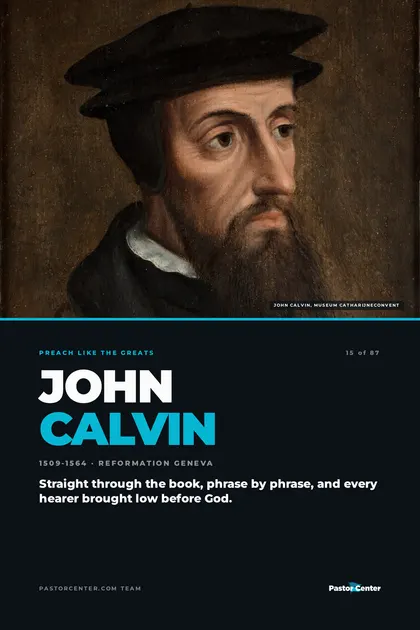
Who John Calvin was
Calvin preached in Geneva from 1541 to 1564, twice on Sundays and every weekday on alternate weeks: the New Testament on Sunday mornings, the Old Testament on weekdays. He took his Hebrew and Greek texts into the pulpit and preached from them without notes.
In 1549 the refugee deacons’ fund hired the stenographer Denis Raguenier to take his sermons down in shorthand. More than 2,000 were recorded and about 1,700 survive. His method trained a generation of Reformed preachers across Europe.
The shape of a Calvin sermon
Calvin preached lectio continua: straight through whole books, two to five verses a sermon. The opening is short. Usually it’s a recap of last time or one governing truth that frames the passage, then he’s into the text.
From there he goes phrase by phrase, in order. He explains each phrase plainly and turns it on the hearers right away, before moving to the next. Application isn’t saved for the end. It’s woven through the whole sermon.
Along the way he usually answers an objection (“someone will say…”) and names an error or a local sin. In his sermon on Micah 6, preached in January 1551, the landing comes down on Geneva’s merchants.
Then the ending. He summarizes and presses, and the congregation is brought to its knees before “the majesty of our good God,” confessing its faults. Often he prays for “all nations.” The repetition does the work: explain, apply, humble.
What made his preaching different
Lectio continua
He preached straight through whole books, a few verses at a time. The next text was never chosen for the occasion; it was simply the next few verses.
Explain, then “us”
Each phrase is explained and turned on the hearers at once. He says “us,” not “you,” so the preacher is under the text too.
Humbled at the end
Every sermon closes in confession before God. The congregation leaves humbled, not just informed.
What others said
“Calvin filled the mind of the hearers with as many weighty sentiments as he uttered words.”
— Theodore Beza, Life of Calvin
“It is expedient that those who are newly starting in this charge observe his way of teaching.”
— Conrad Badius, his printer, 1557
What to take into your own pulpit
Let the next verses choose the sermon
Preaching straight through a book keeps you from picking only the texts you like, and it teaches the church to read the Bible whole.
Apply as you go
Calvin didn’t save application for the last five minutes. Each phrase was explained and pressed on the room before he moved on.
End on your knees
His sermons didn’t finish with a challenge. They finished with the whole church, preacher included, humbled before God.
Those are the ideas. The guide turns them into ten steps you can follow this week, plus the sermons we studied and a fill-in outline in his shape.
Free PDF · Preach Like the Greats
Learn to preach like John Calvin.
This post is the overview. The guide has the research and the method.
- The 8 sermons we studied, start to finish
- Ten steps to preach the way he did
- His sermon outline, movement by movement
- A fill-in template for your own text, 9 pages
Common questions
What was John Calvin’s preaching style?
Plain, steady expository preaching. He worked through whole books a few verses at a time, without notes, explained each phrase and applied it to “us” immediately, and closed by bringing the congregation to confession before God.
How did John Calvin structure a sermon?
A short doorway, usually a recap or one governing truth, then phrase-by-phrase exposition of two to five verses with application woven in, objections answered along the way, and a closing summary that ends in prayer.
How many of Calvin’s sermons survive?
From 1549 a stenographer took them down in shorthand. More than 2,000 were recorded, and about 1,700 survive.