How Martin Luther Preached: The History, Then Its Use, Then Christ “For You”
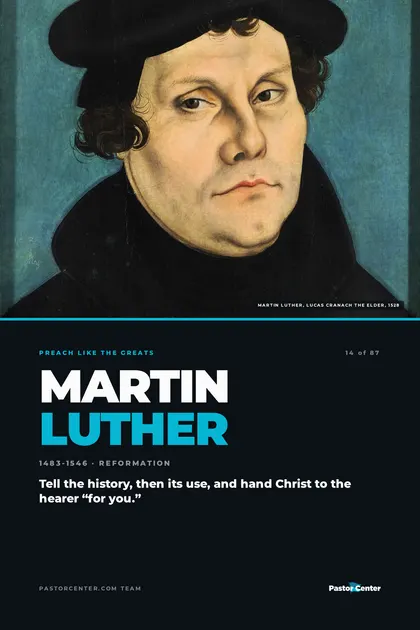
Martin Luther preached about 4,000 times, sometimes four times in one day, and about 2,300 of those sermons survive. We studied thirteen of them, from his church postil of the early 1520s to a pamphlet printed in 1533. His method fits in a phrase he used himself: “the history, then its use.” He told the story plainly, cleared away the false readings, handed Christ to the hearer “for you,” and then simply stopped.
Who Martin Luther was
Most years Luther preached more than 100 times, and nearly 200 times in 1528, despite illness. His sermons survive through shorthand note-takers like Georg Rörer and through his edited postils, model sermons written for other preachers to use.
His preaching changed the shape of worship. His eight Invocavit sermons of March 1522 calmed a riot-torn Wittenberg, and an official of the elector reported that 25,000 people came to hear him preach at Zwickau that same year. He made preaching in plain German, on the text of Scripture, the center of Protestant worship.
The shape of a Luther sermon
Luther often opened by retelling the story in the text. In “Of Christ’s Resurrection” he says so outright: first the text of this narrative, afterwards its benefits. The history came first, told plainly, so ordinary people could follow it.
Then he turned to its use. Somewhere in the sermon he almost always handed Christ to the hearer in the second person: not just that Christ was born or rose, but that he did it “for you.” Comfort usually followed close behind, and faith was often tested against feeling.
Polemic shows up in nearly every sermon, but it is sized to the text. He names the wrong reading, whether a monk’s or a self-righteous listener’s, before giving the right one. Many sermons also move faith outward into love and fruit for the neighbor, sometimes in numbered points.
What he didn’t do was land the plane with a grand conclusion. He just stopped: “This is sufficient on today’s text.”
What made his preaching different
The history, then its use
He told the story plainly first, then applied it. The narrative earned the right to the application.
Clear the false readings
He named the wrong reading before the right one, clearing away false interpretations so the true one could stand on its own.
“For you,” then stop
He handed Christ to the hearer with “for you,” and then simply ended. No summary, no final flourish.
What others said
“To preach plain and simply is a great art.”
— Luther, Table Talk
“I have an eye to the multitude of young people, children, and servants.”
— Martin Luther, Table Talk
What to take into your own pulpit
Tell the story before you use it
People can’t apply a text they haven’t followed. Retell the history plainly, then ask what it’s for.
Make the gospel second person
It isn’t enough to say Christ died and rose. Luther handed it to the listener directly: this was done for you.
Stop when the text is done
Luther didn’t build a grand finale. When he had said what the text said, he said so and sat down.
Those are the ideas. The guide turns them into ten steps you can follow this week, plus the sermons we studied and a fill-in outline in his shape.
Free PDF · Preach Like the Greats
Learn to preach like Martin Luther.
This post is the overview. The guide has the research and the method.
- The 13 sermons we studied, start to finish
- Ten steps to preach the way he did
- His sermon outline, movement by movement
- A fill-in template for your own text, 10 pages
Common questions
What was Martin Luther’s preaching style?
Plain, direct and in the language of ordinary people. He retold the story in the text, cleared away false readings, handed Christ to the hearer “for you,” and moved faith outward into love for the neighbor.
How did Martin Luther structure a sermon?
The history, then its use. He usually started with the narrative, turned to what it means for the hearer, named the wrong reading along the way, and ended without a formal conclusion: “This is sufficient on today’s text.”
How many sermons did Martin Luther preach?
About 4,000, sometimes four in one day. Roughly 2,300 survive through note-takers and his published postils.