How John Knox Preached: Half an Hour of Calm, Then Fire
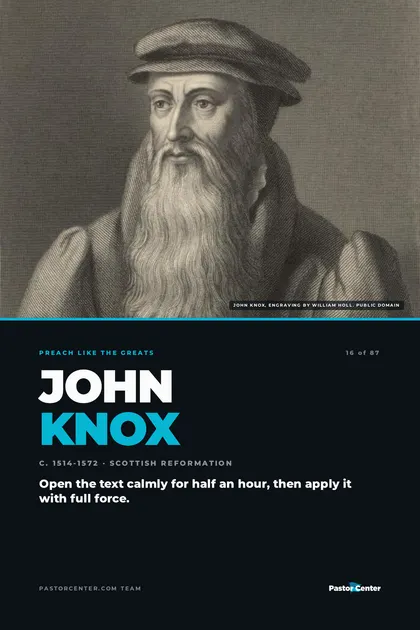
John Knox preached hundreds of sermons in England, Geneva and Scotland, but published only two. We studied seven, from his first sermon at St Andrews in 1547 to his Daniel series there in 1571 and 1572. The shape holds: a calm, plain opening of the text, proof from Old Testament history, and then application so strong a student couldn’t hold his pen.
Who John Knox was
Knox was born at Haddington around 1514 and trained for the priesthood. In 1547 John Rough charged him publicly in the parish kirk of St Andrews to take up the work of preaching. Knox was so reluctant that he wept and withdrew to his chamber for days. From 1559 he was the preacher of Edinburgh at St Giles’.
With other ministers he drafted the Scots Confession and the First Book of Discipline (1560), which set up a weekly “exercise” where men expounded a text and the ministers and elders judged their handling of it, a training school for preachers in every larger town. His order of worship became the Kirk’s Book of Common Order (1565).
The shape of a Knox sermon
Knox usually opened by saying why this text mattered, or by setting it in its history. Early on he announced his heads or his proposition, so the room knew what he meant to prove.
Then he walked the text, often verse by verse or phrase by phrase, and kept it calm. James Melville, a student who took notes as Knox preached through Daniel, said he was “moderat” in the opening of his text for half an hour.
He read the Bible as one story, so every point came with an Old Testament precedent: Saul, Nadab and Abihu, Jacob, Nebuchadnezzar. And he spoke straight to the people in front of him: “dear sisters,” “Edinburgh,” “O Scotland.”
The heat came in application, weighted to the back half. But his comfort was as strong as his warnings. The tempted, he said, should read their temptations as proof that God had begun a work in them. He often closed in prayer or benediction.
What made his preaching different
Calm, then fire
Plain exposition first; the heat comes in application. The calm opening earned him the right to press hard at the end.
Bible history as proof
Every point was proved from an Old Testament story, because he read Scripture as one history of God dealing with his people.
Speaks to them by name
He spoke to “dear sisters,” “Edinburgh” and “Scotland” by name, with no vague “some of you.”
What others said
“He made me so to grue and tremble that I could not hold a pen to write.”
— James Melville, student at St Andrews, 1571
“Ere he haid done with his sermont, he was sa active and vigorus that he was lyk to ding that pulpit in blads and flie out of it.”
— James Melville, on Knox in his last year, 1572
What to take into your own pulpit
Earn the heat
Knox spent the first half calmly opening the text. Application lands with more force when people have already seen it in the passage.
Let history prove the point
An Old Testament story can show what a doctrine looks like when real people obey or ignore it.
Comfort as hard as you warn
His sermons pressed hard, but they also told the afflicted and tempted that God had not let go of them.
Those are the ideas. The guide turns them into ten steps you can follow this week, plus the sermons we studied and a fill-in outline in his shape.
Free PDF · Preach Like the Greats
Learn to preach like John Knox.
This post is the overview. The guide has the research and the method.
- The 7 sermons we studied, start to finish
- Ten steps to preach the way he did
- His sermon outline, movement by movement
- A fill-in template for your own text, 9 pages
Common questions
What was John Knox’s preaching style?
Calm exposition followed by forceful application. He opened the text plainly, proved his points from Old Testament history, spoke to his hearers by name and offered strong comfort alongside strong warning.
How did John Knox structure a sermon?
He usually said why the text mattered, announced his heads or proposition early, walked the text phrase by phrase, and weighted application to the back half before closing in prayer or benediction.
How many of John Knox’s sermons were published?
Only two, out of hundreds he preached. Much of what we know of the rest comes from his own summaries and from eyewitnesses like James Melville.