How Samuel Rutherford Preached: Every Phrase a Window on Christ
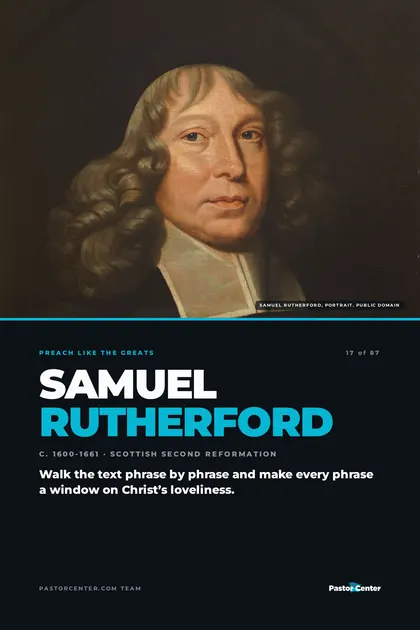
Samuel Rutherford preached to a scattered rural parish in Galloway and later to Parliament in London. We studied nine of his sermons, most from Scottish communion seasons in the 1630s and 1640s. The shape is consistent: walk the text phrase by phrase, draw a plain doctrine from each phrase, and make every one a window on the loveliness of Christ.
Who Samuel Rutherford was
Rutherford was born around 1600 at Nisbet in the Borders, took his MA at Edinburgh in 1621, and in 1627 became minister of Anwoth, by the Solway in Galloway. By his own count he gave Anwoth “nine years’ preaching,” and most of his surviving sermons exist only because hearers took them down at communion seasons in 1630, 1634 and 1637.
He became Professor of Divinity at St Andrews in 1639 and Principal of St Mary’s College in 1647, sat as a Scottish commissioner at the Westminster Assembly, and preached several times before Parliament during his four years in London. His Letters, first printed in 1664 and gathered into 365 letters in Andrew Bonar’s edition, became a devotional classic.
The shape of a Rutherford sermon
He goes straight into the text and its setting, with no warm-up story. Early on he usually announces how he will divide it: “in the words there be…”
Then he walks the text phrase by phrase and draws a doctrine from each. In “The weeping Mary at the sepulchre,” Peter and John run, Mary stays, and every detail becomes its own lesson. Often he labels the parts plainly as “Doctrine” and “Use.”
Christ isn’t a late turn in these sermons. He is the main subject from the start: the Bridegroom, the Host who “bears all the expense,” the King on the white horse. Bridal language from the Song of Songs often carries the love between Christ and the soul.
Along the way he voices objections in the hearer’s own words (“Ye will say…”) and answers them, and in the last third he often stops to comfort weak or doubting believers. He usually ends on a one-line prayer or doxology rather than a long appeal.
What made his preaching different
Christ on high
Every text becomes a window on Christ’s loveliness. Whatever the passage, the sermon is really about a person.
Phrase by phrase
He drew a plain doctrine from nearly every word of the text and pressed each one home with “ye” and “O!”
Farm and market images
Horses that stumble, burgess tickets, bairns at a locked door and a flagon of wine carry the theology. His hearers wrote the images down because they couldn’t forget them.
What others said
“One of the most moving and affectionate preachers in his time, or perhaps in any age of the Church.”
— John Howie, Scots Worthies (1775)
“He was always praying, always preaching, always visiting the sick, always catechising, always writing and studying.”
— Said of him at Anwoth, recorded in Bonar’s edition of the Letters, 1891
What to take into your own pulpit
Make Christ the subject, not the ending
Rutherford didn’t save Jesus for the last five minutes. Ask how each part of the text shows something of Christ himself.
Slow down in the text
Single phrases can carry whole doctrines. Reading slowly often gives you more to preach, not less.
Borrow images from your people’s week
His pictures came from farms and markets his hearers knew. Look for yours in the places your people spend their days.
Those are the ideas. The guide turns them into ten steps you can follow this week, plus the sermons we studied and a fill-in outline in his shape.
Free PDF · Preach Like the Greats
Learn to preach like Samuel Rutherford.
This post is the overview. The guide has the research and the method.
- The 9 sermons we studied, start to finish
- Ten steps to preach the way he did
- His sermon outline, movement by movement
- A fill-in template for your own text, 9 pages
Common questions
What was Samuel Rutherford’s preaching style?
Warm, devotional and doctrinal at once. He walked the text phrase by phrase, drew a plain doctrine from each phrase, kept Christ at the center, and carried the theology with homely images from Scottish farm and market life.
How did Samuel Rutherford structure a sermon?
He opened straight into the text and its setting, announced his division early, worked through the words phrase by phrase with doctrines and uses, answered objections, comforted doubting believers, and usually closed with a short prayer or doxology.
Why did Rutherford’s sermons survive?
Most of them survive because hearers took them down at communion seasons in 1630, 1634 and 1637.