How Richard Baxter Preached: Reason and Conscience at Once
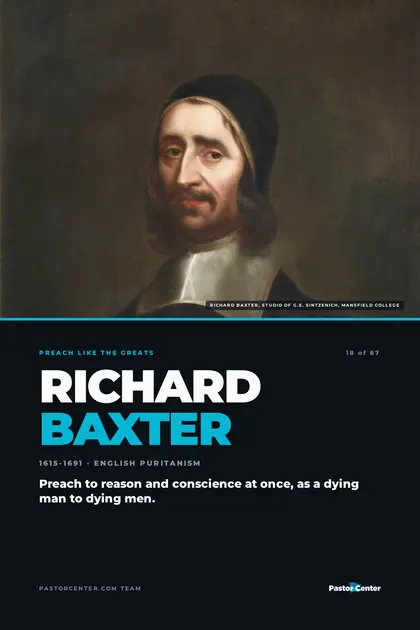
Richard Baxter preached to a weaving town in Worcestershire with the urgency of a dying man speaking to dying men. We studied seven of his sermons, published between 1650 and 1660. Under every one sits the same shape: a text opened briefly, one plain doctrine proved from Scripture and common sense, and then a direct turn on “you” that answers each excuse before it can be spoken.
Who Richard Baxter was
Baxter served the parish of Kidderminster from 1641 to 1660, with an interruption as an army chaplain during the Civil War. He was largely self-taught, never attended university and battled illness all his life, yet he became the most widely read practical writer of his century.
The Kidderminster church seated about a thousand, and five galleries had to be added for the crowds. With an assistant he catechized about fourteen families a week, aiming to reach the parish’s roughly 800 families each year. A Call to the Unconverted sold about 20,000 copies in a little over a year by his own count, and The Reformed Pastor (1656) is still a standard handbook for pastoral ministry.
The shape of a Baxter sermon
Baxter read his text and opened it briefly, then stated a doctrine as one plain proposition, or a short chain of them. Often he announced numbered heads up front and defined his terms before pressing them, so no one could slip out on a word they didn’t understand.
Then he proved the doctrine, from Scripture and from common sense. This was preaching aimed at the mind. He wanted the hearer to agree that the thing was true before he asked them to do anything about it.
The application is where the sermon turns. He spoke straight to “you,” named the excuses and objections people would raise, and answered them one by one. He gave marks for self-examination, set heaven and hell both in view, and often closed with directions for what to do now.
In A Call to the Unconverted, one verse, Ezekiel 33:11, yields several doctrines, from “turn or die” to God pleading “why will ye die?” The sermon ends with plain directions: pray, go to your minister, leave sinful company, turn now.
What made his preaching different
Reason and conscience
He stated a plain doctrine, proved it, and then turned it on “you,” so the same sermon reached the reason and the conscience.
Every excuse answered
He named objections and excuses before his hearers could speak them, and answered each one.
Into the homes
He didn’t let the pulpit work alone. Personal catechizing in people’s homes followed the sermon.
What others said
“In his sermons there was a rare union of arguments and motives, to convince the mind and gain the heart.”
— William Bates, 1692
“the most outstanding pastor, evangelist, and writer on practical and devotional themes that Puritanism produced.”
— J.I. Packer, quoted by The Gospel Coalition, 2015
What to take into your own pulpit
Win the mind, then press the heart
Baxter proved his point before he applied it. Hearers who agree it’s true are more ready to act on it.
Answer the excuse out loud
Everyone in the room has a reason to put it off. Say it for them, and then answer it.
Follow the sermon home
For Baxter the sermon was the start of the conversation, not the end. Personal care carried it into the week.
Those are the ideas. The guide turns them into ten steps you can follow this week, plus the sermons we studied and a fill-in outline in his shape.
Free PDF · Preach Like the Greats
Learn to preach like Richard Baxter.
This post is the overview. The guide has the research and the method.
- The 7 sermons we studied, start to finish
- Ten steps to preach the way he did
- His sermon outline, movement by movement
- A fill-in template for your own text, 9 pages
Common questions
What was Richard Baxter’s preaching style?
Plain, reasoned and urgent. He stated a clear doctrine, proved it from Scripture and common sense, then turned directly on the hearer with “you,” answering their excuses and keeping heaven and hell in view.
How did Richard Baxter structure a sermon?
Text read and opened briefly, a doctrine stated as one plain proposition, often numbered heads and defined terms, proof, and then application: objections answered, marks for self-examination, and directions for what to do now.
What is The Reformed Pastor?
Baxter’s 1656 book, written for the ministers of Worcester from Acts 20:28. It is still a standard handbook for pastoral ministry.