How Matthew Henry Preached: Open the Text, Then Carry It Home
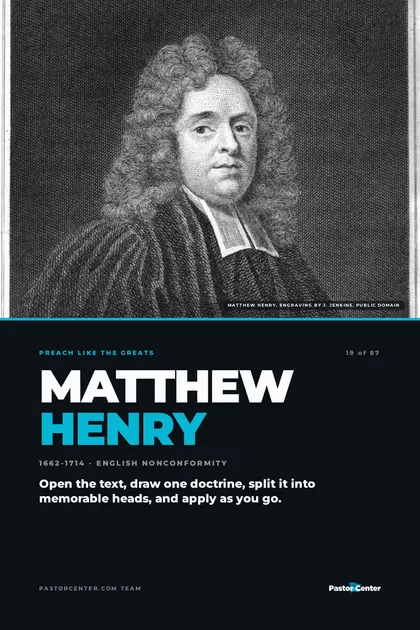
Matthew Henry is best known for his Commentary, but he was a pastor first, and the same voice fills his sermons. We studied nine of them, preached or published between 1705 and 1713. Every one opens the text before drawing anything from it, then draws one plain doctrine, splits it into heads people can carry home, and applies it as he goes.
Who Matthew Henry was
Henry was born at Broad Oak on the Flintshire-Shropshire border. He was trained by his father, Philip Henry, and at Thomas Doolittle’s academy, and he studied law at Gray’s Inn before turning to the ministry. He pastored a Presbyterian congregation in Chester from 1687 to 1712. In about 25 years it grew to more than 350 members and built a new meeting house in 1699. He turned down repeated calls to London and Manchester before moving to Mare Street, Hackney, in May 1712, where the church had fewer than a hundred members.
He began his Exposition of the Old and New Testaments in November 1704 and reached the end of Acts before he died at Nantwich on 22 June 1714. Thirteen Nonconformist ministers finished Romans to Revelation, partly from notes taken by his hearers. Charles Wesley built the hymn “A charge to keep I have” on his comment on Leviticus 8:35.
The shape of a Henry sermon
Every sermon we studied opens the text in its setting before any doctrine appears. He reads the passage as a scene, glosses its words and sometimes lays a parallel Gospel beside it. In “Christ’s Favour to Little Children,” he tells the scene slowly before he says what it teaches.
Then he states one plain doctrine and splits it into numbered heads, often with numbered sub-heads. The heads are built to be remembered: a pair like hope and fear, a controlling image like sin as a debt, or a run of alliteration like “Power, Providence, Pity, Promise.”
Scripture proves Scripture in nearly every paragraph. And he doesn’t save application for the end. The “uses” usually come after each head, pressed with “Let us…” and aimed at named groups in the room: the young, parents, the rich, ministers, mourners.
His funeral sermons follow the same plan. The character of the person who died comes inside or after the doctrine, not at the start. Most of his sermons end on a Scripture promise or phrase.
What made his preaching different
Text as a scene
He opens the passage before he draws anything from it. The sermon is found inside the text, read as a scene.
Memorable heads
His heads come in pairs, numbers and alliteration that hearers can carry home. In “Hope and Fear Balanced,” the whole sermon rests on one pair.
Uses as he goes
Each head closes with “Let us…” aimed at named groups. Application isn’t a final section. It runs all the way through.
What others said
“He seemingly exhausts the subject without exhausting the reader.”
— J. B. Williams, editor of Henry’s Miscellaneous Works, 1830
“Strange readiness, and fertility of invention.”
— John Reynolds, funeral sermon for Henry at Nantwich, 1714
What to take into your own pulpit
Find the sermon inside the text
Henry opened the passage as a scene before he said what it meant. The doctrine came out of the text, not the other way around.
Give people handles
A pair, an image or a run of alliteration makes a sermon portable. He built his heads so hearers could carry them home.
Apply as you go, and name who you mean
He didn’t wait for the end to apply. He pressed each point on the young, the parents, the rich or the grieving by name.
Those are the ideas. The guide turns them into ten steps you can follow this week, plus the sermons we studied and a fill-in outline in his shape.
Free PDF · Preach Like the Greats
Learn to preach like Matthew Henry.
This post is the overview. The guide has the research and the method.
- The 9 sermons we studied, start to finish
- Ten steps to preach the way he did
- His sermon outline, movement by movement
- A fill-in template for your own text, 9 pages
Common questions
What was Matthew Henry’s preaching style?
Expository, plain and pastoral. He opened the text as a scene, drew one plain doctrine, divided it into memorable heads proved by Scripture, and applied each head to named groups in the room.
How did Matthew Henry structure a sermon?
Text opened in its setting, one plain doctrine, numbered heads with numbered sub-heads, and “uses” after each head or from about the middle on. He usually ended on a Scripture promise or phrase.
Did Matthew Henry finish his Commentary?
No. He reached the end of Acts before he died in 1714. Thirteen Nonconformist ministers finished Romans to Revelation, partly from notes his hearers had taken.