How Tim Keller Preached: Three Points That Quietly Tell the Gospel
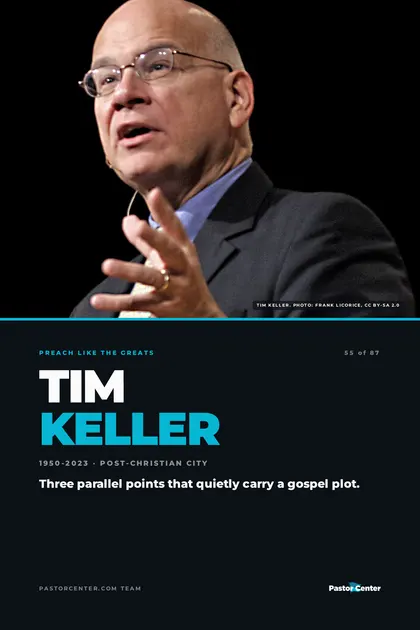
Tim Keller preached to skeptics and believers in the same room at Redeemer Presbyterian in New York for almost three decades. We studied nine of his sermons, from Christmas Eve 1995 to Advent 2013. Under the wit and the literary references, the structure barely changes: three parallel points that quietly tell the gospel, a decisive turn to Christ about 80% of the way through, and then a fast ending.
Who Tim Keller was
Keller founded Redeemer Presbyterian in Manhattan in 1989 and preached there until 2017. It grew from about 250 people to more than 5,000 a week in one of the most skeptical cities in America. Thousands of his sermons are free in the Gospel in Life archive.
His influence ran well past his own pulpit. The Reason for God (2008) became a New York Times bestseller, his books have sold more than 3 million copies, he co-founded The Gospel Coalition in 2005, and Redeemer City to City has helped plant thousands of churches. Newsweek called him “a C.S. Lewis for the twenty-first century.”
The shape of a Keller sermon
Most of the nine sermons we studied have three main points, announced early so the room can see the road ahead. The points are usually parallel and easy to remember: “radical faith, radical flaw, radical cure.”
The points aren’t just a list. They carry a gospel plot. The first names the human condition, the second exposes the idol or flaw beneath it, and the third resolves it in Christ, often as the true and better version of the text’s own image: a greater than Jonah, the true elder brother.
The decisive move to Christ comes late, usually well past three-quarters of the way through. He doesn’t reach for Jesus in the first five minutes. He lets the problem get heavy, turns, and then ends fast with a short prayer.
Along the way he talks to the skeptic directly and often names a “third way” between irreligion and religion: not secular self-salvation, not legalism, but grace.
What made his preaching different
Diagnose
Point one names the human condition in words a skeptic would recognize. Six of the nine sermons open on a cultural assumption, a skeptic’s objection or a common misreading.
Expose the idol
Point two goes underneath the behavior to the thing people are actually trusting. This is where his literary and cultural illustrations do the heavy lifting, about six per sermon.
Resolve in Christ
Point three lands Christ, usually around 80% of the way through, and then he stops. No long recap.
What others said
“The sermons were wry and erudite, filled with literary allusions and philosophical references.”
— Michael Luo, The New Yorker (quoted in Religion Unplugged, 2023)
“Brilliant communicator, superb role-model, and wonderful friend.”
— Nicky Gumbel, Holy Trinity Brompton (Church Times, 2023)
What to take into your own pulpit
Give the skeptic a seat
Assume someone in the room doesn’t believe, and say their objection out loud before they can.
Let the problem get heavy
Keller’s Christ move comes late on purpose. The gospel lands harder when people have felt the weight of what it answers.
Find the “true and better”
Ask what image or longing the passage itself raises, then show how Jesus fulfills it.
Those are the ideas. The guide turns them into ten steps you can follow this week, plus the sermons we studied and a fill-in outline in his shape.
Free PDF · Preach Like the Greats
Learn to preach like Tim Keller.
This post is the overview. The guide has the research and the method.
- The 9 sermons we studied, start to finish
- Ten steps to preach the way he did
- His sermon outline, movement by movement
- A fill-in template for your own text, 8 pages
Common questions
What was Tim Keller’s preaching style?
Thoughtful, conversational and aimed at skeptics. He used three announced, parallel points that diagnose the human condition, expose the idol beneath it and resolve it in Christ, with literary and cultural illustrations along the way.
How did Tim Keller structure his sermons?
Usually three announced, parallel points, a decisive turn to Christ late in the sermon, and a short closing prayer. Each point carries part of a gospel plot: diagnose, expose the idol, resolve in Christ.
What does “true and better” mean in Keller’s preaching?
It’s his habit of showing Jesus as the fulfillment of the text’s own figure: a greater than Jonah, the true elder brother, Jacob’s greater son.
Where can I listen to Tim Keller’s sermons?
Thousands of them are free in the Gospel in Life archive.