How D.A. Carson Preaches: Clear the Misreading, Then Walk the Text
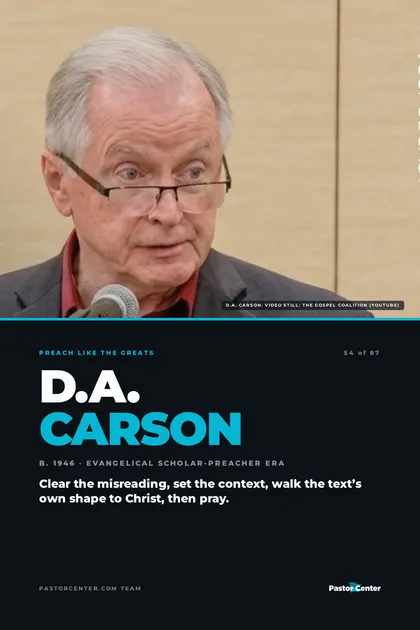
D.A. Carson is a New Testament scholar who has spent decades preaching at conferences, churches and campuses around the world. We studied six of his sermons and lectures. Under every one sits the same shape: clear away the misreading people bring, set the passage in its real context, walk the text’s own structure clause by clause to Christ, and then pray.
Who D.A. Carson is
Don Carson was born in Montreal, grew up in French Canada, pastored a church in Vancouver and earned a Cambridge PhD in New Testament. He joined Trinity Evangelical Divinity School in 1978, served as Research Professor of New Testament from 1991 to 2018, and is now emeritus.
In 2005 he and Tim Keller convened the pastors who became The Gospel Coalition, and he served as its first president until 2020, when he became theologian-at-large. He has written or edited more than 60 books, including the Pillar commentary on John (1991), and served as president of the Evangelical Theological Society in 2022.
The shape of a Carson sermon
Carson often reads the whole passage aloud before he explains any of it. Then, early on, he clears the ground. He names the misreading or the wrong question people bring to the text and sets it aside. In “The Parable of the Rich Man and Lazarus,” he first clears away the idea that the story is about the godly rich and the wicked poor.
Next he backs up into the book or the Old Testament until the passage stands in its real setting. Usually he then announces a structure the text itself supplies: two parts, three cycles, four pairs.
He walks it clause by clause, and often a small word turns the whole reading: a “but,” an “and,” “broad” instead of “easy.” Along the way he keeps asking what you’d expect the text to say, then shows you what it actually says. The scholarship is spoken plainly, with dry humor.
Late in the sermon Christ or the cross becomes the point, and he ends in prayer. In some sermons he sets heaven and hell side by side near the end.
What made his preaching different
Clear the ground
He names the easy misreading before he opens the text, so the room can hear the passage fresh.
The small word
He watches for the small word, a “but” or an “and,” that turns the whole passage.
What did you expect?
He asks what you expected the text to say, then restores the shock that familiarity has dulled.
What others said
“Don undergoes no metamorphosis moving from the lectern to the prayer meeting.”
— John Piper, Serving the Church, Reaching the World (2017)
“His manner of speaking is just as articulate, thoughtful, and engaging as his published books and articles.”
— Andy Naselli, New Testament scholar, 2006
What to take into your own pulpit
Clear the ground first
People come with a reading already in their heads. Name it and set it aside so the text can speak.
Watch the small words
A single conjunction can change the meaning of a passage. Slow down enough to notice it, and show the room.
Let the text surprise them again
Ask what they expected the passage to say. Familiar texts lose their edge, and that question gives it back.
Those are the ideas. The guide turns them into ten steps you can follow this week, plus the sermons we studied and a fill-in outline in his shape.
Free PDF · Preach Like the Greats
Learn to preach like D.A. Carson.
This post is the overview. The guide has the research and the method.
- The 6 sermons we studied, start to finish
- Ten steps to preach the way he does
- His sermon outline, movement by movement
- A fill-in template for your own text, 9 pages
Common questions
What is D.A. Carson’s preaching style?
Careful, plain-spoken and conversational. He preaches the passage the way a careful reader would teach it, clears away misreadings, attends to small words, uses dry humor and always arrives at Christ and a call to believe.
How does D.A. Carson structure a sermon?
He often reads the passage, clears a misreading, sets the book or Old Testament context, follows a structure the text itself supplies, turns to Christ late in the sermon, and ends in prayer.
What books has D.A. Carson written?
More than 60 written or edited, including the Pillar commentary on John (1991) and An Introduction to the New Testament with Douglas Moo and Leon Morris.