How Andy Stanley Preaches: Tension First, Text Later, One Sticky Line
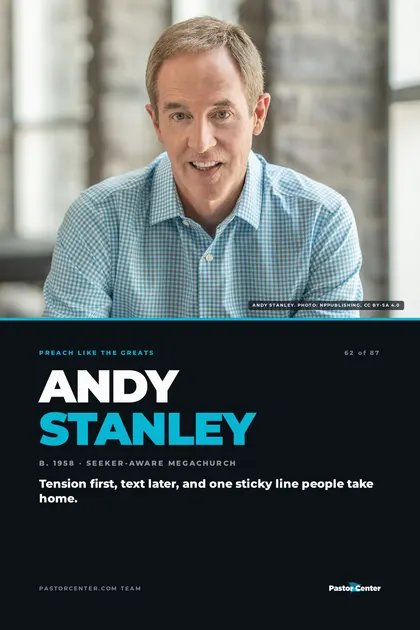
Andy Stanley founded North Point Community Church in Atlanta in 1995, and his book Communicating for a Change is probably the most-copied sermon method in American churches today. We studied nine of his sermons. Under every one sits the same shape: tension first, text later, and one sticky line drawn from the passage and repeated until people take it home.
Who Andy Stanley is
Stanley founded North Point Ministries in Atlanta in 1995. It now has eight metro-Atlanta campuses and a network of more than 225 churches.
Communicating for a Change (2006, with Lane Jones) put his one-point sermon method in the hands of a generation of preachers. In a 2010 LifeWay survey of 1,002 pastors he ranked among the ten most influential living preachers, and his podcast won best spirituality and religion podcast from the Academy of Podcasters in 2016.
The shape of a Stanley sermon
Stanley almost always builds tension before he opens the Bible. He spends the first half of the message on his own story and on a problem everyone in the room shares. Many of the sermons we studied open with a strong personal “me” section.
Then he gives skeptics permission to opt out. He often draws an explicit line between Jesus followers and everyone else: “If you’re not a Christian, just listen.” Only then, often around the halfway mark, does he open the text. Most sermons rest on one anchor passage.
Out of that passage comes one sticky line, and he says it again and again. Sometimes it arrives only after the text, as in “Principle of the Path,” where “direction determines destination” comes late. Sometimes it is a question refrain, like “What’s the win?”
The endings vary. Some close with a vision of what “we” could be, and others with a concrete next step: a prayer, a homework question, a small-group sign-up.
What made his preaching different
Tension first
He spends about half the message on a problem everyone shares before the Bible comes out.
Text at halfway
He opens the Bible around the midpoint, once the room feels the tension the text answers.
One sticky line
He draws one sticky line from the text and repeats it until people can say it themselves.
What others said
“One of the most sought after communicators and leaders in the church today.”
— Carey Nieuwhof Leadership Podcast
“preaching style demonstrate[s] his passion for reaching unchurched people.”
— Christianity Today, 2014
What to take into your own pulpit
Earn the text
Stanley makes the room feel the problem before he opens the Bible. When people want an answer, they lean in to hear it.
Pick one point
His sermons carry one idea, not several. A single line is easier to remember than a list.
Speak to everyone in the room
He names who is a follower and who isn’t, and gives each a way to listen. Skeptics stay when they’re not pressured.
Those are the ideas. The guide turns them into ten steps you can follow this week, plus the sermons we studied and a fill-in outline in his shape.
Free PDF · Preach Like the Greats
Learn to preach like Andy Stanley.
This post is the overview. The guide has the research and the method.
- The 9 sermons we studied, start to finish
- Ten steps to preach the way he does
- His sermon outline, movement by movement
- A fill-in template for your own text, 8 pages
Common questions
What is Andy Stanley’s preaching style?
Conversational, personal and aimed at unchurched people. He builds tension from his own story and a shared problem, opens the Bible around halfway, and repeats one sticky line drawn from the text.
How does Andy Stanley structure a sermon?
Tension first, then permission for skeptics to listen, then one anchor passage around the midpoint, then a single sticky line repeated, and finally a vision or a concrete next step.
What is Communicating for a Change?
His 2006 book with Lane Jones that lays out his one-point sermon method. It is probably the most-copied sermon method in American churches today.