How T.D. Jakes Preaches: Climb Inside the Story, Build on One Image
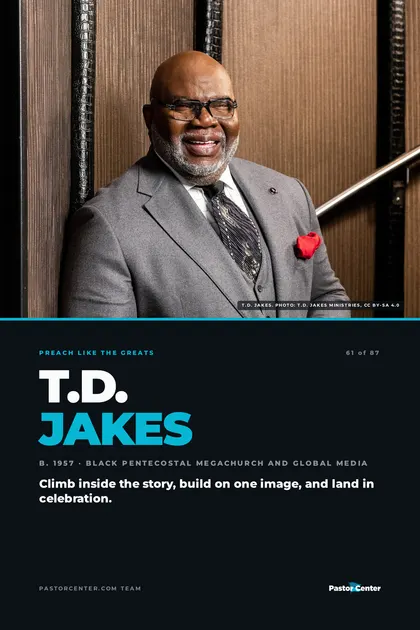
T.D. Jakes calls himself a storyteller and calls preaching “a conversation, not a monologue.” We studied nine of his sermons. The shape holds across all of them: climb inside a Bible scene, relabel its crisis as yours, build the whole sermon on one image, and land in a planned celebration.
Who T.D. Jakes is
Jakes came to Dallas from West Virginia in 1996 with about 50 families and founded The Potter’s House, which grew into a church of some 30,000 members. He stepped down in 2025, and Sarah Jakes Roberts and Touré Roberts now lead.
Woman, Thou Art Loosed (1993) sold more than 800,000 copies in three years. In 2001 TIME named him “America’s Best Preacher,” and his 2008 MegaFest in Johannesburg drew more than 100,000 people on its first day.
The shape of a Jakes sermon
He reads the text himself, early, and the congregation often stands for it. Then he states his title and drills it as a refrain through the sermon. He almost never uses numbered points.
Instead he climbs inside the scene and makes the text’s crisis the listener’s crisis. One controlling image carries the whole sermon. In “The Groan Before the Glory,” it is labor pains before a birth. He pads the retelling with other Bible stories that echo it.
Somewhere along the way the sermon turns to identity: who you are is not what happened to you, as in “Come Out of the Tombs.” He keeps the room involved, asking people to touch, tell or nudge their neighbor.
He builds with false peaks, rising toward a climax and then dropping back to teach. The end is a planned celebration with the organ underneath, a substantial part of the sermon, often followed by prophetic declarations and, in many sermons, an altar call.
What made his preaching different
Inside the scene
He relabels the text’s crisis as yours. The listener stops watching the story and finds themselves inside it.
One image
The whole sermon is built on one picture, like labor pains before birth. Everything else hangs on that image.
Planned celebration
False peaks, then the organ underneath. He rises, pulls back to teach, and rises again until the celebration lands.
What others said
“I think he’s a virtuoso. I think he’s the Michael Jordan of preaching.”
— David Van Biema, TIME
“Each sermon eventually reveals itself as perfectly calibrated and balanced, cohering into an often exquisite extended metaphor.”
— David Van Biema, TIME, 2001 (via Christianity Today)
What to take into your own pulpit
Put the listener in the scene
Don’t just explain what happened to them. Show how the same crisis is happening to the people in front of you.
Pick one image and stay with it
A single controlling picture holds a sermon together better than a list of points.
Plan the celebration
Jakes doesn’t leave the ending to chance. He builds toward it and gives it real time.
Those are the ideas. The guide turns them into ten steps you can follow this week, plus the sermons we studied and a fill-in outline in his shape.
Free PDF · Preach Like the Greats
Learn to preach like T.D. Jakes.
This post is the overview. The guide has the research and the method.
- The 9 sermons we studied, start to finish
- Ten steps to preach the way he does
- His sermon outline, movement by movement
- A fill-in template for your own text, 9 pages
Common questions
What is T.D. Jakes’s preaching style?
Narrative and celebratory. He climbs inside a Bible scene, makes its crisis the listener’s, builds the sermon on one controlling image, rises through false peaks, and lands in a planned celebration.
How does T.D. Jakes structure a sermon?
He reads the text early, states a title and repeats it as a refrain, retells the story through one image instead of numbered points, turns to the listener’s identity, and closes with celebration, declarations and often an altar call.
Does T.D. Jakes use sermon points?
Rarely. Instead of numbered points, he builds the whole message on one controlling image and a repeated title.