How Mark Clark Preaches: One Word, the Skeptic’s Case and the Treasure Test
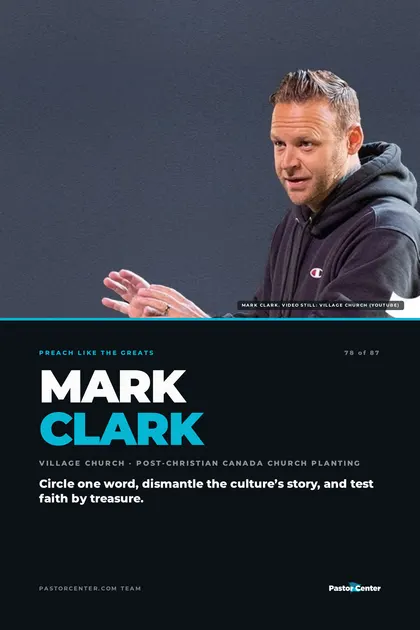
Mark Clark preaches like a skeptic who got convinced. We studied six of his sermons, from Village Church around 2019 to a guest message around 2025. Each one names the belief the room actually holds, takes it apart with evidence and a joke, slows down on one word in the text, and asks whether you just believe it or treasure Jesus above everything.
Who Mark Clark is
Clark grew up in a nonreligious home in Ajax, Ontario, read the New Testament as a teenager and first walked into a church at 19. He moved to Vancouver in 2004 for school, served six years as a young adult pastor, and around 2010 started Village Church with about 50 people in an elementary school gym in Surrey, British Columbia. By about 2020 it had six locations and about 6,000 people on a weekend.
His first book, The Problem of God, answers skeptics’ objections to Christianity, and other churches have preached series from it. He speaks often at conferences and churches across Canada and the U.S., and by about 2025 he was preaching from Bayside Church, a multisite church with ten campuses in the Sacramento area.
The shape of a Clark sermon
Clark names the text in the first couple of minutes and usually opens with a personal or family story: a hike in India, his mom’s surprise party, a hospital season.
Then he goes slow. Most sermons cover only a few verses, and he stops on one word or phrase (“cried out,” “for,” “behold,” “all”) and opens it for a long stretch.
Every sermon names a belief in the culture and argues against it: karma, pluralism, “Christ consciousness,” moral relativism, or “I’m going to heaven because I’m not Hitler.” He quotes writers by name, from Lewis to Solzhenitsyn, and speaks directly to the skeptic, the tired and the churchgoer: “Some of you…” His long, self-deprecating stories with dialogue usually end on a serious turn.
Underneath runs one test: real faith treasures Jesus, because even Satan believes the resurrection. Near the end he states what Christ did in our place, and he closes with a prayer that restates the point.
What made his preaching different
The skeptic’s case
He argues the room out of karma and relativism with evidence and a joke, then shows why Jesus is better.
One word, slowly
He covers a verse or two and opens one word for as long as ten minutes, like the emphatic “behold.”
Treasure test
Real faith treasures Jesus. Believing the facts isn’t enough; even Satan believes the resurrection.
What others said
“Mark is one of those people that I think just once in a generation or so, God raises up some incredible voices.”
— Host introducing him at Connexus Church, c. 2020
“He’s got a lot of street smarts, but he’s actually academically very solid.”
— Host introducing him at Connexus Church, c. 2020
What to take into your own pulpit
Argue with the real belief
Name what people in your city actually believe, in their own words, and answer it honestly.
Slow down on one word
A single word, opened carefully, can hold a whole sermon and show people how to read the Bible.
Test for treasure
Ask not only whether people believe, but whether they treasure Jesus above everything.
Those are the ideas. The guide turns them into ten steps you can follow this week, plus the sermons we studied and a fill-in outline in his shape.
Free PDF · Preach Like the Greats
Learn to preach like Mark Clark.
This post is the overview. The guide has the research and the method.
- The 6 sermons we studied, start to finish
- Ten steps to preach the way he does
- His sermon outline, movement by movement
- A fill-in template for your own text, 9 pages
Common questions
What is Mark Clark’s preaching style?
Apologetic, story-driven and close to the text. He names the beliefs his hearers hold, argues against them with evidence and humor, slows down on one word in the passage and tests faith by whether it treasures Jesus.
How does Mark Clark structure a sermon?
A personal story and the text early, a slow walk through a few verses with one word opened up, a cultural belief taken apart, direct address to different hearers, Christ’s work in our place near the end, and a closing prayer that restates the point.
What is Mark Clark’s book The Problem of God about?
It answers skeptics’ objections to Christianity, and other churches have preached series from it.