How JP Pokluda Preaches: Confess First, Then Short Commands and One Step for This Week
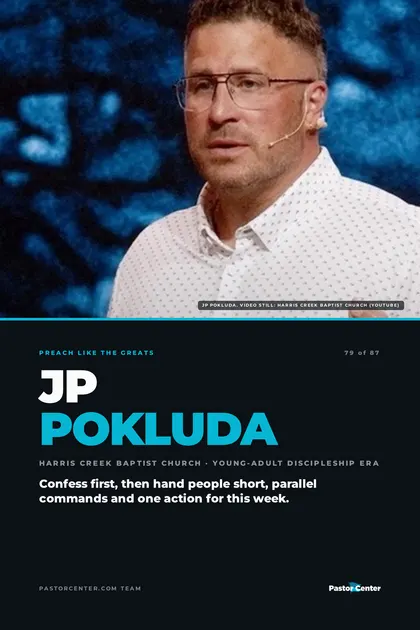
JP Pokluda preaches like a coach running a practice. He led The Porch, the young-adult ministry of Watermark Community Church in Dallas, and now leads Harris Creek Baptist Church in Waco. We studied six of his sermons from 2024 to 2026. Each one opens with a family story that becomes the sermon’s question, hands the room short parallel commands to repeat, confesses his own failure before any ask, and ends with one specific action.
Who JP Pokluda is
Jonathan “JP” Pokluda led The Porch in Dallas, which draws 3,000 to 4,000 young adults every Tuesday night, before he moved to Waco to lead Harris Creek. He now preaches to a college town, co-hosts the Becoming Something podcast and answers questions on Instagram every week. He says he has been asked more than a million questions in his Friday Q&A and has answered more than 20,000.
Between 2018 and 2021 he published four books in four years: Welcome to Adulting, Welcome to Adulting Survival Guide, Welcoming the Future Church and Outdated, a book on dating that Baylor students still quote. In January 2025 he spoke at Passion for the third year in a row.
The shape of a Pokluda sermon
Every sermon we studied opens with a funny personal or family story that turns into the sermon’s question. In “Fake Faith,” his son asks how he knows a beach Rolex is fake, the expert says “look at the Y,” and that becomes “look at the why.”
He states the big idea, or the questions, before he reads the text. Then he walks through three, five or seven parallel numbered points, each a short command or label the room can repeat: “I can’t. God can. I trust him.” A spoken refrain or running metaphor often ties them together.
He keeps the room working. They say things together, raise hands, answer out loud. He confesses his own weakness or failure as proof at almost every turn, and he hands people a script or a habit to try that week. Some messages include a video testimony.
Near the end he summarizes all the points, often closes with a story that bookends the opener, and finishes with a specific action and prayer: hands raised, come forward, fast tomorrow. In “Peace with Difficult People,” a story about his neighbor Jean opens the sermon and her lonely funeral closes it.
What made his preaching different
Story becomes question
A family scene raises the question the text answers, so the sermon starts with something everyone in the room has lived.
Say it together
His points are short commands the room repeats together. He often preaches that “clarity is kindness.”
Confess, then correct
His own failure comes before any ask. He confesses first, then corrects.
What others said
“He often preaches that ‘clarity is kindness.’”
— The Baylor Lariat, 2021
“JP’s message was talking about like those core values that we really hold true to… I knew in that moment that I wanted church not to just be Sunday entertainment.”
— Kendall, Baylor transfer student, 2026 (Harris Creek video)
What to take into your own pulpit
Let a story ask the question
Start with a scene from your own life that raises the question the passage answers. The room leans in when they want the answer.
Confess before you correct
Pokluda names his own failure before he asks anything of anyone. People take hard words better from someone who has needed them.
End with one thing to do
Not a general challenge, but a specific step for this week. Clarity is kindness.
Those are the ideas. The guide turns them into ten steps you can follow this week, plus the sermons we studied and a fill-in outline in his shape.
Free PDF · Preach Like the Greats
Learn to preach like JP Pokluda.
This post is the overview. The guide has the research and the method.
- The 6 sermons we studied, start to finish
- Ten steps to preach the way he does
- His sermon outline, movement by movement
- A fill-in template for your own text, 9 pages
Common questions
What is JP Pokluda’s preaching style?
Clear, funny and practical, like a coach running a practice. He opens with a family story that becomes the question, gives short parallel commands the room repeats, confesses his own failures, and ends with one specific action.
How does JP Pokluda structure a sermon?
A personal story that raises a question, the big idea before the text, three to seven parallel points, a script or habit for the week, a summary of the points, and a specific action with prayer.
What does “clarity is kindness” mean in JP Pokluda’s preaching?
It’s a line he often preaches. In practice it means short points people can repeat and a specific next step instead of a vague challenge.