How G.E. Patterson Preached: Read It Together, Make It Plain
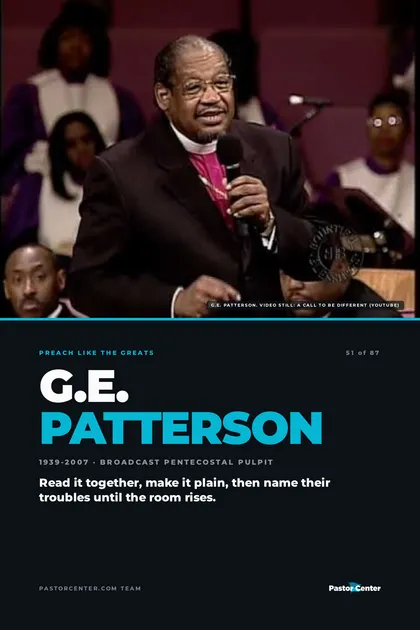
G.E. Patterson founded Temple of Deliverance in Memphis in 1975, and his Bountiful Blessings broadcast carried his voice across the country every Sunday. We studied five of his sermons, mostly from around 1999 to 2003. He preached like a teacher who could sing: the whole room reads the text aloud, he boils it to one sentence, makes it plain with homely pictures, and lands on a late litany of the hearers’ troubles that climbs into praise.
Who G.E. Patterson was
Gilbert Earl Patterson was born in Humboldt, Tennessee, grew up in Memphis and Detroit, and was ordained an elder in the Church of God in Christ as a teenager. On Temple of Deliverance’s opening day in March 1975, 436 people joined. Within three years membership passed 2,000, and by 1984 the 1,200-seat sanctuary built in 1978 overflowed into the fellowship hall.
His sermons aired weekly on BET, TBN and the Word Network, alongside WBBP radio and Bountiful Blessings Magazine. He served as Presiding Bishop of the Church of God in Christ from 2000 until his death in 2007, re-elected by acclamation in 2004. Two months before he died he won a Stellar Award as traditional male vocalist of the year.
The shape of a Patterson sermon
Patterson starts with the whole congregation. They read the text aloud with him, and within the first few minutes he states the theme in one sentence and tells them to pass it to a neighbor: “tell somebody.”
Early on he names what the hearers are actually facing: bills, the doctor’s report, eviction, the job. Then he walks the background story or the chapter in order.
He makes doctrine plain with homely pictures: a billboard you read at highway speed, a gas tank, his mother’s sewing-machine belt, a palm tree that moves to Chicago. Most of the time he sings or quotes a gospel song along the way.
Then the close that keeps going. He signals “as I close” or “finally” and keeps preaching, and the body of the sermon ends in a litany that names troubles or promises one by one until the room rises into praise. In “Have No Fear, God Is in Control” the litany is “He knows about…”
What made his preaching different
Text read together
The whole room reads the verse aloud with him. Before he says a word about it, the text is in everyone’s mouth.
Make it plain
He makes it plain with everyday pictures. Billboards, gas tanks and a sewing-machine belt carry the doctrine.
Litany into praise
A late list of named troubles climbs into celebration. Each line meets someone in the room where they are.
What others said
“He had this humongous voice - a big, meaty, bright, wide, vocal range.”
— Braxton D. Shelley, Yale University, 2024
“Patterson was always repeating these little fragments across his sermons.”
— Braxton D. Shelley, author of An Eternal Pitch, 2024
What to take into your own pulpit
Put the text in their mouths
Reading the passage aloud together makes the congregation participants before the sermon starts.
Reach for the kitchen, not the library
Patterson explained deep things with ordinary objects. A picture from daily life makes doctrine stick.
Name what they’re carrying
His litanies worked because they were specific. People rise when they hear their own trouble named.
Those are the ideas. The guide turns them into ten steps you can follow this week, plus the sermons we studied and a fill-in outline in his shape.
Free PDF · Preach Like the Greats
Learn to preach like G.E. Patterson.
This post is the overview. The guide has the research and the method.
- The 5 sermons we studied, start to finish
- Ten steps to preach the way he did
- His sermon outline, movement by movement
- A fill-in template for your own text, 9 pages
Common questions
What was G.E. Patterson’s preaching style?
A teacher who could sing. He had the room read the text aloud, gave a one-sentence theme to pass to a neighbor, explained it with homely pictures, often sang inside the sermon, and closed with a litany that rose into praise.
How did G.E. Patterson structure a sermon?
Text read together, a one-sentence theme early, the hearers’ situation named, the background story walked in order, everyday pictures for the doctrine, a close signaled early, and a late litany into praise, often followed by an invitation.
What was Bountiful Blessings?
Patterson’s broadcast ministry. His sermons aired weekly on BET, TBN and the Word Network, alongside WBBP radio and Bountiful Blessings Magazine.