How R.C. Sproul Preached: Find the Drama in the Text, Then Preach the Drama
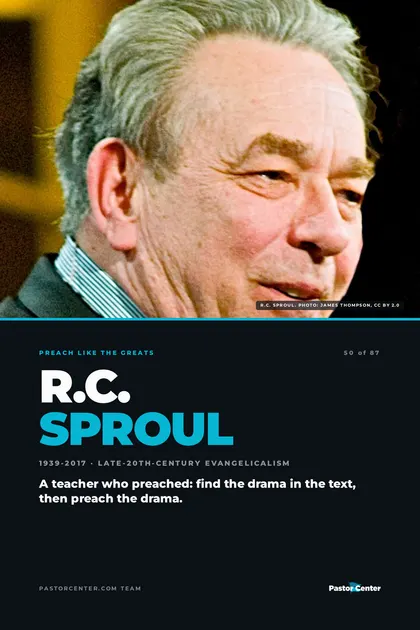
R.C. Sproul was a teacher who preached. He built a teaching ministry first and became a local pastor later. We studied eight of his sermons, preached from 2002 to 2007. Each one takes a single text phrase by phrase, makes it feel as real as a news event, and stays warm the whole way through. His own rule for preachers sums it up: find the drama in the text, then preach the drama.
Who R.C. Sproul was
Sproul founded Ligonier Ministries in 1971, with the Ligonier Valley Study Center. The Holiness of God followed in 1985, the Renewing Your Mind broadcast in 1994, and Saint Andrew’s Chapel in Sanford, Florida, in 1997. He also founded Reformation Bible College in 2011 and wrote more than 100 books.
Renewing Your Mind has aired daily since 1994 and still broadcasts his sermon series. He made deep theology, like the holiness of God and justification by faith, accessible to lay people across the English-speaking world.
The shape of a Sproul sermon
His sermons usually came in series, and he opened by bridging from last week: “Once more…” Then he read the full text aloud, and most of the time he prayed for illumination right after the reading.
Next came a block of background: history, context, sometimes archaeology. In “Jesus Heals Many,” the reading and prayer give way to the excavations at Capernaum. In “The Crucifixion,” he walks the room through the scourging and the Praetorium. Often a Greek word or a theological distinction comes in here too.
Then he walked the passage phrase by phrase, slowly and carefully. Along the way he wove in stories, many from church history, and he kept the tone warm, calling his listeners “beloved.”
Many sermons have a distinct application section, and many close simply: “Let us pray.”
What made his preaching different
Phrase by phrase
He took one text slowly and carefully, phrase by phrase. He didn’t skip ahead to the parts that preach easily.
Real as the news
History, archaeology and a Greek word made the passage feel as real as a news event. As one sermon put it, “Christianity is married to history.”
Warm and clear
He kept it warm and clear with “beloved,” humor and stories from church history, so the depth never felt cold.
What others said
“Rigorously biblical and ruthlessly logical … with a smile.”
— Al Mohler
“He taught his homiletics students to find the drama in the text and then to preach the drama.”
— Ligonier tribute, December 2017
What to take into your own pulpit
Find the drama first
Before you outline, ask where the tension and stakes are in the passage. Then let the sermon carry that drama.
Make the text feel like news
A little history, place or language can turn an old passage into something that actually happened. Use it to make the text real, not to show off.
Depth doesn’t have to be cold
Sproul taught hard theology to lay people with warmth and humor. Clear and kind beats clever.
Those are the ideas. The guide turns them into ten steps you can follow this week, plus the sermons we studied and a fill-in outline in his shape.
Free PDF · Preach Like the Greats
Learn to preach like R.C. Sproul.
This post is the overview. The guide has the research and the method.
- The 8 sermons we studied, start to finish
- Ten steps to preach the way he did
- His sermon outline, movement by movement
- A fill-in template for your own text, 9 pages
Common questions
What was R.C. Sproul’s preaching style?
Teaching-driven, logical and warm. He took one text phrase by phrase, used history, archaeology and Greek to make it feel real, and kept the tone personal with humor, church-history stories and “beloved.”
How did R.C. Sproul structure a sermon?
He usually bridged from the series, read the full text and prayed for illumination, gave a block of background, walked the passage phrase by phrase with stories woven in, and often closed with “Let us pray.”
What did R.C. Sproul teach about preaching?
He taught his homiletics students to find the drama in the text and then to preach the drama.