Pastor, here’s how to stop falling for AI doomerism.

AI doomerism sounds like wisdom. It gets nodding heads in staff meetings and shares on Facebook, and it lets a pastor feel discerning while never learning a thing. But most of the doom being preached about AI isn’t discernment — some of it is somebody else’s business model, and the rest is a category error about what this technology actually is. I wrote Pastoral Artificial Intelligence to pull pastors out of exactly this ditch. Here are the five moves.
Step 1 — Recognize whose tune you’re dancing to
Follow the money before you follow the fear. The loudest “this could end the world” talk doesn’t come from the church — it comes from the AI companies themselves. And it works for them twice. First, existential drama is a fundraising pitch: nobody writes a billion-dollar check for a boring productivity tool, but they will for “the most powerful and dangerous technology in human history.” Second, fear is a lobbying strategy: scare regulators into rules so heavy that only the biggest labs can afford to comply, and you’ve built a moat — a market tilted toward a duopoly, where open-source models that anyone can run and inspect struggle to compete.
So when a pastor stands up and repeats doomer talking points, he isn’t being prophetic. Too often he’s reciting a fundraising deck he never read. You’re dancing to someone else’s tune — and the band is getting paid.
Step 2 — Settle it: no, it isn’t alive
It mimics human behavior; that is not the same thing as having any. These models are trained on oceans of human writing, so of course the output sounds human — that’s the whole trick. There is no soul in the machine, no consciousness, no agency, no little someone in there. And yes, you’ve seen the stories — companies bringing in priests and ethicists to ponder whether their model has a soul. Read those for what they are: marketing. “Our product is so powerful the clergy are worried” is a press release, not a theology.
You don’t need a demonology of software. You need a doctrine of man — and it will tell you the image of God is not conferred by fluent sentences.
Step 3 — Treat it like what it is: software. Then learn it.
Strip the mystique and what’s left is software — remarkable software, software that can even write software — and the pastors who win with it are the ones who learn to drive it. The skill that matters most is prompt architecture: what you ask, how you frame it, and what context you feed the model. In practice, 70–80% of the quality of the output is determined by the prompt and the context, not by which model you happen to open.
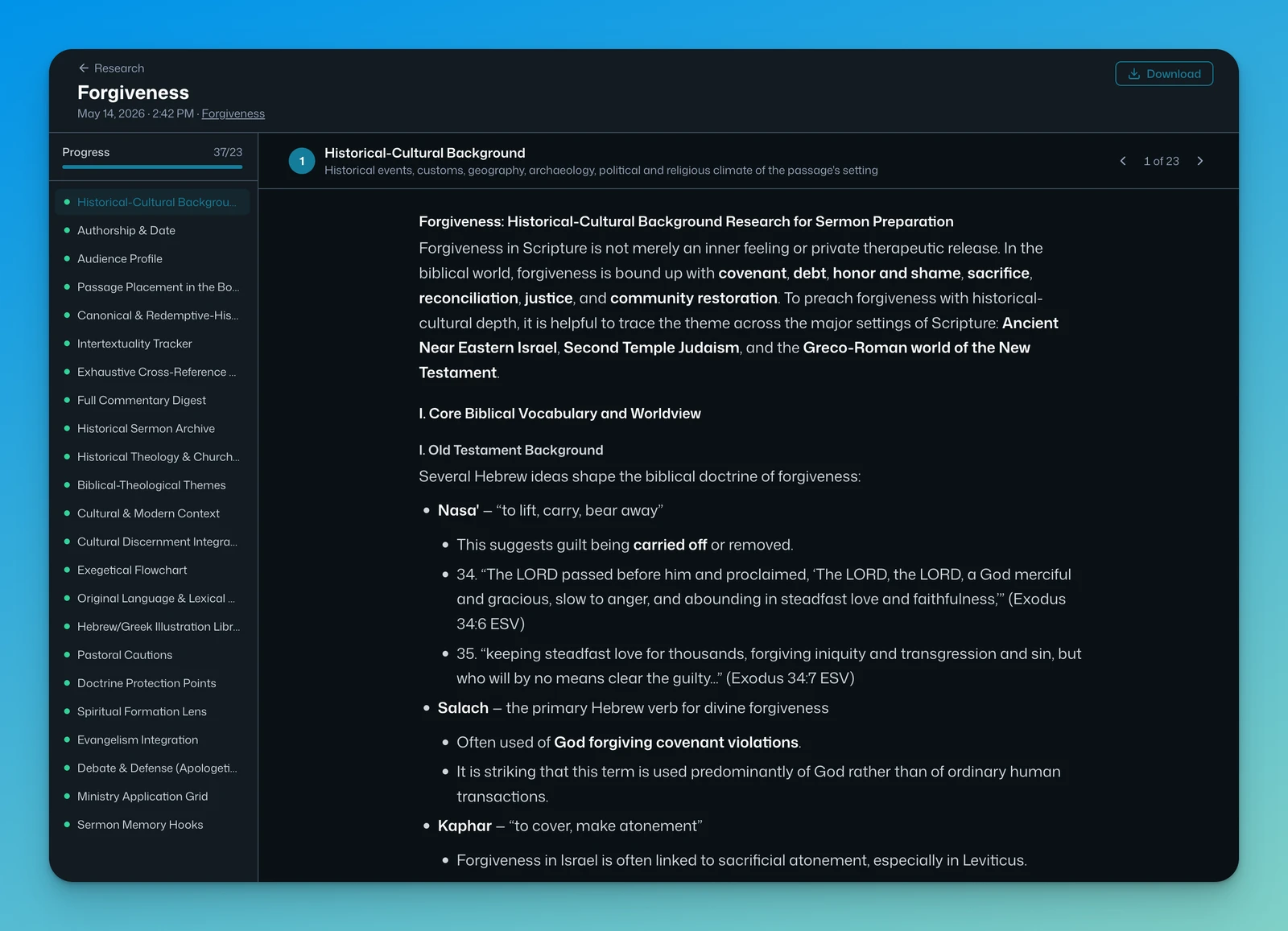
If you want to see what serious prompt architecture actually looks like, look at how we built Deep Sermon Research in the Sermons module: 23 specialized agents, each carrying 300–400 words of theological instruction, pointed at thousands of commentaries, lexicons, and scholarly sources — and what comes back is one citation-rich report, not a generic answer. That’s the 70–80% doing its work.
That’s why the widely shared Gospel Coalition piece ranking “the best AI for pastors” — and handing the crown to a Chinese model — was flawed at the foundation. It graded the engines and ignored the driver. Once you understand that the prompt and context do most of the work, the idea that pastors should route their sermon prep through a model aligned with Chinese state censorship isn’t just wrong, it’s ridiculous. Model choice matters some. Prompt architecture matters more. Learn the skill and almost any frontier model will serve you well.
Step 4 — Pick the tool up for God’s glory and our good
Here’s the settled center of Pastoral Intelligence: AI is a neutral tool. Not holy, not demonic — a tool, and neutral tools take the character of the hands that hold them. Which means it can be used for God’s glory and our good, and history begs us to notice. Imagine the Protestant movement without the printing press — no ninety-five theses spreading across Europe in weeks, no Bible in the plowboy’s language. The press printed indulgences before it printed Luther; the church picked it up anyway, and God used it to put Scripture in every hand.
AI is that kind of gift. We can spend the moment wringing our hands, or we can do what the reformers did with their new technology: seize it for the gospel.
Step 5 — Claim the advantage doomerism is costing you
Walk out of doomerism and here’s what’s waiting on the other side: the single biggest practical advantage available to a pastor today. Hours back every week. Research that used to take days, done in minutes. One sermon multiplied into a week of ministry. This is why we built Pastor Center the way we did — the prompt architecture from Step 3 is built into every module, aimed at ministry, so you’re never starting from a blank box. The Church Media module alone takes the sermon you already preached and turns it into captioned clips and a week of content while you go be a pastor.
Don’t argue with the fear — outgrow it. Book a 20-minute demo, send us one sermon, and the team will cut your first 20 captioned clips — free, yours to keep.
Discernment stays. Guardrails stay. But the fear? The fear was never yours — you borrowed it from people selling something. Hand it back, learn the tool, and use the gift for God’s glory and our good.
— Automate the mundane. Protect the sacred.
Pastoral Intelligence
The wise, Christ-centered use of AI to amplify your calling — never replace it. From skeptic to operator in eleven lessons.
 ▶
▶+ 7 more lessons — all free
Get the free course
Instant access — every lesson, free forever. No card, no catch.

“If you’re a pastor, you need to know about PastorCenter.”
Josh Howerton · Lead Pastor, Lakepointe Church