Pastor, AI gave me back 10 hours a week. Here’s exactly what I automated.

The promise of AI isn’t doing more. Read that again, because the whole hustle-culture pitch gets it backwards. The promise is doing less of the wrong things — the emails, the scheduling, the drafts, the summaries — so you finally have margin to do the sacred things slowly: pray, study, sit in hospital rooms, weep with people. When I ran this audit on my own week as an executive pastor, it surfaced about ten hours of work that never needed me. Here’s the audit, in four steps.
Step 1 — Track one real week, then list your ten most mundane tasks
Don’t guess — guessing flatters you. For one week, keep a running note of everything you actually do. Then pull out the ten tasks that are the most mundane: recurring, low-judgment, draining. For most pastors the list writes itself — inbox triage, meeting scheduling, announcement copy, event descriptions, volunteer follow-ups, meeting summaries, the social posts that never get posted.
Notice what the list has in common: none of it requires your ordination. All of it requires your hours.
Step 2 — Before you automate anything, write the never-automate list
This step comes second on purpose, and it’s the one that makes the rest safe. On a separate page, write down what you will never hand to a machine. Mine:
- Prayer — mine, and praying with my people
- Counseling, confession, and every hard conversation
- Hospital rooms, funerals, and front porches
- The hour in sermon prep where the text confronts me before I preach it to anyone
- Discernment — any decision about a person’s soul
Automate the mundane. Protect the sacred. Never reverse the order. AI is a neutral tool — it can be used for God’s glory and your good, and the line you just drew is what keeps it there. The pastors who get burned by AI aren’t the ones who used it too much — they’re the ones who never drew this line and let it creep into work God assigned to a shepherd.
Step 3 — Hand three tasks over this week
Not ten. Three. Pick the three most mundane items from Step 1 and actually delegate them to AI this week — draft the replies, summarize the meetings, write the first pass of the announcements. Two rules as you do it: you review everything before it ships, and you keep a note of how long each task used to take you.
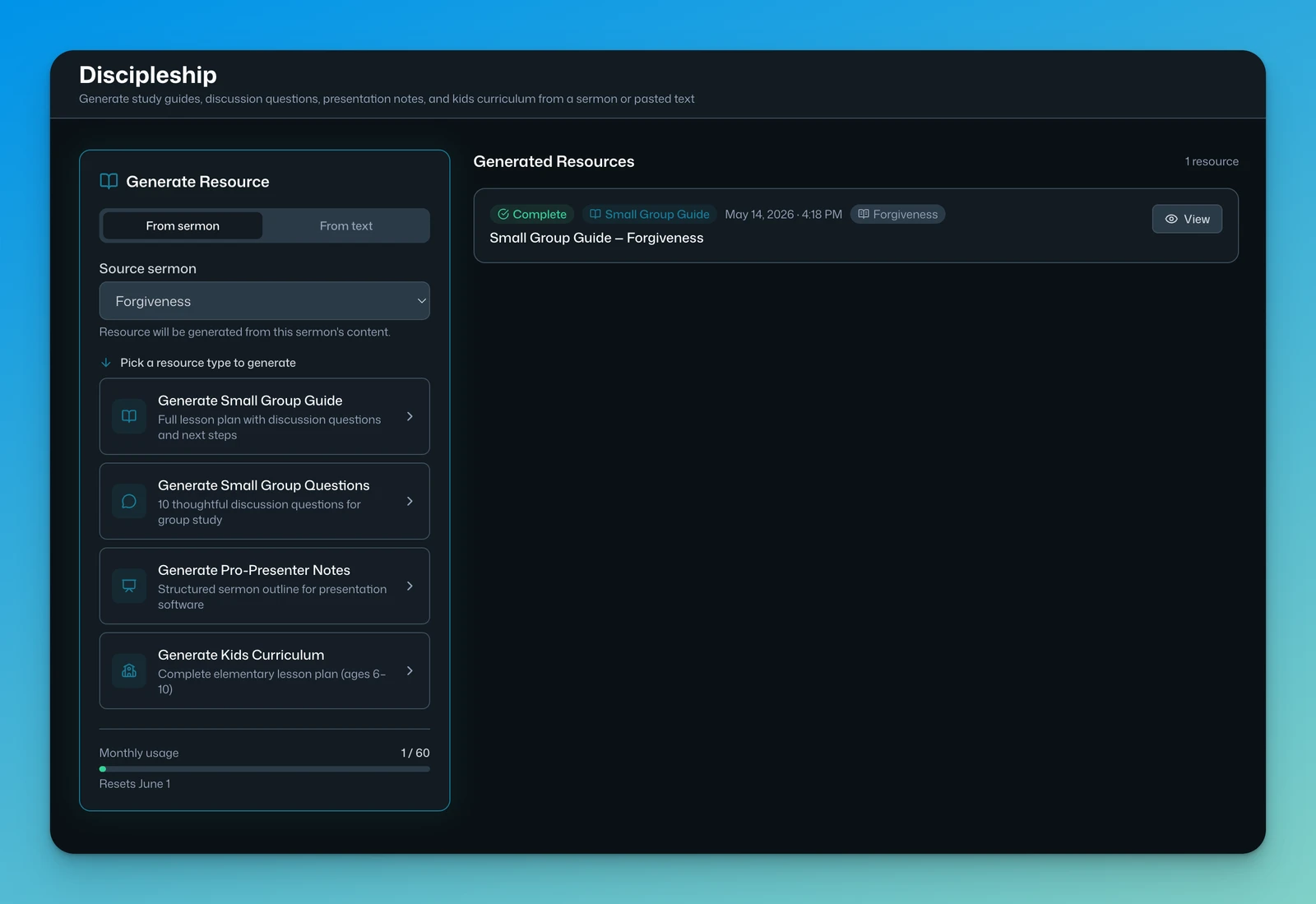
If any of your three sit downstream of the sermon, the hand-over is even easier than it sounds. The Discipleship tool in the Sermons module turns a finished sermon into small group guides, discussion questions, devotionals, even kids curriculum — one click. You still review before it ships; you just stop drafting from zero.
That second rule matters, because at the end of the week you’ll have a number. For most pastors I coach it lands between six and twelve hours. Mine was about ten. That number is the whole argument.
Step 4 — Reinvest the hours on purpose, or lose them
Here’s the failure mode nobody warns you about: recovered time evaporates. If you don’t assign those hours, the church calendar will — to more meetings, more email, more mundane. So reinvest them deliberately, and put the reinvestment on the calendar before the week starts. One in-person pastoral visit. An unhurried morning in the Word. Lunch with a leader you’ve been meaning to develop. Being home when your kids get home.
The point of the audit was never efficiency. It was freedom to do the sacred slowly. If the hours don’t end up with people and with God, you didn’t automate the mundane — you just made room for more of it.
Step 5 — Start with the biggest single time-sink: sermon research
If you want one move that recovers the most hours at once, it’s this. The largest block of automatable time in a pastor’s week isn’t the inbox — it’s the research grind: the hours of hunting through commentaries, chasing context, and checking cross-references before the real writing can even begin. The Sermons module in Pastor Center runs research agents on your passage and hands you one cited brief — historical context, original languages, cross-references, commentary synthesis — so the mundane layer of prep collapses from hours to minutes while the sacred layer, the hour where the text confronts you, stays untouched. It’s the same reason we built the rest of Pastor Center: every module exists to move something off this list.
See the audit pay off before you change anything else. Book a 20-minute demo, name the passage you’re preaching next, and the team will send you the full research report — free, yours to keep.
You weren’t called to an inbox. Run the audit this week — list the ten, draw the line, hand over three, and spend the hours you get back on the work only a pastor can do.
— Automate the mundane. Protect the sacred.
Pastoral Intelligence
The wise, Christ-centered use of AI to amplify your calling — never replace it. From skeptic to operator in eleven lessons.
 ▶
▶+ 7 more lessons — all free
Get the free course
Instant access — every lesson, free forever. No card, no catch.

“If you’re a pastor, you need to know about PastorCenter.”
Josh Howerton · Lead Pastor, Lakepointe Church