Pastor, here’s how I use AI every week without losing my voice — or my soul.

The question I get most about AI in ministry isn’t theological or technical. It’s personal: “Won’t I lose my voice?” After 1,000 sermons and several years of using these tools every week, here’s my answer: you only lose your voice if you get the order wrong. The Holy Spirit is your first author. AI is the last assistant. Keep that sequence and the tool amplifies you; reverse it and the tool replaces you. This is the four-step order of operations I run every week.
Step 1 — Be prompted before you prompt
Before I open any tool, I block thirty minutes with the text and with God. No screen, no software. I read the passage slowly, I pray it, and I listen. Then — and this is the discipline that changes everything — I write down what I sense the Spirit saying before AI gets a vote. A sentence or two. A burden. A direction.
Prayer before AI. Listening before generating. Conviction before composition. The order matters more than the output, because whatever is on that page when you finally open the laptop is the thing every tool now exists to serve. Skip this step and you’re not preaching a word from God polished by a machine — you’re preaching a word from a machine baptized by a prayer.
Step 2 — Write your conviction down before you compose
Take what you heard in Step 1 and force it into your own words: what this sermon must say, to these people, this week. Rough is fine. Ugly is fine. But it has to be yours, and it has to exist before anything generated does. That paragraph becomes your plumb line — every output the tools hand you later gets measured against it, and anything that doesn’t serve it gets cut without mercy.
Pastors who skip this step don’t notice the drift until it’s late. The material gets smoother, the sermons get more generic, and one Sunday you realize you’re delivering content instead of bearing witness. The conviction paragraph is the vaccine.
Step 3 — Take the wheel: every prompt is a pastoral decision
Now, and only now, open the tool — and understand what’s actually happening when you do. AI has no agency. You do. It’s a neutral tool, and in the hands of a praying pastor a neutral tool gets used for God’s glory and your good. What to ask, how to frame it, what to keep, what to throw out — every one of those is a pastoral decision, which means prompting isn’t delegating your creativity. It’s directing it. You never gave up creativity; you took up a director’s chair.
Three prompts anchor my prep, and I’d commend the same three to you:
- Research — what do I need to know about this text: context, background, the debates?
- Structure — how could this material be organized to serve the conviction from Step 2?
- Refinement — tighten this section in my voice: plain words, short sentences, no clichés.
Those three prompts, incidentally, are the blueprint we built into the Sermons module. Research is Deep Sermon Research — specialized agents working thousands of commentaries, lexicons, and scholarly sources into one cited report. Refinement is the Sermon Writer, trained on up to 15 of your past sermons, so “in my voice” isn’t a hopeful instruction to a generic model — it’s the starting point. The director’s chair stays yours either way.
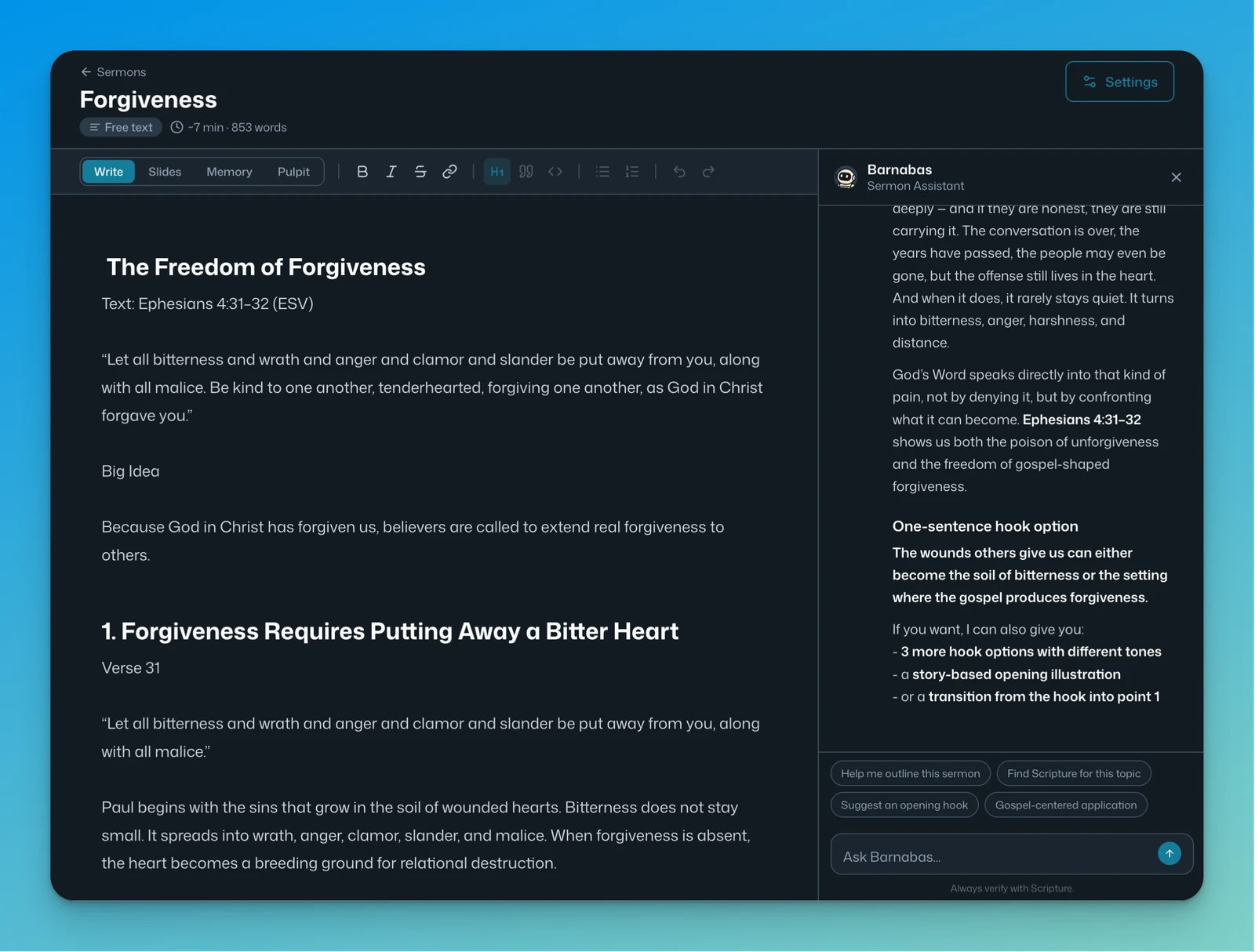
And a habit worth keeping: reject the first output on principle. Push back, refine, redirect. AI is a mirror, not an oracle — the wisdom comes from the one holding the wheel, and rejecting a draft is how you feel your own editorial voice in your hands.
Step 4 — Take the last pass alone
The final read-through belongs to you and God, the same way the first thirty minutes did. Print it or read it aloud — aloud matters — and ask two questions of every page: Does this sound like me? and Does this say what the Spirit gave me in Step 1? Anything that fails either test goes. The sermon should end its week the way it began: in the presence of God, in the voice of the shepherd who will stand and deliver it.
Step 5 — Let the tools carry the sermon after Sunday
Here’s where the order of operations pays a second dividend. Once the sermon is preached, the sacred work is done — and everything downstream of it is exactly the kind of work AI should carry. The Church Media module in Pastor Center takes that one Sunday sermon and turns it into captioned clips and a week of content. Spirit-authored on the front end, machine-multiplied on the back end. The order stays right the whole way through.
Book a 20-minute demo, send us one sermon, and the team will cut your first 20 captioned clips — free, yours to keep.
You won’t lose your voice to AI. You’ll lose it the way pastors have always lost it — by composing before you’ve listened. Be prompted before you prompt. Get the order right this week, and everything the tools touch will sound more like you, not less.
— Automate the mundane. Protect the sacred.
Pastoral Intelligence
The wise, Christ-centered use of AI to amplify your calling — never replace it. From skeptic to operator in eleven lessons.
 ▶
▶+ 7 more lessons — all free
Get the free course
Instant access — every lesson, free forever. No card, no catch.

“If you’re a pastor, you need to know about PastorCenter.”
Josh Howerton · Lead Pastor, Lakepointe Church