Pastor, my teams kept failing until I learned this about seats.

When I planted, my teams kept collapsing and I blamed commitment. People weren’t “bought in.” They needed more vision, more pep talks, more of me. Then I watched my best sound tech quit six months after I made him the production leader — and it finally landed. My teams weren’t failing from lack of effort. They were failing because I kept putting gifted people in the wrong seats. A decade of coaching pastors from 200 to 5,000 has only confirmed it: role clarity is the antidote to burnout. Here’s the placement system that fixed ours.
Step 1 — Learn the three seats before you fill any of them
Most churches don’t have teams — they have activity without leadership. A real team has three layers, and each one asks a fundamentally different question:
- The doer (team member) asks, “What’s my task, and did I do it with excellence?”
- The manager (team leader) asks, “Is every position covered, and is my team cared for?”
- The multiplier (department head) asks, “Who am I developing, and how do we double?”
Until you can name those three seats, you can’t tell a team from a crowd of doers. A team is gifted people serving where they make the most impact, inside a structure that serves both them and the church. That definition is the whole game.
Step 2 — Audit one department, honestly
Don’t reorganize the whole church this week. Pick one department — whichever one frustrates you most — and label every person in it: doer, manager, or multiplier. Not by their title. By the question they actually ask on Sunday.
Then write down what’s missing. In most departments I audit, the answer is the same: a stack of faithful doers, maybe a manager, and nobody — nobody — asking the multiplier question. That’s why the department has been the same size for three years.
Step 3 — Find the technician sitting in the multiplier seat
Here’s the failure pattern I see in almost every church: the best doer gets promoted into the leadership seat. Best musician becomes worship leader. Best tech runs production. Best teacher takes over kids. And the department stops growing — because the best doer is almost never the best leader, and leadership matters more than skill.
Until you believe that, your departments will never grow past one personality. That was me as a planter. I was the bottleneck — and I was staffing my departments with smaller versions of the same bottleneck: technicians doing brilliant work alone in seats built for people who multiply.
Step 4 — Move people with courage — and call it what it is
Now the hard part. Somebody in your church is in the wrong seat right now, and you know who it is. You have to have the courage to move them — and the kindness to frame it truthfully: this is not a demotion. It’s an alignment.
Moving a gifted doer out of a leadership seat they’re drowning in isn’t punishment — it’s rescue. The conversation goes better than you fear when it’s about their gifts instead of their failure: “You are extraordinary at this, and I’ve had you spending your energy on that. I want to fix my mistake.” Doers do. Leaders lead. Multipliers multiply. Everyone breathes easier when the seats match the wiring.
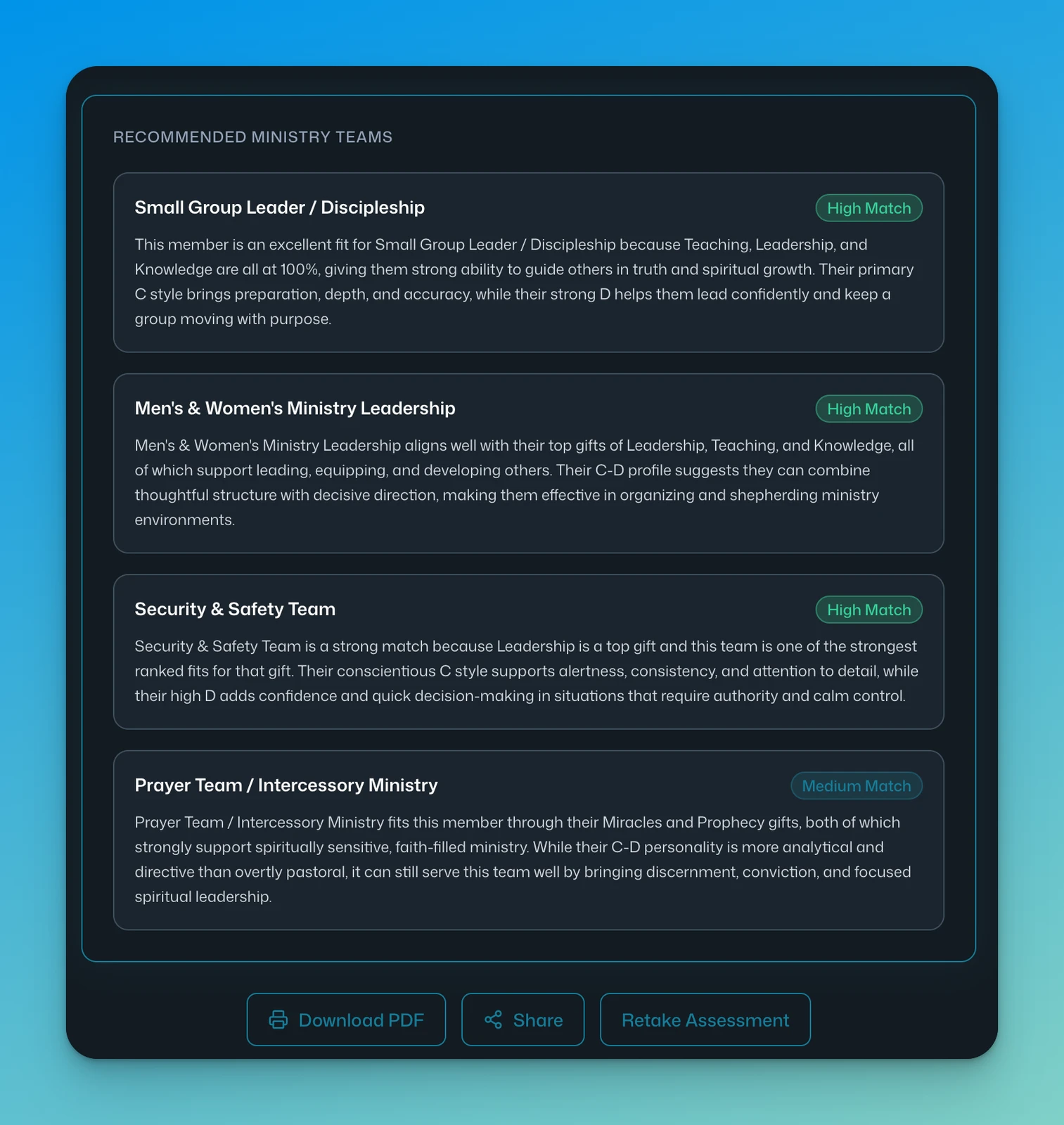
One thing that softens this conversation more than anything I’ve found: hand them their own results. The moment someone finishes the assessment, they get a profile that’s theirs to keep — top five gifts with descriptions and Scripture references, plus a DISC breakdown — and the module matches them to the actual named teams on your roster, ranked High Match and Medium Match, with the reasons why. “Alignment” stops being your word for it and becomes what the page in their hands says.
Step 5 — Stop guessing about wiring
Everything above works with a whiteboard and honesty. But steps 2 through 4 all hang on one judgment call: how people are actually wired — and your opinion of them is not data. The Spiritual Gifts module in Pastor Center runs every member through a spiritual gifts + DISC assessment and shows you who’s wired as a multiplier, who’s a steady manager, and who’s a faithful doer — so the hardest conversation in ministry starts with objective data instead of your hunch.
Before you move anyone, get the data. Book a 20-minute demo and the team will run the full spiritual gifts + DISC assessment on your whole staff — free, results are yours to keep.
Your teams aren’t failing because your people don’t care. They’re failing because caring people are sitting in the wrong seats. Audit one department this week. Have the one conversation you’ve been avoiding. That’s where the ceiling starts to crack.
— Your ceiling is a structure problem. Structure can be fixed.
Elite Serving Teams
Your growth ceiling is a team problem, not a preaching problem. The eight key teams and the leadership tree that break it.
 ▶
▶+ 12 more lessons — all free
Get the free course
Instant access — every lesson, free forever. No card, no catch.

“If you’re a pastor, you need to know about PastorCenter.”
Josh Howerton · Lead Pastor, Lakepointe Church