Pastor, guests decide in 10 minutes. Here’s how I built a first impressions team that wins them.

Here’s the fact that changed how I build churches: a first-time guest decides whether they’re coming back within the first seven minutes — before the sermon, before worship, before they ever sit down. I’ve preached over 1,000 sermons, and I’ll tell you plainly: not one of them ever out-preached a chaotic parking lot, a confusing lobby, or a cold greeting. The sermon decides almost nothing for a first-timer. The walk from their car to their seat decides almost everything. So build a team that owns that walk. Four steps.
Step 1 — Map the walk, position by position
First impressions is not “a greeter at the door.” It’s a full team covering every point of contact between a guest’s car and their seat: parking-lot greeters, door greeters, lobby hosts, guest connection, coffee. This Sunday, walk your own property like a first-timer — park where they’d park, enter where they’d enter — and write down every spot where a guest could feel lost, ignored, or unsure.
Each of those spots is a position. List them all. Then set the rule that makes it a real team: every position scheduled, every position trained, every week. A greeter who’s “usually there” is a hole in your line.
Step 2 — Recruit warm, train the process
Here’s the recruiting principle for this team: warmth can’t be taught. Process can. So recruit the naturally warm people — the ones who light up a room without trying — and then train them on the standards: where to stand, what to say, how to walk a guest to the kids wing instead of pointing. Smiles are non-negotiable; everything else is trainable.
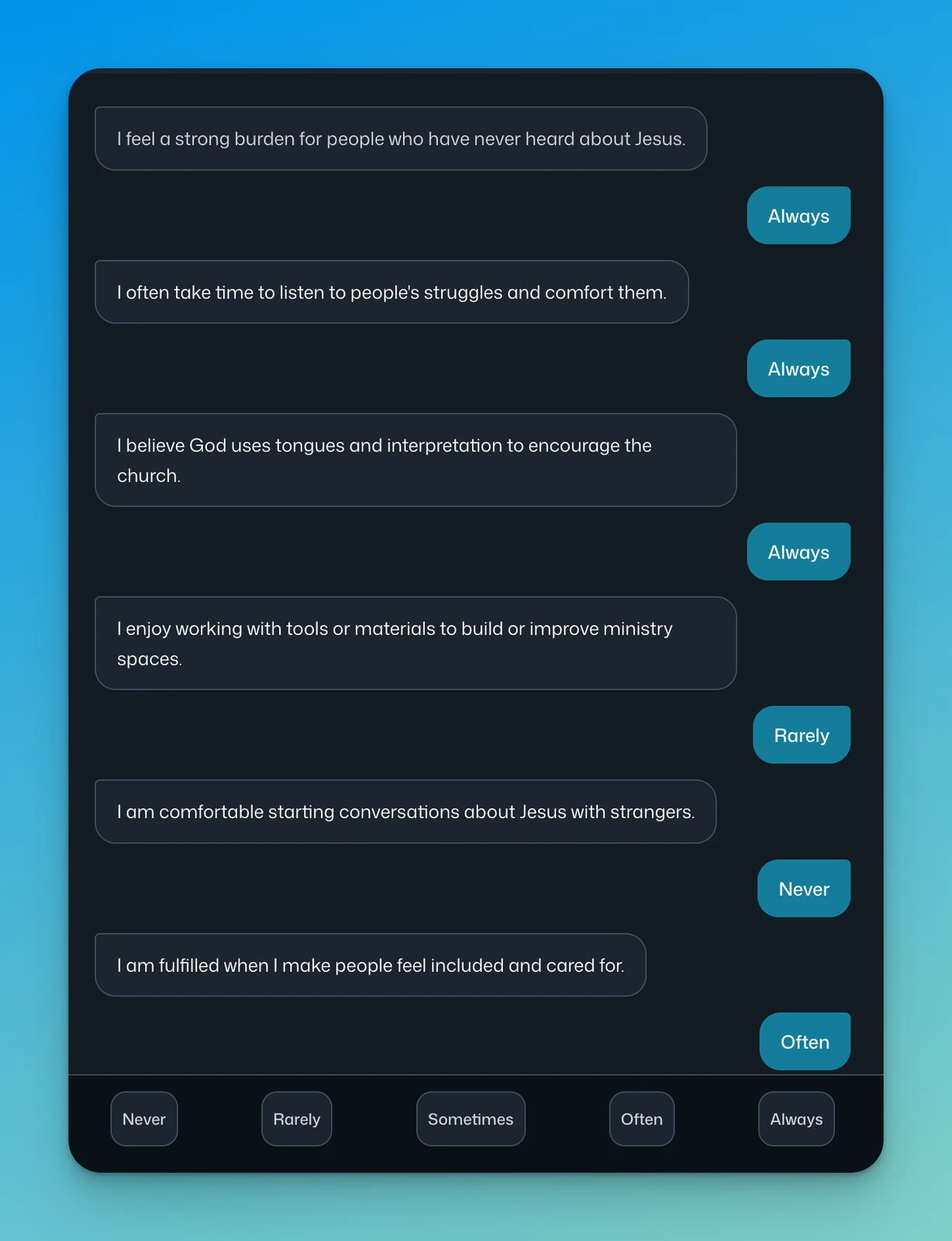
How do you find the naturally warm ones beyond the obvious three or four? This is exactly what the assessment surfaces: 112 questions across 24 spiritual gifts and four DISC dimensions, plain English written for working adults, finished in one 20-minute sitting on a phone (or saved and picked up later — progress syncs). The people-first wiring you’re recruiting for shows up in the DISC results before you ever put someone at a door.
And free your team’s multiplier from a post. Their job on Sunday is not to greet — it’s to develop the people who do. If your first-impressions leader is stuck holding a door, nobody is building the team.
Step 3 — Put ushers on the flow of the room
The most underestimated team in the church. When ushers are great, no one notices — and that’s the point. They run the flow of the room: seating late arrivals without a scene, managing communion and offering, responding to medical or safety issues, counting attendance, closing the back sections so the room feels full.
Two standards make it work. First, a written playbook — seating, communion, offering, emergency response — so every usher knows the service flow before it starts. Second, a pre-service huddle: five minutes, ten minutes before doors open, every Sunday. That huddle is also where your next generation of team leaders shows up — ushers are your most natural feeder pool of dependable people looking for more. Develop them.
Step 4 — Win the 48 hours after they leave
First impressions gets a guest through the front door. Hospitality is what makes them feel like family — and it starts the moment they drive away. Set the rule and hold it absolutely: every first-time guest gets a personal follow-up — a text, a call, a handwritten note — within 48 hours. No exceptions. That single rule changes everything.
Then build the rest of the pathway from “I visited” to “I belong”: fresh coffee ready 30 minutes early, newcomer lunches, meals for new babies and surgeries. Name each step and put a name next to who owns it. A friendly church gets compliments. A family gets a second visit.
Step 5 — Find the people wired for this
Every step above runs on having the right people — warm greeters, steady ushers, natural hosts — and they’re already sitting in your congregation unidentified. The Spiritual Gifts module in Pastor Center runs a spiritual gifts + DISC assessment across your church and shows you who’s wired for hospitality, helps, and service — so you fill the map from Step 1 with people built for the work instead of whoever felt guilty enough to say yes.
Book a 20-minute demo and the team will run the full spiritual gifts + DISC assessment on your whole staff — free, results are yours to keep.
You’ll spend 15 hours this week on a sermon your guests will judge in seven minutes they spend before it starts. Give the walk from the parking lot to the seat one team, one map, and one 48-hour rule — and watch first-time guests start becoming second-time guests.
— Your ceiling is a structure problem. Structure can be fixed.
Elite Serving Teams
Your growth ceiling is a team problem, not a preaching problem. The eight key teams and the leadership tree that break it.
 ▶
▶+ 12 more lessons — all free
Get the free course
Instant access — every lesson, free forever. No card, no catch.

“If you’re a pastor, you need to know about PastorCenter.”
Josh Howerton · Lead Pastor, Lakepointe Church