Pastor, here are the 8 teams every church needs — and the order to build them.

Every pastor I coach hits the same ceiling, and almost every one of them diagnoses it wrong. They think it’s a preaching problem. It never is. Your church will only scale as far as your teams scale — because ministry isn’t about how much you do, it’s about how many people you empower. I learned that the expensive way as a planter, doing five jobs every Sunday and calling it sacrifice. Here are the eight teams every healthy church needs, and the order I’d build them in if I were starting over.
Step 1 — Know the eight
This is the non-negotiable infrastructure of a healthy, growing church. Whatever your size, whatever your starting point, these eight need to exist and function:
- Worship — rotating teams, not five hired musicians
- Production — sound, visuals, stream
- Kids — the return-visit engine of your church
- First impressions — parking lot, doors, lobby, coffee
- Ushers — the flow of the room, seating to offering to emergencies
- Security — a trained team, not one ex-cop who usually shows up
- Prayer — the engine room, not a Facebook group
- Hospitality — the pathway from “I visited” to “I belong”
Notice what’s not on the list: a bigger staff. Staff are not how you grow. Empowered volunteer teams are.
Step 2 — Mark your gaps without flinching
Take the list and grade yourself. Which of the eight are running well — scheduled, led, and healthy? Which ones are one-person operations wearing a team’s name? Which ones simply don’t exist?
Most churches I walk through this exercise with have two teams running well, three limping, and three missing entirely. That’s not a rebuke — it’s a map. You can’t recruit toward a gap you haven’t admitted.
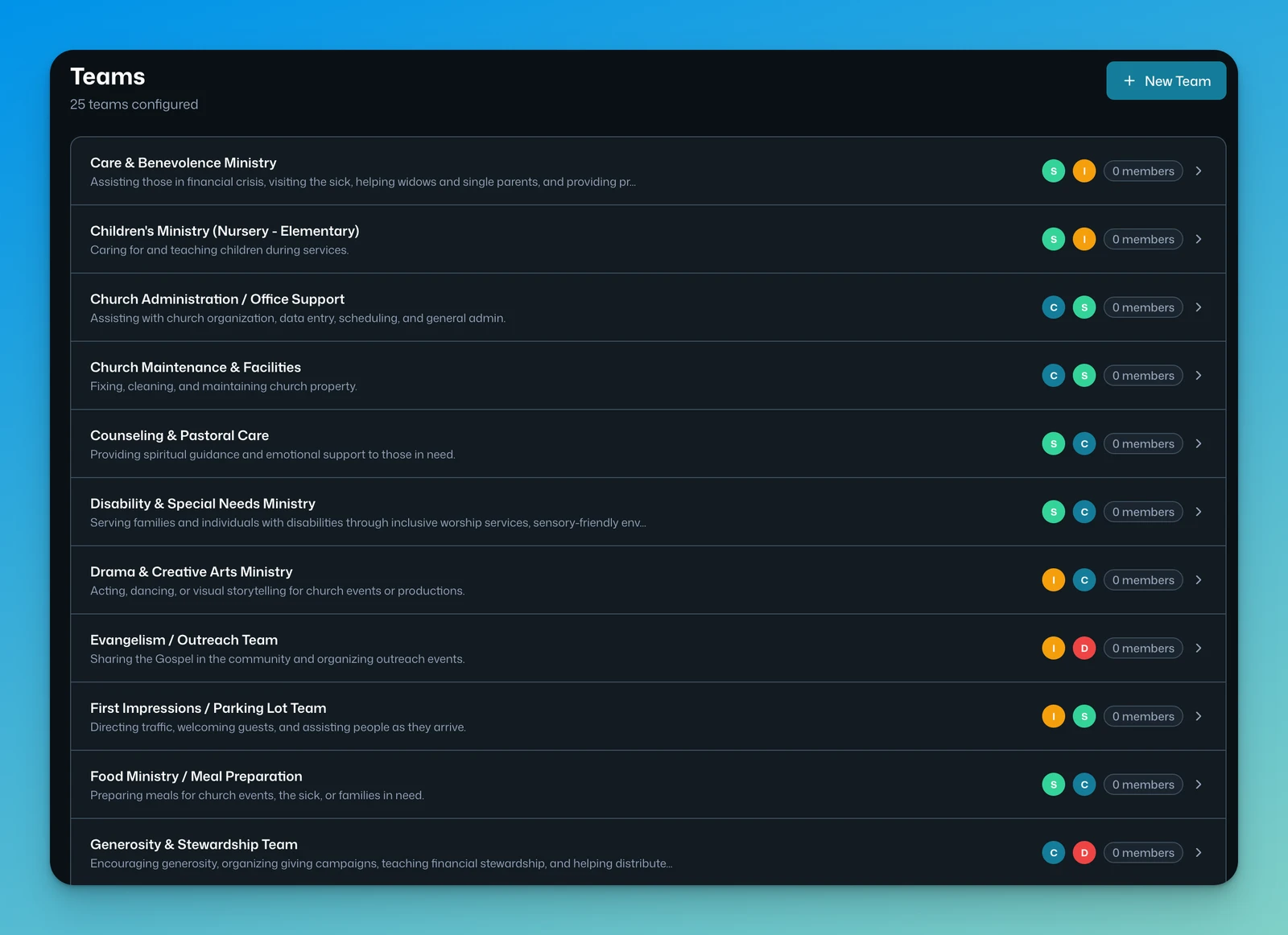
And keep the map somewhere it can’t get erased. In the Spiritual Gifts module, your staff configures every ministry team by name — with a description and the gift mix you want on each — and it syncs rosters with Planning Center, so there’s one place everyone can see who’s serving where and which of the eight are still hollow.
Step 3 — Build the guest-facing spine first
You can’t build all eight at once, so sequence them by what a first-time family actually touches. A guest decides whether they’re coming back before you say a word of your sermon — so first impressions and kids come first. Kids especially: it’s the most overlooked, most understaffed department in most churches, and it’s one of the biggest factors in whether a new family returns.
Then ushers and security, because a room that flows and a building that’s safe are the floor, not the ceiling. Then strengthen worship and production — they usually exist already; they need structure, not invention. And build prayer and hospitality alongside all of it, because prayer is the engine room of everything else, and hospitality is what turns a friendly church into a family.
Step 4 — Put a multiplier over each team, and don’t pay doers
A team without a leader is a task list. Each of the eight needs one person whose job is not to do the work but to build the bench — a multiplier. And here’s my rule, the one that saves church budgets: don’t pay doers, don’t pay managers. Only pay multipliers, and only if that department genuinely requires one.
Then pace yourself. One team per quarter, built properly — a named multiplier, a scheduled roster, a training standard — beats eight teams launched in a burnout blaze by Easter. Two years from now you have all eight, and none of them run on you.
Step 5 — Let the gifts fill the rosters
The slowest part of all this is figuring out who goes where — and begging from the stage is not a placement strategy. The Spiritual Gifts module in Pastor Center runs a spiritual gifts + DISC assessment across your congregation and shows you which of the eight teams each person is actually wired for — the intercessors you didn’t know you had, the people built for kids, the watchful ones suited to security. You recruit out of strength instead of desperation.
Start with your leaders. Book a 20-minute demo and the team will run the full spiritual gifts + DISC assessment on your whole staff — free, results are yours to keep.
Eight teams. That’s the infrastructure. Grade yourself against the list this week, pick the biggest guest-facing gap, and start building. Building big people is how you build a big church.
— Your ceiling is a structure problem. Structure can be fixed.
Elite Serving Teams
Your growth ceiling is a team problem, not a preaching problem. The eight key teams and the leadership tree that break it.
 ▶
▶+ 12 more lessons — all free
Get the free course
Instant access — every lesson, free forever. No card, no catch.

“If you’re a pastor, you need to know about PastorCenter.”
Josh Howerton · Lead Pastor, Lakepointe Church